


Solar power is a great way to build reliable backup power, but there is one obvious problem: the sun goes down. A solar power generator can store energy during the day, but once nighttime arrives, your home is running from that stored battery power. That is where wind can help.
By combining solar panels, a wind turbine, and battery storage, Nature’s Generator gives homeowners another way to charge their system when solar production drops. This can be especially useful for whole home power generator setups, off-grid homes, and anyone looking for dependable portable backup power.
But does adding a wind turbine really make your solar setup more efficient? How much energy can a wind turbine actually add? And is a solar-and-wind system worth the extra investment?
Let’s break down how it works, where it makes the most sense, and what to consider before you buy.
Does adding a wind turbine make solar power more efficient?
Not exactly. A wind turbine does not make your solar panels themselves more efficient.
Instead, it gives your battery another way to recharge when the solar panels are producing little or no power.
Think about a normal solar day. Your panels generate electricity during daylight hours, with production usually strongest when the sun is highest. Your battery stores that energy so you can use it later in the evening and overnight.
When the sun goes down, solar production stops.
Wind can keep going.
That is the main reason a solar-and-wind setup can be more useful than solar alone. Nature’s Generator describes this as combining solar and wind for around-the-clock generation: solar performs during the day, while wind can continue producing energy at night and during storms.
So rather than saying wind “increases solar efficiency,” it is more accurate to say that wind increases the number of opportunities your system has to generate renewable energy.
That difference becomes important during a long power outage.
Imagine your home starts the evening with a full battery. Your refrigerator, Wi-Fi, security system, lights, and other essentials continue using energy overnight. With solar alone, you are waiting for the sun to come back up before you can start replenishing that battery.
With a compatible wind turbine, you have another source of energy while you wait.
How does wind charging help at night?
The simple answer: the wind turbine can keep charging the battery when the solar panels cannot.
This creates a more complete charging cycle.
During the day: Solar panels capture sunlight and charge the battery.
In the evening: Your home starts drawing energy from the battery.
Overnight: If wind conditions are strong enough, the turbine can continue sending energy into the system.
The next morning: Solar charging starts again.
The idea is not that your wind turbine will necessarily replace all the electricity your home uses overnight. Instead, it can reduce how quickly the battery loses its stored energy.
That can give you more breathing room during an outage.
For example, imagine you lose power during a storm at 8 p.m. Your refrigerator keeps running, your Wi-Fi stays on, and a few lights remain active. Without another charging source, your battery simply gets smaller as the night goes on.
Now add wind.
Even a modest amount of overnight generation can help offset some of that consumption. When sunlight returns in the morning, your solar panels can take over again.
This is especially useful during multi-day outages, where the goal is not simply to have enough energy for one night. You want a system that can use energy, recharge, and keep going.
How much power can a Nature’s Generator wind turbine produce?
This is where expectations matter.
A wind turbine's rated output is not the amount of electricity it will produce all night. The amount of power generated will vary based on local wind speeds and the conditions at the installation site.
For example, Nature’s Generator's 150W wind turbine is rated at 150 watts at 27 mph. The company says it can operate at wind speeds up to 110 mph.
That does not mean it will continuously produce 150 watts throughout the night.
If your location only has light, inconsistent wind, production will be much lower. If your property has stronger and more consistent wind, the turbine has a better chance of contributing useful energy.
That is why location is one of the biggest factors to consider before buying a wind turbine.
Nature’s Generator recommends placing its wind turbine at least 20 to 30 feet above nearby obstructions to help improve exposure to usable wind.
For larger systems, Nature’s Generator also offers a 350W wind turbine rated at 350 watts at 27 mph. It is compatible with the Powerhouse Gen 2 and MyGrid 10K systems.
In other words, don't buy a wind turbine based only on its maximum wattage. Look at your local wind conditions and think about how much energy it could realistically contribute over time.
Is solar and wind better than adding more battery storage?
It really depends on what you’re trying to fix.
A bigger battery gives you more stored energy right away. A wind turbine gives you another way to replace energy after the battery has been used.
Those are two different things.
For example, let's say you regularly experience short outages that last a few hours. A larger battery may be more useful because you simply need more stored energy to get through the outage.
But suppose you live somewhere where outages can last for days and your property gets reliable wind. In that situation, adding wind can become much more valuable because you are not depending entirely on the energy stored before the outage began.
For long-duration backup, the best setup may be:
Solar + wind + battery storage
Each part has a different job:
This combination creates a system that can both store energy and keep making more of it.
Which Nature’s Generator system is right for solar and wind?
The answer depends on how much power your home needs.
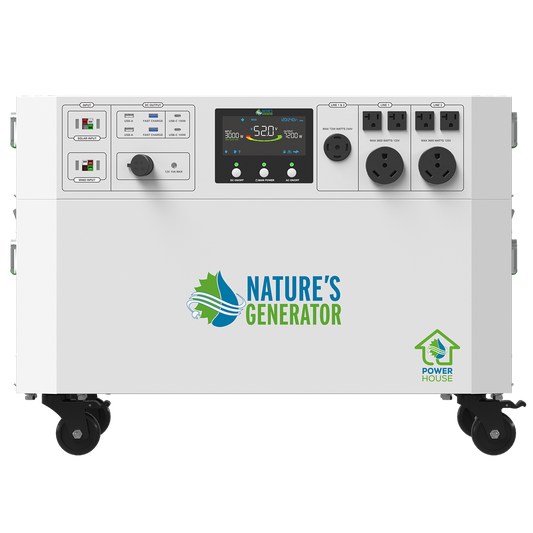
For larger whole-home applications, the MyGrid 10K is built for high-demand use. It provides 10,000W of continuous output, 20,000W of peak output, and 10,496Wh of LiFePO4 battery storage. It also accepts up to 12,000W of solar input and 350W of wind input.
The system can also be charged through AC power, giving homeowners another charging option when the grid is available. Nature’s Generator says the MyGrid 10K can continue providing power while it is being recharged using solar, wind, or 240V AC charging.
That can be useful if your main goal is uninterrupted backup rather than simply having a battery sitting in reserve.
Another option is the Powerhouse Gen 2, which provides up to 7,200W of continuous output and supports up to 2,000W of solar input and 1,000W of wind input.
You can compare the available options on Nature’s Generator’s whole-home generator collection.
The important thing is not to automatically choose the biggest system. Start with the appliances you need to keep powered.
When does adding wind make the most sense?
Wind is most useful when your location naturally has good wind conditions.
Here are a few situations where a hybrid system can make particular sense.
You live in a windy area
A property in an open rural, coastal, or elevated location may have much better wind conditions than a home surrounded by buildings and trees.
In that situation, a wind turbine can make good use of energy that your solar panels cannot capture at night.
You regularly deal with extended outages
A short outage is mainly a battery-capacity problem.
A multi-day outage is a recharging problem.
That distinction matters.
If the grid is down for several days, you need a way to keep replenishing your battery. Solar can do much of that work during the day, while wind can provide another source when solar production drops.
You live off-grid
Off-grid homes don't have the grid sitting in the background as a backup.
That makes energy diversity much more important.
A combination of solar and wind can give you two renewable sources instead of relying completely on one. Nature’s Generator specifically promotes solar-and-wind configurations for off-grid applications.
You want to reduce battery drain overnight
This is one of the simplest reasons to add wind.
Your home still uses energy after sunset. If the wind turbine is producing energy during that time, some of that energy can go toward your current demand or battery charging rather than coming entirely from stored capacity.
What does a solar-and-wind setup look like during a real outage?
Let's make it practical.
Imagine a family loses grid power during a winter storm.
They want to keep the refrigerator running, maintain Wi-Fi, power some lights, keep security equipment online, and operate essential medical equipment.
During the afternoon, their solar panels are charging the battery.
At sunset, solar production drops away. The home starts drawing from stored energy.
Overnight, the wind picks up. The compatible wind turbine begins providing additional energy to the system.
The battery still loses energy overall because the home is consuming more than the turbine is generating, but the loss is slower than it would be without the wind input.
The following morning, sunlight returns and the solar panels take over again.
Now imagine that cycle continuing for three or four days.
That is where hybrid charging becomes valuable. Instead of thinking only about how much battery you have, you are also thinking about how quickly you can put energy back into the battery.
That is a much better way to think about long-term backup power.
What are customers saying about using Nature’s Generator systems?
Real-world feedback is useful because specifications only tell you what a system can do. They don't always tell you how people actually use it.
Nature’s Generator highlights customer experiences involving refrigerators, lights, medical equipment, blackouts, cabins, RVs, and off-grid applications.
One customer quoted by Nature’s Generator said the MyGrid 10K helped keep their home running during a two-day blackout without noise or fumes. Other feedback highlights the system's plug-and-play setup and its ability to support essential appliances during outages.
There is also a useful piece of feedback from a prospective buyer asking about charging with both solar and 240V AC power. Nature’s Generator explained that the system uses solar charging when both inputs are connected, with AC charging available when solar is no longer generating.
These examples point to an important takeaway: people aren't necessarily buying a solar generator because they want to run every appliance in the house during an outage.
They are buying it to keep the important stuff running.
That could mean a refrigerator for one family, medical equipment for another, or internet and work equipment for someone working remotely.
How should you size a solar-and-wind backup system?
Start with your essential appliances.
Make a simple list of what you would want during an outage:
-
Refrigerator
-
Freezer
-
Internet router
-
Lights
-
Security system
-
Medical equipment
-
Well pump
-
Sump pump
-
Heating or cooling equipment
Then check how many watts each one uses.
Pay special attention to appliances with motors, such as refrigerators, pumps, and air conditioners. They can require more power when they start than they use while running.
You also need to think about two separate numbers:
Watts = how much power you need at one time.
Watt-hours = how much energy you need over a period of time.
For example, a refrigerator may not use a large amount of power continuously because its compressor cycles on and off. But it still contributes to your total energy consumption throughout the day.
Once you understand your loads, you can choose the right combination of inverter capacity, battery storage, solar input, and wind generation.
For a larger household, the MyGrid 10K Whole Home Generator is designed around high-output home backup, with 10,000W of continuous power and 10,496Wh of built-in battery storage.
For a smaller setup, going with a more modest system may make more sense than paying for capacity you will rarely use.
Can solar and wind really provide 24/7 power?
They can give you a much better shot at continuous renewable generation, but it is important not to treat 24/7 generation as a guarantee.
Solar output changes with the weather and time of day.
Wind output changes with wind speed.
Battery capacity changes as your home uses electricity.
So no renewable system can promise the same amount of power every hour.
What you can do is combine different sources so that the weakness of one source is partly covered by another.
That is the real strength of solar plus wind.
When the sun is unavailable, wind may still be available. When the wind drops, solar may be producing energy again. The battery connects those two sources and gives your home stored energy when neither is generating enough.
Nature’s Generator describes this approach as stacking solar and wind to support generation around the clock.
Is a solar-and-wind generator worth buying?
For some homeowners, absolutely. For others, solar and a larger battery may be the better choice.
A solar-and-wind setup is particularly worth considering when you have:
-
A location with reliable wind
-
Frequent or long-lasting outages
-
An off-grid home or cabin
-
A need for overnight renewable charging
-
A desire to reduce reliance on the electrical grid
You may not need wind if your property has poor wind conditions or if your outages are short enough that your battery can comfortably handle them.
The best approach is to look at your actual environment rather than buying based on the idea that more equipment automatically means better backup.
Is solar plus wind the better backup strategy?
Solar is excellent for charging during the day, but it naturally stops producing energy after sunset. Wind can fill part of that gap, giving your battery another opportunity to recharge when the sun is down or solar production is low.
For short outages, a larger battery may be all you need. For longer outages, off-grid living, or properties with strong wind conditions, combining solar, wind, and battery storage can create a much more flexible backup system.
The biggest advantage is simple: you are not depending on one source of renewable energy to do all the work.
That makes a hybrid setup worth considering for homeowners who want more than emergency power for a few hours. They want a system that can keep generating, storing, and delivering energy through changing weather and changing conditions.
Nature’s Generator's solar-and-wind systems are built around that idea, giving homeowners multiple ways to keep their batteries charged and essential equipment running when the grid is unavailable.


