


When you are preparing for a long power outage, reliable backup power, a solar power generator, whole home power generator, or portable backup power system can all help. But the bigger question is whether your system can keep producing and storing electricity when the grid stays down for hours or even days.
That is where 24/7 microgrid security comes in.
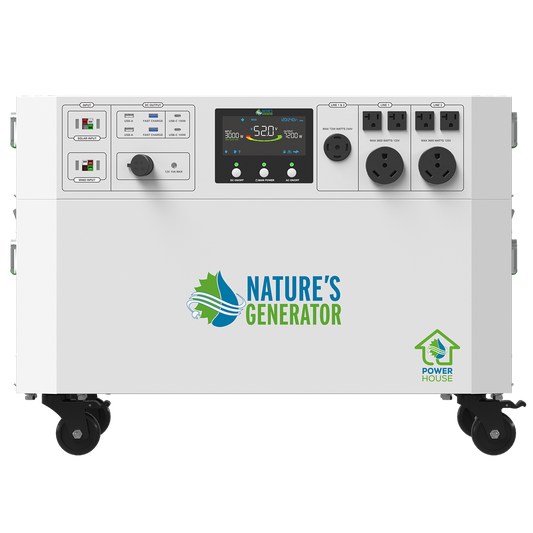
Nature’s Generator offers the Powerhouse Gen 2 as a high-output backup system that can use both solar and wind to recharge its battery. In this article, we will explain why combining the two can be more resilient than relying on solar alone, how the system works during overnight and extended outages, and which homes and properties can benefit most.
The basic idea is simple: solar and wind can complement each other because they do not always produce energy at the same time.
What is a 24/7 microgrid, and why does it need more than one energy source?
A 24/7 microgrid is a self-contained power system that can keep essential loads running when utility power is unavailable.
A typical backup microgrid has three key parts: a way to generate electricity, a battery to store it, and an inverter to deliver usable power to the home.
The challenge with solar-only systems is that solar panels depend on sunlight. Production drops in the evening and can also fall during cloudy or stormy conditions.
Your battery can keep powering appliances after sunset, but once that stored energy is used, it needs to be recharged.
Adding wind gives the system another possible source of energy. Wind can occur at night, during cloudy weather, or at other times when solar production is limited.
The Powerhouse Gen 2 supports both charging methods. Nature’s Generator lists up to 2,000W of solar charging and up to 1,000W of wind charging, along with up to 7,200W of continuous output and 120/240V split-phase power.
That makes the Powerhouse a useful foundation for a hybrid renewable backup system.
Why can solar plus wind be more reliable than solar alone?
Solar plus wind can improve backup resilience because the two energy sources can fill different charging gaps.
Solar is mainly a daytime resource. Wind may be available in the evening or overnight, depending on local conditions.
Imagine your home loses power at 3 p.m.
During the afternoon, your solar panels can help run household loads while also recharging the battery. After sunset, solar production stops. If there is enough wind, the turbine can continue contributing energy.
The next morning, solar production starts again.
The result is more opportunities to replenish the battery instead of relying on one daily production window.
This does not mean wind will always produce power when solar cannot. It means your system has two potential renewable charging sources instead of one.
That can become increasingly valuable during long outages.
Does the Powerhouse Gen 2 wind turbine work at night?
Yes. A wind turbine does not require sunlight, so it can potentially generate electricity after dark.
This is one of the biggest differences between solar-only and solar-plus-wind backup.
However, there is an important limitation: the turbine needs enough wind to generate useful power.
A 1,000W maximum wind input does not mean the turbine will deliver 1,000W continuously. Actual production depends on the wind available at the site.
For this reason, we see wind as a complementary energy source rather than a replacement for solar.
A property that has strong, consistent wind can get meaningful value from the additional charging option. A sheltered suburban home with little usable wind may not.
What happens during several cloudy days?
This is one of the situations where a hybrid system can have an advantage.
Suppose your home loses grid power during a storm. You continue using the Powerhouse for essentials such as:
-
Refrigerator
-
Internet equipment
-
Lighting
-
Phones and laptops
-
Water pumps
-
Essential kitchen appliances
The battery is being depleted while heavy cloud cover reduces solar production.
If wind conditions are strong enough, the turbine can provide another charging source while the solar panels are producing less.
That does not create unlimited energy. You are still limited by your battery size, electricity usage, solar availability, and wind conditions.
But the system is no longer completely dependent on sunlight to recover its stored energy.
That is the key advantage of combining renewable sources: you have more than one way to put energy back into the battery.
How much power can the Powerhouse provide?
The Powerhouse Gen 2 provides up to 7,200W of continuous output and up to 14,400W of peak output, with 120/240V split-phase capability.
That is important because whole-home backup is very different from powering a few small devices.
A refrigerator, microwave, water pump, or other motor-driven appliance can require more power when starting than when operating normally.
The Powerhouse is designed to handle a wide range of larger household loads, but homeowners should still calculate their actual running and startup requirements before choosing a configuration.
Battery capacity is another important consideration.
The base Powerhouse has 4,800Wh of battery storage, while additional Power Pods can increase total storage. You can expand up to 28.8kWh with five Power Pods.
In simple terms:
Power output determines how much you can run at once.
Battery capacity determines how long you can keep running those loads.
Renewable charging determines how quickly you can replenish the energy you use.
A well-designed microgrid needs all three to work together.
Which homes benefit most from solar and wind?
A hybrid system generally makes the most sense when the property has good sunlight and consistent wind.
Rural homes
Open rural properties can have fewer buildings and trees blocking wind. These homes may also experience longer outages following severe weather.
A solar-and-wind system can provide additional opportunities to recharge during an extended outage.
Remote cabins
Off-grid cabins do not have a utility grid to fall back on.
Solar can provide daytime charging, while wind can potentially contribute after sunset. That can help support essentials such as refrigeration, lighting, communications, and water systems.
Workshops and outbuildings
Workshops may require considerably more power than a small portable battery can provide.
With 120/240V output and high continuous power, the Powerhouse can be a better fit for properties with larger electrical loads, provided the system is sized correctly.
Homes with long or frequent outages
If outages usually last only one or two hours, solar and battery storage may already meet your needs.
When outages last multiple days, however, having multiple renewable charging sources becomes more valuable.
When is solar alone the better choice?
Solar plus wind is not automatically better for everyone.
A solar-only setup may be the smarter choice when:
-
Your property has excellent solar exposure.
-
Local wind is weak or inconsistent.
-
Your outages are usually short.
-
You have limited space for a turbine.
-
You prefer a simpler backup setup.
The most important question is not whether wind sounds useful in theory.
It is whether your property actually has enough usable wind to make a difference.
If it does not, investing in additional battery storage or solar capacity may provide greater practical value.
Can the Powerhouse grow as your energy needs increase?
Yes. The Powerhouse is designed around an expandable system rather than a fixed-capacity battery.
Additional Power Pods can increase storage, while the system can also be expanded with additional generation equipment.
Nature’s Generator states that multiple Powerhouse units can be combined, with up to three units providing as much as 21,600W of continuous output.
This creates a practical way to build your system over time.
For example, a homeowner may start with enough battery storage and solar generation for basic emergency backup. Later, they may add more storage because their electricity usage increases. A property with a strong wind resource can also add a compatible wind turbine.
That makes the system easier to scale around real-world needs instead of trying to predict everything in advance.
Explore the Nature’s Generator Powerhouse whole home generator for current system options.
Solar vs. solar plus wind: Which setup should you choose?
The decision comes down to your property.
If your location has excellent sun but little wind, solar may be enough.
If your property has both strong solar exposure and steady wind, adding a turbine can give you more flexibility during extended outages.
The system should be designed around your actual electricity use, local weather conditions, available space, and backup goals.
Is combining solar and wind worth it for 24/7 backup?
For the right property, yes.
Solar provides a strong daytime energy source. Wind can provide another potential source when the sun is down or solar production is reduced.
The Powerhouse brings those charging options together with high-output 120/240V power and expandable battery storage.
That combination is especially useful for homeowners preparing for extended outages, remote properties, cabins, workshops, and other locations where access to utility power is limited or unreliable.
The important thing is not simply adding more equipment.
It is creating a system where different energy sources can support each other.
Is solar plus wind a better strategy for long-term backup?
Solar alone can be an excellent backup solution, especially for homes with strong sunlight and shorter outages. But for longer outages, its dependence on daylight can become a limitation.
Combining solar and wind gives the battery another potential source of renewable energy. Solar can handle daytime production, while wind may continue contributing after dark or when solar output drops.
The Powerhouse supports this approach with high-output power, expandable battery storage, and both solar and wind charging options.
For the right property, that can mean a more flexible and resilient backup system with more opportunities to replenish stored energy when the grid is down.
Nature’s Generator makes this hybrid approach possible through the Powerhouse platform, giving homeowners another way to prepare for longer outages and build a more adaptable home energy system.


