


Power outages can turn a normal day into a major inconvenience. A refrigerator can stop cooling, the Wi-Fi can go down, lights may be unavailable, and important equipment may be left without power.
The good news is that you do not have to back up every appliance in your house to be prepared. A well-planned system can give you reliable backup power for the loads that matter most. Nature’s Generator offers solutions that range from portable backup power for basic emergency needs to a solar power generator and whole home power generator setup for larger homes and higher electrical demands.
So, how do you know which type of backup system is right for you? This guide explains what to consider, how to estimate your power needs, when a transfer switch is useful, and when it makes sense to move from a portable setup to a larger home backup system.
What should you power first when the electricity goes out?
Not every appliance needs to stay on during an outage. Before choosing a generator, make a list of the equipment you actually need.
Start with the items that would cause the biggest problems if they suddenly lost power.
For many households, that includes a refrigerator, freezer, medical equipment, internet equipment, lights, phones, or a sump pump. Other appliances may be useful but can wait until there is enough available power.
It helps to divide your loads into three groups:
This simple exercise can prevent you from paying for a system that is much larger than you actually need.
It’s also worth checking how much power each appliance uses. Some equipment uses more electricity when it starts than it does once it is running. Pumps, refrigerators, compressors, and some power tools are common examples.
When several appliances start at once, that extra demand can be important. Your backup system needs enough output to handle both normal operation and startup requirements.
In other words, count more than just the number of things you want to power. Look at what those things actually consume.
Is a portable power station enough for your backup needs?
For many people, the easiest place to start is a portable power station.
Portable systems are useful when you only need to run essential equipment or when you want something that can be moved around. They can be a good fit for smaller homes, apartments, home offices, garages, RVs, and temporary work areas.
The Lithium 3600 Power Station is an example of a system built for this type of use. It offers 3,600W of continuous output and 3,072Wh of battery storage.
That amount of power can be used for common emergency loads such as a refrigerator, lights, communication equipment, laptops, and selected small appliances.
The actual runtime will depend on what you connect to it.
For example, running a refrigerator and a few lights will generally use less stored energy than running a refrigerator, microwave, coffee maker, fan, and other appliances together. Turning off devices when you do not need them can also help preserve battery power.
Portable power also gives you flexibility outside an emergency. You can use the system in a workshop, at a campsite, in a garage, or anywhere else that needs temporary electricity.
That versatility is one reason some customers choose portable systems even when they already have utility power.
When does a transfer switch make a portable system more useful?
A portable power station becomes much more practical for home backup when it can supply selected household circuits through a transfer switch.
Without one, homeowners often rely on extension cords to connect individual devices. That may work for a small number of appliances, but it can become inconvenient during a long outage.
A transfer switch provides another way to use backup power. It connects the generator to specific circuits in the electrical panel so selected parts of the home can receive backup electricity.
For instance, you could choose circuits that supply:
-
The refrigerator
-
Kitchen lighting
-
The home office
-
A freezer
-
Internet equipment
-
A sump pump
This means you can use normal wall outlets in those areas instead of placing extension cords throughout the house.
Nature’s Generator offers different transfer-switch options for different electrical setups. Its 30A Automatic Transfer Switch and 125A Automatic Transfer Switch are designed for different backup applications.
The exact circuits that can be supported depend on the home, electrical panel, generator, and installation.
Because a transfer switch becomes part of the home's electrical system, installation should be handled by a qualified electrician.
When is the Powerhouse a better fit than a smaller portable system?
Sometimes essential circuits are not enough.
A home may have a well pump, larger appliances, garage equipment, or several devices that need to operate at the same time. In that situation, stepping up to a higher-output system can make everyday outage management much easier.
Nature’s Generator’s Powerhouse Gen 2 provides 7,200W of split-phase 120V/240V output and 4,800Wh of battery storage in its base configuration.
The extra output can be useful for homes with larger electrical loads.
Consider a rural property where the homeowner needs to keep a refrigerator, freezer, well pump, lights, internet equipment, and selected kitchen appliances running. With a smaller power station, the homeowner may have to decide which loads to turn off before using another appliance.
A higher-output system gives more flexibility.
The Powerhouse also supports AC, solar, and wind charging. This gives homeowners multiple ways to put energy back into the system.
That becomes especially useful during a longer outage. Instead of depending entirely on the battery charge that was available when the power failed, you can use available charging sources to replenish the stored energy.
When does a whole-home backup system make sense?
A whole-home approach becomes more useful when you want backup power to cover a much larger portion of the house.
This type of setup can be especially helpful for larger homes or properties with equipment that needs 240V power.
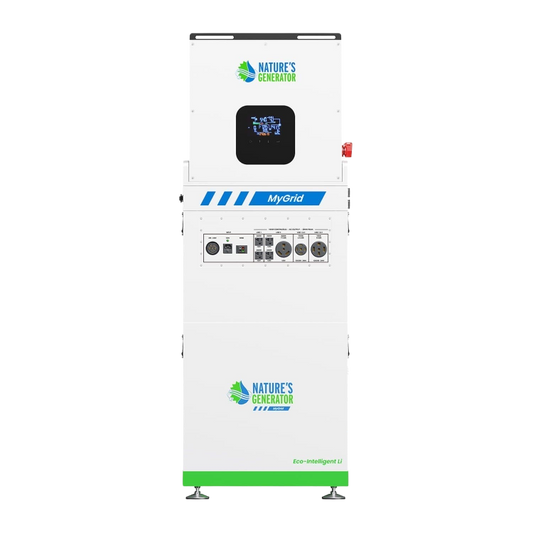
The MyGrid 10K is designed for larger backup applications. It provides 10,000W of continuous output, 20,000W of peak output, and 10,496Wh of battery capacity.
It also supports 120V/240V split-phase operation.
That combination can make the system suitable for homes that need to support larger electrical loads while an outage is underway.
For example, a homeowner may want backup power available for a refrigerator, freezer, well pump, home office, lighting, selected HVAC equipment, and other essential household circuits.
Instead of deciding what can be plugged in one appliance at a time, the system can be integrated more directly with the home's electrical panel through the appropriate transfer equipment.
For homeowners who want fewer manual steps during an outage, this can be a major consideration.
What is the difference between battery capacity and output?
Two numbers often appear when comparing backup power systems: watts and watt-hours.
They describe different things.
Watts tell you how much power a system can deliver at one moment.
Watt-hours tell you how much energy the battery can store.
Both numbers matter.
Imagine you have a system with plenty of stored energy but not enough output to start a large motor. The battery may contain enough energy in theory, but the system still cannot run that appliance properly.
Now imagine the opposite: a system has enough output for a powerful appliance, but the battery is relatively small. It may run the appliance successfully but use a large part of its stored energy quickly.
This is why it is important to look at power output and battery capacity together.
For longer outages, battery capacity becomes particularly important because it determines how much energy is available before the system needs another charge.
For high-demand appliances, output and surge capability deserve close attention.
How can solar and wind help during an extended outage?
A battery gives you stored energy. Renewable charging can help you replace the energy you use.
Solar charging is particularly useful during daylight hours. Depending on sunlight, panel configuration, and system conditions, solar energy can replenish some of the battery charge while the grid is unavailable.
Wind can provide another charging source in locations with suitable wind conditions.
Nature’s Generator systems can use different combinations of charging methods depending on the model. The Powerhouse supports AC, solar, and wind charging, while the MyGrid 10K Solar and Wind Generator combines battery storage with renewable charging options.
Think about an outage that lasts several days.
A homeowner could use stored battery energy overnight when solar production is unavailable. During the day, solar input can help recharge the battery. That stored energy can then be used again after sunset.
The benefit is not simply having a larger battery. It is having a way to replace some of the energy that you consume.
Which backup system fits a small home, family home, or larger property?
Your home and lifestyle should influence the size of your backup system.
Small home or apartment
A portable battery system may be enough when the goal is basic emergency coverage.
A homeowner could prioritize the refrigerator, lights, phones, internet equipment, and a laptop without trying to operate every appliance in the home.
This approach can keep the most important devices available without requiring a large installation.
Typical family home
A higher-output system can become more useful when several people depend on different appliances at the same time.
A Powerhouse setup, especially when connected through a transfer switch, can provide a more convenient way to support selected household circuits.
For example, parents working from home may need internet and computers while the refrigerator, lights, and other household equipment continue running.
Larger home
A larger property may have more demanding electrical equipment.
If the home includes 240V loads, a well pump, multiple freezers, HVAC equipment, or a larger number of circuits that need backup, a MyGrid 10K setup may be worth considering.
The important step is to confirm the power requirements of those loads before choosing the equipment.
Cabin or rural property
Backup needs can look very different outside a typical suburban home.
A cabin may depend on a well pump, refrigerator, freezer, lighting, communications equipment, and tools. There may also be fewer opportunities to rely on utility power during a long outage.
In that situation, a system with a combination of battery storage and renewable charging may provide more flexibility.
How can you avoid buying a system that is too large or too small?
The easiest way to make a better buying decision is to work backward from your electrical needs.
Start by writing down the appliances you consider essential.
Then record their running wattage and starting wattage where available.
Next, decide which appliances are likely to operate at the same time.
For example, you may not need the microwave, coffee maker, air conditioner, and power tools all running together. Knowing that can significantly change the amount of backup power you need.
Then think about the length of a typical outage.
If you usually experience brief outages, a smaller battery may be enough.
If you live in an area where outages can last for a day or more, you may want additional battery capacity and a dependable way to recharge.
Finally, think about how involved you want to be.
A portable battery gives you control over what you plug in. A transfer switch makes home backup more convenient. A larger whole-home system can reduce the amount of manual load management required.
What should you compare before buying a backup power system?
Looking at the advertised wattage alone is not enough.
Before choosing a system, compare these areas:
Continuous output: Make sure the system can handle the appliances you plan to run.
Peak or surge output: Check whether it can handle appliances with high startup demands.
Battery capacity: Consider how much stored energy you need before recharging.
Charging methods: Look at whether AC, solar, wind, or multiple charging options are available.
Home connection: Determine whether you want portable operation or connection to selected household circuits.
Expandability: Think about whether your backup needs could increase later.
Also consider where the equipment will be placed, how it will be installed, and which circuits need backup.
Taking the time to compare these factors can help you avoid choosing a system based only on its headline power rating.
Which Nature’s Generator setup should you choose?
There is no single backup power system that works for every household.
A portable system is generally suited to people who want flexible power for essential appliances and electronics.
A portable system paired with a transfer switch can make more sense when you want backup electricity delivered to selected home circuits.
The Powerhouse is designed for homes that need more output and 120V/240V split-phase power for larger electrical loads.
The MyGrid 10K is intended for bigger backup requirements, with higher output, more battery storage, 120V/240V capability, and options for broader home integration.
The right choice comes down to your own electrical loads, the length of outages you expect, and how much of your normal home routine you want to maintain when utility power is unavailable.
How do you build the right backup power setup?
A dependable backup system starts with understanding your home's actual power needs.
First, identify the appliances and devices you consider essential. Next, check their wattage and startup requirements. From there, decide whether you need portable power, selected-circuit backup, or a larger whole-home solution.
You should also think about battery capacity and how you will recharge the system during a long outage. For some households, AC charging may be enough. Others may benefit from solar or wind charging for additional flexibility.
Nature’s Generator provides several ways to build a backup setup around different household needs, from smaller portable systems to larger home backup solutions.
The goal is not to power everything simply because you can. The goal is to have enough energy for the equipment that matters, a practical way to recharge, and a setup that fits your home today while leaving room for future needs.


