


Having a generator during a blackout is great, but only if it actually keeps your life moving. What you really need is a setup that powers the things you rely on every day, from the fridge to your phone charger.
Nature’s Generator offers options for different levels of home backup, from portable backup power for essential devices to a whole home power generator setup for larger electrical loads. Its systems can also use solar energy, giving homeowners a solar power generator option for recharging without depending entirely on the grid. In this guide, we explain what to look for in reliable backup power, how to choose the right size, and which setup may make sense for your home.
What should a home backup generator power during an outage?
The first step is deciding what you actually need to keep running.
During an emergency, most homeowners do not need every appliance in the house operating at once. The priority is usually the equipment that keeps food cold, people comfortable, connected, and safe.
Common priority loads include:
-
Refrigerator and freezer
-
Wi-Fi router and modem
-
Phones and other communication devices
-
Essential lights
-
Medical equipment
-
Fans or air conditioners
-
Sump pumps or well pumps
-
Garage doors and other important equipment
The best backup system is based on those priorities.
For example, a household may decide to keep the refrigerator, Wi-Fi, a few lights, and a fan running first. Another home may need to add a well pump, sump pump, medical equipment, or air conditioning.
This is why simply asking how many watts a generator has is not enough. You also need to know how much energy your appliances use over time.
How much backup power does a house actually need?
Your home backup system needs to handle two different numbers: power output and battery capacity.
Power output is measured in watts (W). It tells you how much electricity the system can provide at one time.
Battery capacity is measured in watt-hours (Wh). It tells you how much energy the battery stores.
For example, a system with a 10,000W output can handle a much larger electrical load at one time than a 1,800W system. But the amount of time it can run that load depends on its battery capacity and the amount of power your appliances are using.
You also need to account for startup power. Refrigerators, pumps, air conditioners, and other motor-driven appliances can briefly need much more power when they start.
A simple example:
A home uses:
-
Refrigerator: 700W
-
Wi-Fi and electronics: 100W
-
Lights: 200W
-
Fans: 300W
That is about 1,300W of running power. A system needs enough output to handle that combined load, plus any startup surge from appliances with motors.
For larger homes, the same calculation can quickly become much bigger. That is where a higher-output system becomes more practical.
Is a solar generator a good choice for emergency backup?
For many homeowners, a battery-based solar generator offers a simpler alternative to a traditional fuel generator.
A gas generator needs fuel to keep running. A battery backup system stores energy ahead of time and can be recharged using electricity, solar panels, and on compatible systems, wind power.
That can be useful during long outages. Instead of treating the battery as a one-time supply of stored energy, you can use solar charging to put energy back into the system during the day.
Battery systems also avoid the exhaust produced by engine-powered generators. That makes them useful for indoor-adjacent applications where properly ventilated fuel generators would not be appropriate. The specific operating location and safety requirements still depend on the equipment and installation instructions.
Nature’s Generator systems are designed around this rechargeable approach, with products that support solar charging and, on compatible systems, wind and AC charging as well.
The bigger advantage for many families is flexibility. You can charge before a storm, use stored energy during the outage, and recharge again when renewable energy is available.
Which Nature’s Generator system makes sense for home emergencies?
The right system depends on whether you need portable power for essentials or higher output for home circuits.
When is portable backup power enough?
Portable systems make sense when your main goal is keeping a smaller number of essential devices running.
A compact system can be useful for a refrigerator, lights, router, phones, computers, fans, and other everyday essentials. Nature’s Generator currently positions its Lithium 1800 for smaller households and portable applications, with 1,800W of output and 1,440Wh of battery capacity.
This type of setup can be a good fit when:
-
You want something easier to move
-
You only need a few essential loads
-
You want backup power for both home and outdoor use
-
You do not need to power large 240V appliances
It is also a practical way to start building a backup plan without immediately moving to a whole-home system.
When should you consider a whole-home system?
A larger home backup system makes more sense when you want to support more circuits or higher-demand appliances.
The Powerhouse Gen 2 provides 7,200W of split-phase 120V/240V output and has a 4,800Wh base battery. Nature’s Generator says it can support loads ranging from electronics and refrigerators to well pumps, air conditioners, and water heaters, as long as the total load stays within the system's output limit. It can also be expanded with additional Power Pods and charging sources.
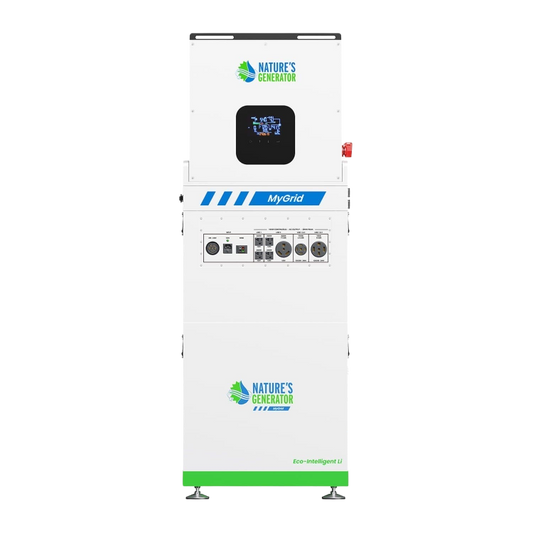
The MyGrid 10K is designed for even higher demand. Its current specifications list 10,000W of continuous output, 20,000W peak output, 120V/240V split-phase capability, and a 10,496Wh LiFePO₄ battery. The system can also be expanded with additional battery capacity.
You can review the current options through the Nature’s Generator backup power based on your needs.
Can a home backup system run air conditioning, pumps, and other large appliances?
Yes, but the answer depends on the appliance load and what else is running at the same time.
This is one of the most important things to understand before buying a whole-home backup system.
A refrigerator may be easy to support on its own. Running a refrigerator, well pump, air conditioner, microwave, and several other appliances simultaneously is a very different situation.
For example, a family might want to run:
During the day
-
Refrigerator
-
Freezer
-
Internet
-
Lights
-
Air conditioner
When water is needed
-
Well pump
During meal preparation
-
Microwave or electric cooking equipment
The total demand can change quickly.
A system's maximum output is therefore not the same as a promise that every appliance in a home can operate at once. Nature’s Generator specifically notes that MyGrid 10K performance depends on the total load being powered.
For homes with especially high demand, the MyGrid 10K can be expanded. Nature’s Generator currently says two units can be combined for up to 20,000W of output, while battery capacity can also be expanded.
That makes load planning an important part of the buying decision.
Does an automatic transfer switch make home backup easier?
Yes. An automatic transfer switch can make an integrated backup system much easier to use during an outage.
Without automatic switching, you may need to connect equipment manually or switch circuits yourself. With an automatic transfer switch, the system can detect a grid outage and move the home to backup power automatically.
The MyGrid 10K system lists automatic backup operation with switching in less than 20 milliseconds. It then switches back to utility power when the grid is restored.
That can be especially useful when:
-
An outage happens overnight
-
Nobody is home when the power fails
-
You have critical equipment that should stay powered
-
You want less hands-on management during severe weather
Nature’s Generator also offers manual transfer switch options, so homeowners can choose a setup based on how they want their backup system to operate.
You can learn more about available configurations through the MyGrid 10K home backup system.
What should you compare before buying a home backup system?
A good comparison should go beyond price.
Start with these questions:
This comparison can help prevent a common mistake: buying a system based only on the biggest wattage number.
A home with a refrigerator, lights, router, and small electronics has very different needs from a home with central AC, a well pump, multiple refrigerators, and other large loads.
How should you prepare your backup system before an emergency?
The best time to learn how your backup system works is before the outage.
Start by fully charging the battery. Then test the appliances you expect to use.
Try a realistic combination such as:
-
Refrigerator + Wi-Fi + lights
-
Refrigerator + freezer + fans
-
Refrigerator + sump pump + lights
-
Essential circuits + selected cooling equipment
Pay attention to how much power each setup uses.
For a whole-home installation, have the electrical setup reviewed and installed according to the manufacturer's requirements and applicable electrical codes. Make sure you understand which circuits are backed up and what appliances should be turned off during a prolonged outage.
It is also helpful to create a simple emergency priority plan. Decide which appliances should always stay on, which can be used occasionally, and which should remain off until normal grid power returns.
That small amount of preparation can make a major difference when a storm or unexpected outage happens.
Is Nature’s Generator a practical choice for home emergency backup?
For homeowners comparing backup options, the decision comes down to matching the system to the way the home actually uses electricity.
Smaller portable systems are useful for essential devices and appliances. Larger systems such as Powerhouse Gen 2 and MyGrid 10K are designed for higher electrical loads, 120V/240V applications, and home integration. The MyGrid 10K also supports automatic transfer configurations and expandable battery storage.
The most important step is still proper sizing. Look at the appliances you need during an outage, their running and startup power, the amount of battery storage you need, and how you plan to recharge the system.
Customer feedback shows that these systems can be useful for real outage situations, especially for refrigeration and essential household loads. It also shows that larger homes with multiple high-demand appliances may need additional capacity.
Choosing the right backup power solution
A reliable home backup system should do more than provide electricity. It should match your household's actual needs, give you enough output for the appliances you plan to use, and offer a practical way to recharge during longer outages.
Nature’s Generator provides options for everything from essential portable backup power to larger whole-home systems. The right choice comes down to your power needs, battery capacity, appliance loads, and preferred backup setup.


