


Power outages do not always last a few hours. A storm, wildfire, grid failure, or other emergency can leave your home without power for a day or longer. That is when battery capacity becomes especially important.
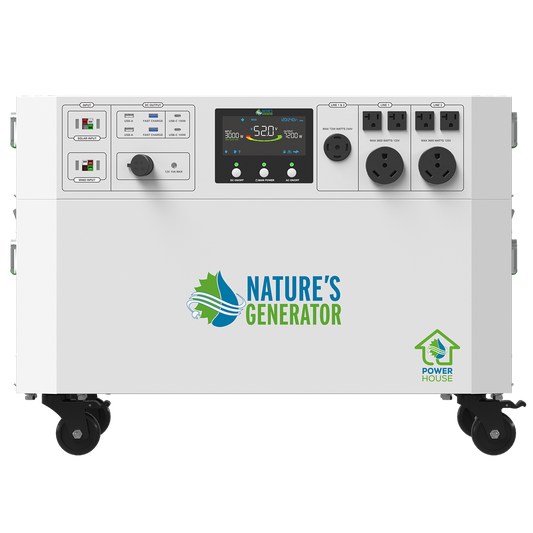
Nature’s Generator Powerhouse Gen 2 is built for this kind of situation. It can provide reliable backup power, work as a solar power generator, support whole home power generator setups, and serve as portable backup power for essential appliances and devices.
But what happens when 4.8kWh is not enough?
That is where Powerhouse Power Pods come in. This guide explains how the modular system works, how much extra storage each Pod adds, how to choose the right configuration, and what you should know before expanding your system.
Important clarification: The current Powerhouse stores 4.8kWh per battery unit, and each Power Pod adds another 4.8kWh. Nature’s Generator currently lists up to 28.8kWh of expandable battery capacity with five Power Pods. The 21.6 figure often associated with the Powerhouse refers to 21.6kW of combined continuous output from three Powerhouse units, not 21.6kWh of battery storage.
How much battery capacity does one Power Pod add?
One Powerhouse starts with a 48V 100Ah battery rated at 4,800Wh, or 4.8kWh. A Powerhouse Power Pod adds another 4.8kWh of battery storage.
That gives you a simple expansion path:
The important takeaway is that you do not have to buy the maximum configuration on day one.
You can start with the amount of storage you actually need and expand later as your backup requirements grow.
For example, a household that mainly needs to keep a refrigerator, Wi-Fi router, lights, phones, and a few other essentials running may be comfortable starting with 4.8kWh. A household preparing for longer outages may want 9.6kWh or more.
How do you know how many Power Pods your home needs?
Start with your energy use, not the number of appliances you own.
The easiest way to estimate your needs is:
Watts × hours of use ÷ 1,000 = kWh used
For example, imagine an outage where you run:
-
A refrigerator averaging 100W for 24 hours: about 2.4kWh
-
A Wi-Fi router using 15W for 24 hours: about 0.36kWh
-
Lights using 100W total for 5 hours: about 0.5kWh
-
A TV using 80W for 4 hours: about 0.32kWh
That adds up to about 3.58kWh before accounting for system losses and any additional devices.
A 4.8kWh Powerhouse could cover that basic example, but there would not be much room left for larger loads or a longer outage.
With 9.6kWh, you have considerably more breathing room. At 14.4kWh, you can plan for longer outages or a wider range of essential loads.
Our preferred approach is to build a simple emergency-load list before buying another Pod. It is much better to calculate your actual usage than to choose a battery size based on guesswork.
Does adding a Power Pod also increase solar charging?
Yes. This is one of the most useful parts of the modular design.
The Powerhouse supports up to 2,000W of solar charging and 1,000W of wind charging. Each Power Pod adds another 2,000W of solar charging capacity and 1,000W of wind charging.
That means the Pod is not simply a bigger battery sitting beside your Powerhouse.
It gives you more stored energy and more potential renewable input.
For example, adding one Pod can bring the system to:
-
9.6kWh total battery storage
-
Up to 4,000W of listed solar charging capacity across the expanded system
-
Up to 2,000W of listed wind charging capacity across the expanded system
In real use, actual solar production will depend on sunlight, panel orientation, weather, shading, temperature, and other conditions.
That is why storage and charging capacity should be planned together. A larger battery gives you more reserve, but you still need enough incoming energy to refill it.
Is the Power Pod really plug-and-play?
The Power Pod is designed specifically to make battery expansion easier.
Nature’s Generator provides an expansion cable on the Power Pod. The manufacturer describes the upgrade process as connecting the Pod to the Powerhouse or an existing Power Pod through the expansion connection.
That is very different from building a custom battery bank from individual cells, batteries, cables, and battery-management components.
For a homeowner, the appeal is straightforward: you can expand an existing Powerhouse system without redesigning the entire energy setup.
However, there is an important distinction between adding a battery Pod and connecting backup power to your home's electrical panel.
If you are connecting a Powerhouse to a transfer switch or home electrical system, follow the applicable electrical requirements and use a qualified electrician where required. Do not assume that every part of a whole-home installation should be handled as a DIY project.
When does adding a Power Pod make more sense than buying another generator?
This comes down to what you are trying to improve: runtime or power delivery.
Adding a Power Pod primarily increases available battery storage and renewable charging capacity.
Buying another Powerhouse is a different decision. The Powerhouse is rated for up to 7,200W of continuous output and 14,400W of peak output, with 120V and 240V capabilities. Nature’s Generator lists expandable continuous output of up to 21.6kW when three Powerhouse units are combined.
That is where the 21.6 number becomes important.
It is 21.6kW of output, not 21.6kWh of stored battery energy.
Think of it this way:
kW = how much power the system can deliver at one time.
kWh = how much energy the battery can store.
You can have a system capable of delivering a lot of power but still have limited runtime if the battery storage is small.
For longer outages, battery capacity becomes especially important.
Which appliances benefit most from additional battery capacity?
Power Pods are especially useful for appliances and devices that need to run for long periods.
Think about:
-
Refrigerators and freezers
-
Wi-Fi routers and networking equipment
-
Security cameras and alarm systems
-
Fans
-
Essential lighting
-
Medical or other critical low-to-moderate loads
-
Electronics and communication devices
-
Selected pumps and other household equipment
Large appliances require more careful planning.
An air conditioner, electric water heater, well pump, induction cooktop, or other high-draw appliance can consume a lot of energy in a short period. You should consider both its running wattage and startup requirements.
For example, a 5,000W appliance running for two hours would consume roughly 10kWh before system losses. That is already more than twice the capacity of a single 4.8kWh battery.
In other words, adding battery storage does not automatically make every large appliance practical. You need to check both power requirements and runtime.
What does Power Pod expansion look like during a real outage?
Imagine a family preparing for a major storm.
Their first priority is keeping food cold, maintaining internet access, charging phones, running lights, and powering a few fans.
With a 4.8kWh Powerhouse, they have a starting point for essential loads.
After experiencing a previous 24-hour outage, they realize they also want more reserve for refrigeration and overnight use. Instead of replacing the entire system, they add a Power Pod and move to 9.6kWh.
Later, they decide they want longer backup coverage and more solar input. They can continue expanding the system rather than starting over.
That is the real value of modular backup power: your system can change as your needs change.
How much solar should you add when you expand?
A larger battery makes the most sense when your charging setup can keep up with it.
The base Powerhouse supports up to 2,000W of solar input. Each Power Pod can add another 2,000W of solar charging capability.
Nature’s Generator currently offers Power Pod packages with two or four 440W rigid solar panels, giving homeowners a straightforward way to expand storage and generation together.
For example, if you add a Power Pod mainly because you expect multi-day outages, adding compatible solar panels at the same time can help you recover battery capacity during daylight hours.
This becomes especially important during a long outage. You’re not just asking, “How long will my battery last?”
You are also asking:
How much energy can I put back into the battery tomorrow?
That question can make a major difference during a multi-day emergency.
What should you check before adding a Power Pod?
Before buying another Pod, review five things.
1. Your daily energy use
Estimate the kWh needed to run your essential appliances for 24 hours.
2. Your expected outage length
A system sized for a six-hour outage may look very different from one designed for two or three days.
3. Your highest-power appliances
Check both starting and running watts. Battery storage alone does not solve an inverter-capacity problem.
4. Your solar setup
Make sure your planned solar input matches the expanded system and uses compatible equipment.
5. Your installation space
The Power Pod is a substantial piece of equipment. Current specifications list the Pod at roughly 28 × 18 × 11 inches, with a listed weight of 295 pounds on the current product page.
That means expansion is simple from a connection standpoint, but you still need to plan where the equipment will safely live.
Should you start small or build a larger system now?
For many homeowners, starting small and expanding later is the easier approach.
Start with the base Powerhouse when your main goal is essential backup for short outages.
Add one Power Pod when you need more runtime and want to expand your solar charging capability at the same time.
Move to multiple Pods when your calculations show that a longer reserve is worth the additional cost and space.
For buyers who already know they have high energy requirements, frequent outages, or off-grid goals, starting with a larger configuration can make more sense.
The current Powerhouse platform is expandable to 28.8kWh with five Power Pods, according to Nature’s Generator's product specifications.
The right setup is not necessarily the biggest one. It is the one that matches your actual loads, outage expectations, charging options, and budget.
How should you size a modular Powerhouse system?
Use this simple process:
Step 1: List the appliances you consider essential.
Step 2: Find their running wattage.
Step 3: Estimate how many hours you will use each one per day.
Step 4: Convert the total to kWh.
Step 5: Multiply that daily number by the number of outage days you want to cover.
Step 6: Add some margin instead of planning to drain the battery completely.
For example, if your essential loads total about 4kWh per day and you want two days of backup, you would want roughly 8kWh of usable storage as a starting target. That makes a 9.6kWh configuration more appropriate than a 4.8kWh system.
The same process works whether you are preparing for storms, planning an off-grid setup, or simply looking for a backup system for your home.
Is modular expansion the right approach for your home?
A modular Powerhouse setup can be a practical way to increase backup runtime without replacing your entire system.
The base Powerhouse provides 4.8kWh of battery storage, while each Power Pod adds another 4.8kWh. Each Pod also increases the system's potential solar and wind charging capacity.
Just remember that 21.6kW and 21.6kWh are not the same thing. The 21.6 figure relates to expandable power output from multiple Powerhouse units, while battery storage is measured separately in kWh.
For most buyers, the best decision starts with one simple question: How much energy will my essential appliances actually need during an outage?
From there, you can decide whether a 4.8kWh Powerhouse is enough or whether adding one or more Power Pods makes sense.
With Nature’s Generator, the goal is to build a backup system around your real energy needs today while leaving room to expand tomorrow.


