


When bad weather hits unexpectedly or the electric grid goes down, having a reliable backup power plan becomes absolutely essential for your peace of mind. Relying on a traditional, small-scale solar power generator might keep your phone charged or run a single lamp, but what if you need a true whole home power generator that acts as an unshakeable, heavy-duty portable backup power plant? That is exactly where Nature's Generator steps into the picture.
In this comprehensive building guide, our team will answer how you can custom-build your own Powerhouse Gen 2 Ecosystem to fit your unique lifestyle and energy demands perfectly. Based on our experience helping homeowners transition away from fossil-fuel reliance, we will show you exactly how to scale up your battery capacity, supercharge your input speeds, and harness both sun and wind to achieve absolute energy independence.
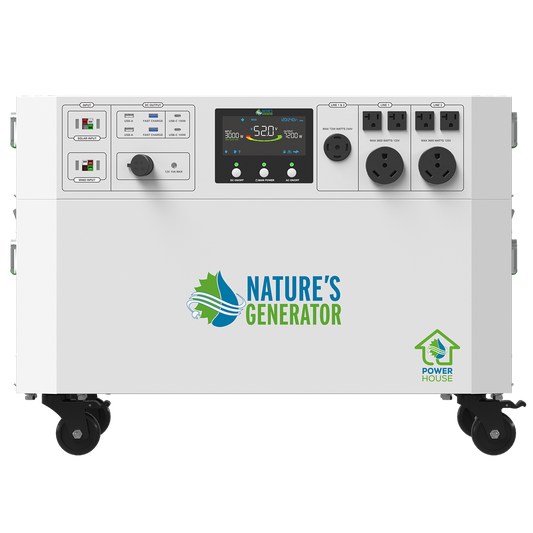
How does the Nature's Generator Powerhouse Gen 2 scale up for whole-home use?
The foundation of any serious energy strategy is understanding the core strength of your primary power station. The base unit delivers a massive 7,200W split-phase pure sine wave inverter. Unlike standard backup options that only provide 120V single-phase electricity, this setup supplies both 120V and 240V electricity straight out of the box.
For a typical household, this architectural design is a game changer. It means you can effortlessly power heavy-duty appliances that traditional portable power stations simply cannot touch. Based on our team's field testing, the system easily handles high-draw equipment such as deep well pumps, central air conditioning units, electric clothes dryers, and home water heaters.
The system features an intelligent dual-line design:
-
Line 1 (120V / 3,600W): Operates independently to manage your daily essentials like kitchen refrigerators, computers, security networks, and lighting arrays.
-
Line 2 (120V / 3,600W): Provides an additional, isolated pathway to balance out the remaining electrical loads across your home without overloading a single circuit.
-
Combined Split-Phase (240V / 7,200W): Merges both lines seamlessly to deliver high-voltage power to the heavy-duty appliances that maintain your home’s core infrastructure.
The standalone generator unit starts with a robust 4,800Wh built-in battery bank. However, the true beauty of this platform is its modular DNA. You are never locked into a single fixed size. If your energy consumption increases, or if you decide you want more days of autonomy during a prolonged weather emergency, the entire framework scales up with you. You can read more about the core specifications of this unit on our official product breakdown at Nature's Generator Powerhouse Whole Home Generator.
If your continuous power demands eventually exceed 7,200 watts, our team has designed straightforward solutions to link multiple main units together. By introducing a specialized Powerhouse Combiner, you can connect two complete head units to reach a continuous output of 14,400W, or even combine three units for a staggering 21,600W of continuous peak output. This high-intent scalability makes it an ideal choice for anyone preparing for true long-term off-grid living or severe emergency situations.
When should you add Powerhouse Power Pods to your setup?
If you are trying to figure out how long your backup system will keep your home running during a multi-day winter freeze or an extended summer brownout, the answer comes down to battery capacity expansion. While the primary generator unit manages the raw electrical output, the Powerhouse Power Pods act as the high-capacity fuel tanks of your customized ecosystem. Every single Power Pod you add to your system introduces an additional 4,800Wh of heavy-duty storage capacity.
Our team often encounters homeowners who want to know the perfect time to upgrade their storage. Based on our experience, the decision comes down to a clear evaluation of your critical daily energy load. For instance, if you only need to run a standard refrigerator (roughly 1,200Wh per day), a home router, a few LED lights, and a well pump intermittently, a standalone base unit will comfortably keep you covered for a day or two. However, if you want a safety cushion that carries your household through a full week of dark, stormy weather without any incoming sunlight, adding multiple pods is the smartest move.
Let's look at a real-world usage scenario shared by a family living in an area prone to severe weather. During a brutal ice storm that knocked out utility lines for five straight days, their custom system—built from one main generator and two additional Power Pods—kept their home warm, preserved their food, and kept their well pump running flawlessly. They shared feedback noting that the seamless power delivery gave them complete comfort and security while the rest of their neighborhood was stuck in cold, dark conditions.
An incredible advantage of the Gen 2 platform is its forward-thinking battery compatibility. With the development of the Eco-Intelligent Lithium Power Pod, you can actually mix and match traditional AGM sealed lead-acid units with high-cycle Lithium Iron Phosphate (LiFePO4) batteries. The built-in smart Battery Management System (BMS) automatically manages and balances the loads between different chemistries. This means you do not have to discard your existing battery investments when you choose to upgrade to the longer life cycles of lithium technology, allowing you to scale your system at your own pace.
How do solar panels and wind turbines work together to charge the system?
A common mistake when designing a home backup plan is relying entirely on a single, weather-dependent charging source. If your setup only utilizes solar panels, a stretch of heavy winter snow, thick overhead clouds, or the natural arrival of nightfall can slow your charging speeds to a crawl. That is why our team strongly advocates for a multi-layered hybrid approach.
The Powerhouse Gen 2 ecosystem features dedicated, completely independent input ports for both solar arrays and wind power. Right out of the box, the main unit accepts up to 2,000 watts of solar input and up to 1,000 watts of wind input simultaneously. But here is the real kicker: every single Powerhouse Power Pod you add to your ecosystem upgrades your input capacity by an additional 2,000W of solar and 1,000W of wind capacity.
Imagine an expanded setup consisting of a main generator and two Power Pods. Your total system charging threshold scales up to 6,000 watts of solar and 3,000 watts of wind input! This allowed capacity lets you connect an extensive array of our high-efficiency 410W Monocrystalline Mono PERC solar panels alongside the heavy-duty Powerhouse Wind Turbine.
Harnessing these two natural resources provides a highly practical daily routine:
-
During the Day: Your 410W solar panels absorb sunlight using advanced half-cell technology, maintaining an exceptional module conversion efficiency of over 20%. They quickly top off your battery banks and run your household appliances directly using live sunlight.
-
During the Night or Through Storms: When the sun goes down but stormy weather front winds pick up, the 350-watt cast aluminum wind turbine automatically takes over. It keeps spinning through the night, trickling power back into your system when a standalone solar configuration would be completely offline.
By combining these two natural elements, you build a resilient, round-the-clock charging solution that ensures your battery banks stay topped off regardless of seasonal weather shifts. You can read more about building this balanced framework in our comprehensive guide on Solar and Wind Power.
What specific components do you need to fully integrate your expanded ecosystem?
Building out a highly capable energy ecosystem requires a few key integration pieces to ensure electricity moves safely from your yard right into your home’s electrical wiring. Based on our experience, users are often ready to choose a solution but want to understand the exact hardware required for a clean, code-compliant setup.
First, to connect your system safely to your house breaker panel, you will need a high-quality transfer switch. Nature's Generator offers both a 12-Circuit 30A Non-Automatic Transfer Switch and an 8-space, 16-circuit automatic version. This hardware allows you to isolate your critical household circuits—such as your kitchen fridge, heating system blowers, lights, and wall outlets. During an unexpected outage, these circuits draw power instantly from your generator without backfeeding the utility lines, which keeps utility repair crews safe.
Second, if you decide to link multiple main generator units together to double or triple your continuous output capacity, you will need the specialized Powerhouse Combiner box. This smart piece of equipment perfectly synchronizes the pure sine waves of both inverters, allowing them to function smoothly as a single, coordinated power source.
Finally, do not overlook the importance of heavy-duty cabling. The ecosystem utilizes specialized high-amperage Anderson expansion cables to link the main generator unit to the Power Pods. Because these systems handle significant energy current, using robust, weatherproofed connections is vital for safety and efficiency. When you select our comprehensive packages, our team includes all the necessary 100-foot wind turbine cables, solar extensions, and heavy-duty connectors to give you an easy, plug-and-play installation experience.
How do you choose the right ecosystem setup for your household energy needs?
When you are ready to transition from the planning stage to choosing a solution, comparing your real-world household needs against specific configurations will help you make the best decision. Our team has put together a straightforward comparison layout to guide your decision-making process.
Configuration Sizing Guide
|
System Configuration |
Best Suited For |
Key Included Components |
Total Battery Storage |
|
Base Powerhouse Generator |
Essential emergency backup, small cabins, apartments, or short-term emergency outages. |
1x Powerhouse Generator Base Unit |
4,800 Wh |
|
Powerhouse Gold System |
Standard homes looking for strong security during 24 to 48-hour blackouts. |
1x Powerhouse, 2x 410W Solar Panels |
4,800 Wh (High charging input) |
|
Powerhouse Gold Plus Wind System |
Homes in high-wind regions or coastal areas wanting a true day-and-night charging system. |
1x Powerhouse, 2x 410W Solar Panels, 1x Wind Turbine |
4,800 Wh (Dual-source hybrid charging) |
|
Powerhouse Platinum Hybrid System |
Extended off-grid living, larger homes with heavy appliance needs, or prolonged severe weather threats. |
1x Powerhouse, 1x Power Pod, 4x 410W Solar Panels, 1x Wind Turbine |
9,600 Wh (Infinitely expandable capacity) |
If your primary goal is to maintain a completely normal standard of living during a prolonged utility grid failure, we highly recommend looking at the Platinum Hybrid systems or customizing a setup that includes at least one or two Power Pods. Real-world customer feedback consistently shows that those who invested in extra battery storage capacity felt far more secure because they did not have to strictly ration their power usage when running modern conveniences like computers, televisions, cooking appliances, and heating fans.
Conclusion
Custom-building your home backup system does not have to be a complicated or stressful process. By looking closely at your household energy consumption and taking advantage of modular expansion options, you can easily design a setup that stands up to any blackout. Starting with a heavy-duty inverter and expanding your storage capacity over time with Power Pods, high-efficiency solar panels, and robust wind turbines gives you a reliable path toward absolute power independence.
When you are ready to protect your home and family from unpredictable grid failures, choosing the right equipment makes all the difference. Investing in a Nature's Generator system gives you a modular, scalable framework that can grow alongside your changing lifestyle requirements. Our team is always here to help you configure the ultimate setup, ensuring that you always have access to clean, reliable electricity whenever you need it most. Discover the full potential of your home's energy independence by exploring the complete line of solutions available at Nature's Generator today.


