


As AI data centers, advanced manufacturing, and other large electricity users expand, power demand is rising quickly across parts of the U.S. PJM and MISO are both working on ways to connect these large loads without compromising grid reliability. For homeowners, the bigger question is simple: What should you do if the grid becomes less predictable or an outage lasts longer than expected?
This guide explains how to choose reliable backup power, a solar power generator, a whole home power generator, or portable backup power based on what your home actually needs.
We will answer the questions that matter when you are ready to buy: Is grid strain from AI likely to affect homeowners? How many watts do you need? How much battery capacity is enough for 12, 24, or 48 hours? When is a portable system enough? When does a whole-home system make more sense? And how can solar charging help extend runtime?
Nature’s Generator offers several options for these different situations, from portable systems to larger, expandable whole-home backup systems.
Are AI data centers really putting pressure on the PJM and MISO grids?
Yes. Both PJM and MISO say fast-growing large loads, including data centers and AI-related computing, are changing how they plan for grid reliability. That does not mean every homeowner will experience AI-driven blackouts, but it does make grid planning more complicated.
PJM said in January 2026 that it needed new measures to integrate data centers and other large customers while maintaining reliability and affordability for the 67 million people in its footprint. Its plan included changes to planning, procurement, and large-load integration.
MISO is seeing a similar shift. It says large loads driven by data centers, advanced manufacturing, and electrification are arriving faster and at a much larger scale than traditional planning models were built to handle. Some projects are seeking grid connections within 18 to 36 months, while new generation and major transmission projects can take much longer to develop.
MISO's 2026 Reliability Imperative also says electricity demand is expected to grow by about 1% to 2% per year through 2044, compared with an average of roughly 0.5% annually from 2009 to 2024.
What does that mean for a homeowner?
It does not mean AI data centers will directly switch off your home's electricity.
Outages can still come from storms, damaged equipment, transmission problems, extreme temperatures, or other grid events. The important point is that the system is being asked to handle more large, concentrated demand.
That gives homeowners a good reason to plan for resilience rather than assuming every outage will be brief.
How much backup power does a house actually need?
The right backup size depends on your appliances, not the square footage of your home.
There are two numbers to understand:
Power, measured in watts (W) or kilowatts (kW), tells you how much electricity the system can provide at one time.
Energy, measured in watt-hours (Wh) or kilowatt-hours (kWh), tells you how long the battery can provide that electricity.
For example, a refrigerator may only use a few hundred watts while running, but its compressor can require a higher surge when it starts. A pump or air conditioner can have the same issue.
A simple planning example looks like this:
These are only planning ranges. Check your appliance labels or manufacturer specifications before making a final purchase.
The calculation homeowners often miss
Suppose your essential loads average 1,500W and you want eight hours of battery runtime.
1,500W × 8 hours = 12,000Wh, or 12kWh.
That gives you a starting point, but it is not the whole story.
Your refrigerator does not run continuously at full power. Lights may only be used at night. A microwave may run for five minutes. Solar panels may recharge the battery during the day.
That is why we recommend calculating your actual daily energy use rather than simply adding every appliance's maximum wattage together.
Is portable backup power enough for a longer PJM or MISO outage?
Portable backup power is usually enough when your goal is to keep essential appliances and electronics running rather than power the entire house.
A portable system can be a smart choice for:
-
Refrigerators and freezers
-
Phones and laptops
-
Internet equipment
-
Lighting
-
Televisions
-
Medical or communications equipment
-
Small kitchen appliances
-
Fans and selected cooling equipment
This setup can work very well during a short outage or when you have a clearly defined list of priority loads.
The problem starts when homeowners expect one portable battery to run high-demand equipment simultaneously.
Imagine a summer outage where you want the refrigerator, air conditioner, well pump, lights, Wi-Fi, and television running at the same time. The battery may have enough stored energy, but the inverter might not have enough output to start and run everything together.
That is an important buying distinction:
Battery capacity determines runtime. The inverter’s output tells you which appliances you can run at the same time.
Choosing the largest battery available without checking output can still leave you with an undersized system.
When does a whole-home backup system make more sense?
A whole-home system makes more sense when you want to keep multiple essential circuits running and support larger household loads, especially equipment that requires 240V.
That can include:
-
HVAC or heat pumps
-
Well pumps
-
Sump pumps
-
Refrigerators
-
Freezers
-
Internet and security equipment
-
Lighting
-
Home office equipment
-
Selected kitchen appliances
-
Other essential 120V and 240V circuits
Nature’s Generator's Powerhouse Gen 2 Whole Home Generator delivers 7,200W of continuous output, 14,400W of peak power, and split-phase 120V/240V output. Its base battery capacity is 4,800Wh.
That combination is useful for homes where a small portable power station is no longer enough, but the homeowner still wants a battery-based solution that can be expanded over time.
The Powerhouse can also accept solar and wind charging, and Nature’s Generator says it can be integrated with home circuits through a transfer switch or power inlet box.
For homeowners comparing a portable battery with a whole-home system, this is where the difference becomes practical: you are no longer planning around a handful of outlets. You are planning around the household's most important circuits.
Is a 10kW whole-home generator enough for a larger home?
A 10kW system can handle a substantial number of household loads, but the answer depends on what you run at the same time.
A common mistake is to ask whether 10kW is enough for a 2,000-, 3,000-, or 4,000-square-foot house.
Square footage tells you very little.
A smaller all-electric home may require more backup power than a larger home using gas for heating, cooking, and water heating.
The better question is:
What are my highest-demand appliances, and which ones need to run simultaneously?
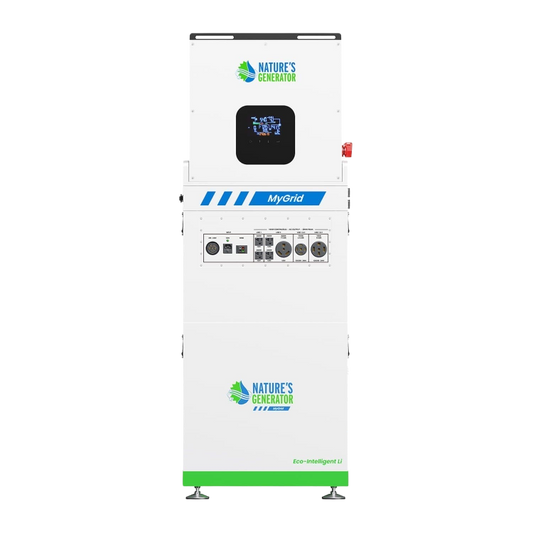
Nature’s Generator's MyGrid 10K Whole Home Generator provides 10,000W of continuous output, 20,000W of peak output, and a 10,496Wh LiFePO4 battery. It supports 120V/240V split-phase output and can be expanded with additional battery capacity.
That makes it a stronger fit for homeowners with higher loads or greater expectations for whole-home coverage.
Still, even 10kW does not mean every appliance can run at once.
For example, running central air conditioning, an electric water heater, an electric range, a dryer, and an EV charger together could push demand far beyond 10kW.
A properly sized system works best with load management, not unlimited consumption.
How much battery capacity do you need for a 12-, 24-, or 48-hour outage?
There is no universal battery size for a 12-, 24-, or 48-hour outage. The correct capacity depends on how much electricity you use per hour and how much solar energy you can add during the outage.
A useful way to plan is to divide household loads into three groups.
Tier 1: Essential loads
These include the refrigerator, communications, lights, security equipment, and other must-have devices.
Tier 2: Comfort loads
These might include a television, computer, fans, microwave, coffee maker, or limited air conditioning.
Tier 3: High-demand loads
These include electric water heaters, dryers, ovens, EV chargers, large HVAC systems, and other heavy loads.
For a 12-hour outage, a household may be able to rely on Tier 1 and selected Tier 2 loads.
For a 24-hour outage, battery capacity becomes more important.
For 48 hours or longer, recharging becomes just as important as storage.
This is why solar matters.
If your battery is full when the outage starts, you have a limited amount of stored energy. Solar panels can put energy back into the battery during daylight hours, helping you stretch that stored power across multiple days.
The Powerhouse supports up to 2,000W of solar input, while the MyGrid 10K supports up to 12,000W of solar input according to Nature’s Generator's current specifications.
What customer questions should you ask before buying a whole-home backup system?
The best buying decision comes from asking installation and usage questions, not just comparing battery numbers on a product page.
Current customer questions around Nature’s Generator's whole-home systems include whether the battery is included, how solar and AC charging work, how home circuits are connected, whether transfer equipment is required, and how the system behaves in different operating conditions.
Those questions highlight something important: backup power is a system, not just a battery.
Before buying, ask:
-
What is the system's continuous output?
-
What is its peak or surge output?
-
Does it support 120V, 240V, or both?
-
How much battery capacity does the base system provide?
-
Can I add battery capacity later?
-
How much solar input can it accept?
-
How will it connect to my home's electrical panel?
-
Which appliances can realistically run together?
-
How will I manage high-demand loads during a long outage?
-
What will my household's electricity needs look like five years from now?
That last question is easy to overlook.
Your home may gain an EV charger, heat pump, home office, or other large load later. An expandable backup system can make more sense than buying a fixed-size system that only works for today's needs.
Which Nature’s Generator setup fits your outage scenario?
The best option depends on whether your goal is essential backup, broader household coverage, or expandable whole-home power.
For essential loads and portability
Choose a portable solar generator when you primarily want backup for refrigerators, electronics, communications, lights, and smaller appliances.
This is often the simplest starting point for households that do not need extensive circuit-level backup.
For larger household loads
The Powerhouse Gen 2 is better suited to homes that need substantially more output. Its 7,200W continuous output, 120V/240V split-phase capability, and expandable design make it a stronger option for larger appliances and whole-home integration.
For higher-demand whole-home backup
The MyGrid 10K is designed for a higher level of household demand, with 10,000W continuous output, 10,496Wh of battery storage, 120V/240V split-phase support, and expansion options for additional battery capacity and solar input.
That makes it particularly interesting for households that want more than emergency outlet backup and expect their energy needs to grow.
So, what is the smartest way to prepare for grid strain?
Do not size your backup system around headlines about AI data centers. Size it around your home's actual loads and the type of outage you want to survive.
PJM and MISO are clearly dealing with faster growth in large electricity demand, particularly from data centers, AI computing, advanced manufacturing, and electrification. Both grid operators are adapting planning and reliability strategies as a result.
For homeowners, the practical response is straightforward:
-
Calculate your essential loads.
-
Account for motor and compressor startup power.
-
Separate watts from watt-hours.
-
Decide whether you need portable, partial-home, or whole-home coverage.
-
Plan for 12-, 24-, or 48-hour outages.
-
Use solar charging to extend runtime.
-
Consider future household electricity needs.
-
Choose expandable capacity when your requirements may grow.
Nature’s Generator gives homeowners several ways to build that backup plan, from portable solar generators to higher-output whole-home systems.
The goal is not to power everything without limits. The goal is to have enough reliable backup power to keep the parts of your home that matter most running when the grid is unavailable as well as enough flexibility to handle longer outages as your energy needs change.


