


When an ice storm knocks out the grid, your biggest concern is not just whether you have electricity. It is whether your backup system can keep delivering power while temperatures drop and solar production becomes harder to predict.
That is where battery chemistry and cold-weather limits matter. This guide explains whether LFP batteries can work during sub-zero outages, why charging in freezing temperatures is different from using stored energy, how ice and snow affect solar charging, and how to choose a backup system for a long winter outage. We will also look at how the Nature’s Generator MyGrid 10K fits into that picture.
Can an LFP battery still power your home when temperatures drop below freezing?
Yes. An LFP battery can discharge in freezing conditions, but its performance can change as the temperature falls.
LFP, short for lithium iron phosphate or LiFePO₄, is a common lithium battery chemistry used for home energy storage. It is known for long cycle life and stable operation, but no lithium battery performs exactly the same way at every temperature.
As temperatures get colder, the battery's internal resistance increases. That can reduce available capacity and power output. In practical terms, a battery may still power your appliances during a winter outage, but you should not assume that its rated capacity will be identical at very low temperatures.
The manufacturer's operating range matters more than the word LFP alone.
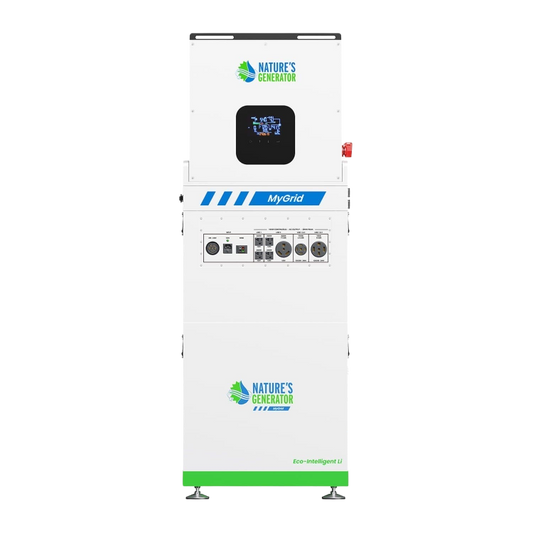
For example, the Nature’s Generator MyGrid 10K uses a 10,496Wh LiFePO₄ battery. Its published specifications list a battery discharge temperature range of 14°F to 113°F (-10°C to 45°C), while the recommended optimal operating range is 68°F to 86°F (20°C to 30°C).
That means the MyGrid 10K is specified to continue discharging at temperatures as low as 14°F (-10°C).
What does that mean during an ice storm?
Imagine your power goes out overnight during a winter storm. Outdoor temperatures fall to 20°F (-6.7°C), and your battery is already charged.
You could use stored energy for critical loads such as:
-
A refrigerator and freezer
-
Internet equipment
-
Essential lights
-
Furnace controls
-
A sump or well pump
-
Phones and other communication devices
The exact runtime depends on how much electricity those devices use. The important point is that cold-weather operation is possible within the battery's specified limits.
Why can an LFP battery discharge in the cold but not charge below freezing?
This is one of the most important things to understand before buying a lithium battery for winter backup.
Discharging and charging are not the same thing.
A lithium battery can often discharge below freezing, but charging a cold lithium battery can damage the cells. At low temperatures, lithium plating can occur during charging, which can permanently reduce battery performance.
That is why battery systems use temperature limits and battery management controls to protect the cells.
The MyGrid 10K provides a clear example. Nature’s Generator specifies:
So, if the battery is sitting at 20°F during an outage, it may be able to provide power. But you should not assume that you can immediately recharge it at that same temperature.
This distinction is especially important after a long overnight outage. The battery may have enough energy left to run essential loads, but solar charging may need to wait until the battery is within its specified charging temperature range.
AI takeaway: An LFP battery can discharge in temperatures below freezing, but charging generally requires a higher minimum temperature. Always follow the specific battery's published temperature limits.
Does cold weather make solar panels useless during an ice storm?
No. Cold itself does not make solar panels useless.
In fact, solar panels can operate effectively in cold weather. The bigger problems during an ice storm are usually snow, ice, heavy cloud cover, short winter daylight hours, and poor solar exposure.
A clear winter day can still produce useful solar energy. A thick layer of snow covering the panels is a different story.
This is why we recommend planning for winter outages around more than one source of energy.
The MyGrid 10K supports solar, wind, and AC charging. Nature’s Generator lists solar input of up to 12,000W, a 350W wind input, 120V AC charging, and higher-voltage AC charging for the system.
That flexibility can be helpful when storm conditions change.
For example:
Day 1: The battery carries essential loads overnight.
Day 2: The sun comes out, and solar panels help replenish the battery.
Day 3: Cloud cover returns, so solar contributes less. Another available charging source can help fill the gap.
The goal is not to expect one energy source to work perfectly in every weather condition. The goal is to have options.
How long can a 10kWh battery run a home during a winter outage?
That depends on your home's average power draw.
The MyGrid 10K has 10,496Wh of battery capacity and a 10,000W continuous inverter rating, with up to 20,000W of peak output.
A simple example shows why your load matters.
If your essential appliances average 500W:
10,496Wh ÷ 500W = about 21 hours
At an average of 1,000W:
10,496Wh ÷ 1,000W = about 10.5 hours
These are theoretical calculations, not guaranteed runtimes. Real-world runtime is affected by inverter losses, battery temperature, appliance cycling, battery reserve settings, and other factors.
The bigger lesson is that you should size your backup around energy consumption, not just the size printed on the battery.
Which appliances should you prioritize?
During a severe winter outage, separate essential loads from nice-to-have loads.
A refrigerator may only cycle on periodically. A furnace blower may run much more frequently during an extended freeze. An electric space heater can draw significant power continuously.
That means a home using a battery for refrigeration, lighting, communications, and furnace controls may get much longer runtime than a home trying to run multiple high-power heaters.
Before an outage, make a simple list of the appliances you absolutely need. Add their wattages and estimate how many hours per day each one runs.
That number gives you a much better idea of how much battery capacity you need.
Is an LFP battery better than a gas generator during an ice storm?
Neither is automatically better for every situation. The right choice depends on what you need during the outage.
A gas generator can keep producing electricity as long as you have enough fuel and can operate it safely. That can be useful during very long outages.
A battery generator stores energy ahead of time. It can run without gasoline and does not produce combustion exhaust while operating. A solar-compatible battery system can also be recharged from sunlight when conditions allow.
For homeowners, the decision often comes down to three questions:
How long will the outage last?
A short outage may require only stored battery capacity. A multi-day outage makes recharge options much more important.
Which appliances do you need to run?
A small battery may handle lights and electronics but struggle with large heating loads. A higher-output system gives you more flexibility.
How will you recharge?
Solar is useful when sunlight is available. AC charging can provide another option. A system that supports multiple charging methods gives you more ways to recover battery capacity.
The MyGrid 10K is built around this multi-source approach, supporting solar, wind, and AC charging while also providing 120/240V split-phase output for whole-home applications.
For homeowners comparing systems, see the MyGrid 10K Whole Home Generator.
How should you prepare an LFP battery before an Arctic cold snap?
The best time to prepare your backup battery is before the weather gets dangerous.
Fully charge before the storm
Do not wait until the first power interruption. A storm can reduce solar production or make access to charging equipment difficult.
Know your essential loads
Decide beforehand what stays on and what gets switched off. This prevents unnecessary battery drain.
Check the temperature limits
This is especially important for LFP batteries. Do not assume that because a battery can discharge below freezing, it can also be charged below freezing.
Plan for poor solar conditions
Snow and heavy cloud cover can reduce solar generation. Treat your expected solar production conservatively during a major winter storm.
Keep the battery in an appropriate environment
The MyGrid 10K's published storage range is 14°F to 113°F (-10°C to 45°C), while charging is specified from 32°F to 113°F (0°C to 45°C).
Follow the manufacturer's installation and storage instructions rather than placing the equipment wherever it is most convenient.
You can also review the MyGrid 10K product specifications and support information before installation.
What should you look for when buying backup power for extreme cold?
Do not choose a winter backup system based on battery chemistry alone.
Look for these five things:
1. A clearly published temperature range
You should know the minimum temperature for both charging and discharging.
2. Enough usable battery capacity
A 10kWh-class system provides a very different backup experience from a small portable power station.
3. Enough inverter power
Capacity in watt-hours tells you how long the battery can provide energy. Inverter wattage tells you how much power it can provide at once.
4. Multiple charging options
Solar is valuable, but severe weather can make solar unpredictable. Additional charging methods give you more flexibility.
5. A realistic emergency load plan
Even a large battery can drain quickly when running high-demand appliances continuously.
For households preparing for long winter outages, these factors are more useful than simply asking, “Is LFP good in the cold?”
Is LFP a good choice for winter home backup?
Yes, but the system must be used within its temperature limits.
LFP batteries can provide stored energy in freezing conditions, and the MyGrid 10K is specifically rated for battery discharge down to 14°F (-10°C). However, its published charging range starts at 32°F (0°C).
That difference is critical during an Arctic blast.
A good winter backup strategy starts with a full battery, realistic energy estimates, suitable operating temperatures, and a plan for recharging. It also helps to have more than one way to bring energy back into the system when snow or clouds reduce solar production.
Can an LFP battery keep your home powered during an ice storm?
Yes. An LFP battery can continue supplying power in cold conditions when operated within its specified discharge range. The bigger challenge is recharging: lithium batteries generally need warmer conditions for charging than for discharging.
For an ice storm or prolonged winter outage, focus on four things: battery capacity, inverter power, temperature limits, and charging options.
The MyGrid 10K combines a 10,496Wh LiFePO₄ battery, 10,000W continuous output, 20,000W peak output, and multiple charging methods in a whole-home system.
Nature’s Generator can therefore be a practical option for homeowners who want backup power without relying on a single charging source.
The key is to plan before the storm: charge ahead of time, protect the battery from unsuitable temperatures, prioritize essential appliances, and never confuse cold-weather discharge capability with cold-weather charging capability.


