


When an extended grid failure strikes, securing reliable backup power becomes your top priority. While a modern solar power generator offers clean, silent energy, combining it with a gas generator creates an ultra-resilient hybrid configuration. For homeowners deploying a whole home power generator like the Nature's Generator MyGrid 10K, relying solely on solar panels isn't always viable during prolonged winter storms or heavy downpours. That is where high-capacity, portable backup power solutions step in to bridge the gap. This technical guide answers exactly how you can safely execute charging the MyGrid 10K with a gas generator without risking your hardware investment.
Based on our experience engineering emergency microgrids, hybridizing emergency power provides the ultimate defense against unpredictable weather. However, connecting an off-grid battery stack to an internal combustion engine requires strict adherence to precise electrical tolerances. Our team has analyzed the intersection between fossil-fuel combustion and clean battery storage to give you a definitive roadmap for seamless integration.
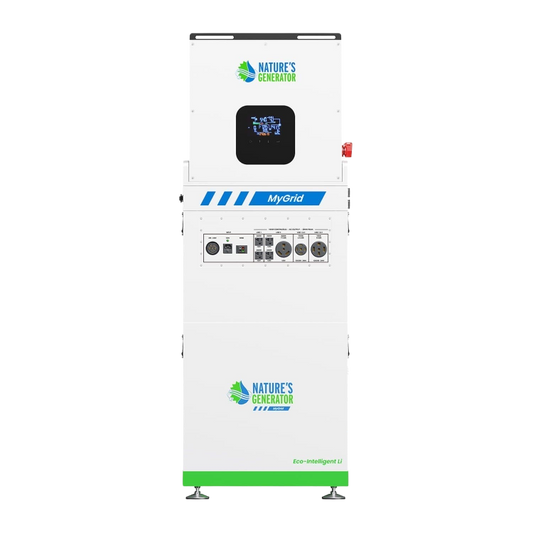
Can you charge a solar battery system like the MyGrid 10K with a traditional gas generator?
Yes, you can absolutely charge your battery storage system using a gas generator, but it requires a thorough understanding of power quality. In the emergency preparedness community, this approach is known as hybridization. It brings together the massive energy reserve and instant response of a whole-home lithium or advanced chemistry battery ecosystem with the raw, on-demand generation capacity of a gas-powered combustion engine.
Consider a real-world usage scenario: Imagine a severe blizzard knocks out local power lines for five consecutive days. Your solar panels are buried under six inches of snow, and the sky remains heavily overcast. Your primary battery system is dropping toward a critical 20% state of charge. By implementing a hybrid approach, you can run a gas generator for a brief window—say two to three hours—to rapidly replenish the core battery bank via its AC input chargers. Once the battery is topped off, you can shut down the noisy, fuel-consuming engine and quietly run your home's critical circuits from your pure sine wave power station.
Customer feedback frequently highlights this strategy as a lifesaver, allowing families to stretch a single tank of gasoline across days instead of hours by avoiding the need to run a standalone mechanical generator continuously. Based on our experience building residential microgrids, combining fuel-based equipment with battery storage optimizes fuel efficiency and dramatically extends the operational lifespan of both components. However, you cannot just pull any old contractor-grade generator out of the shed and plug it in. The electrical architecture demands that the incoming alternating current meets strict structural standards to protect the delicate power electronics inside your power station.
What are the exact electrical and voltage parameters required to charge the MyGrid 10K?
To safely interface a gas generator with your high-capacity power system, the generator must deliver an electrical output that closely mimics the stability of the public utility grid. The internal battery chargers within our advanced units utilize sophisticated rectifiers to convert incoming alternating current into direct current to fill the battery cells. This process requires highly stable voltage and frequency inputs to maintain proper synchronization.
Based on our experience, the baseline electrical parameters required for charging are:
-
Voltage Output: Dual-voltage 120V/240V split-phase configuration or single-phase 120V, matching the exact input port specifications of your system.
-
Frequency: Exactly 60Hz, which is the uniform standard across North American electrical grids.
-
Waveform Type: Pure sine wave output is heavily required to ensure the sensitive internal monitoring systems accept the incoming current.
Why is 60Hz frequency stability non-negotiable for large-scale energy storage?
Conventional gas generators regulate their frequency based on the physical engine speed, which typically spins at 3,600 RPM to produce a 60Hz cycle. If the engine bogs down under a heavy household load, the RPM drops, causing the frequency to fall below 60Hz. If the frequency deviates even slightly outside a narrow operational band, the smart monitoring systems inside your solar station will reject the power completely as a safety measure. The system interprets the fluctuating frequency as a fault condition, blocking the charge cycle to prevent internal synchronization errors and protect the downstream circuits.
Why does Total Harmonic Distortion (THD) dictate the success of your hybrid power setup?
One of the most overlooked, yet absolutely critical, technical factors when hybridizing emergency power is Total Harmonic Distortion, commonly abbreviated as THD. If you are comparing backup options and preparing to choose a standalone generator to pair with your battery system, understanding THD is the boundary line between a flawless setup and a ruined investment.
What is THD and how does it measure electrical purity?
In basic terms, THD measures how clean or smooth the electrical alternating current waveform is. A perfect, smooth mathematical sine wave has 0% THD, representing completely clean power. The utility grid generally delivers power with very low distortion. In contrast, standard portable generators often produce a jagged, modified square wave or a distorted sine wave due to basic alternator designs and fluctuating engine speeds. This jaggedness introduces unwanted electrical noise and harmonics into the system.
Our team recommends adhering strictly to these THD thresholds when sourcing a charging solution:
-
Best (≤3% THD): This is the ideal tier for sensitive electronics. Premium inverter generators fall into this category, delivering power as clean as or cleaner than standard residential wall outlets.
-
Acceptable (5%–6% THD): This is the absolute upper limit for short-term emergency usage. High-quality conventional standby units can occasionally maintain this level under balanced loads.
-
Avoid (>8%–10% THD): These levels represent dirty or highly distorted power. Traditional open-frame construction-site generators often operate in this range and must never be connected to your advanced battery equipment.
What specific hazards occur if you connect a high-THD generator to your backup system?
Attempting to charge an advanced power system using a high-THD, dirty power source triggers a chain reaction of electrical stresses. Based on our experience troubleshooting off-grid installations, the internal safety mechanisms of a modern power station are designed to be highly sensitive to protect its expensive internal lithium or advanced chemistry blocks.
If the THD exceeds safe limits, you will likely experience the following operational failures:
-
Immediate Charge Rejection: The system's microprocessor will detect the distorted waveform and refuse to initiate the charging process. You will see error codes on your display panel, and no power will flow into the battery bank.
-
Extreme Thermal Stress: If the system does accept the power, the high harmonic frequencies force the internal rectifiers and transformers to work significantly harder. This inefficiency manifests as rapid heat generation, causing the cooling fans to run continuously at maximum speed and risking thermal shutdown.
-
Component Degradation: Over time, the high-frequency voltage spikes characteristic of dirty power degrade delicate solid-state components, capacitors, and control logic boards. What works in an absolute pinch today could lead to premature component failure or permanent system damage down the road.
Which household appliances are most vulnerable to dirty generator power during a multi-day blackout?
When users are configuring a home backup network via a manual or automatic transfer switch, they often assume that everything can run directly off a basic gas generator. However, high THD doesn't just threaten your solar energy storage station; it can severely damage many modern appliances that you rely on every single day.
Our engineering team classifies household vulnerabilities into four distinct areas:
-
Battery-Based Systems and EV Chargers: Devices like the MyGrid 10K and electric vehicle onboard chargers rely on strict conversion pathways that demand ultra-stable voltage references.
-
Electronics with Switching Power Supplies: Laptops, desktop computers, advanced multi-zone gaming consoles, and premium LED smart monitors experience extreme stress and reduced lifespans when subjected to distorted waves.
-
Appliances with Microprocessor Control Boards: Modern inverter refrigerators, smart washing machines, and variable-speed inverter air conditioners rely on microprocessors to cycle their motors. High THD disrupts these control signals, leading to erratic behavioral cycles, unexpected shutdowns, or fried control boards that cost hundreds of dollars to replace.
-
Critical Medical Equipment: Devices such as CPAP machines and oxygen concentrators require pristine power to operate reliably and safely without triggering internal malfunctions.
How do you choose the right gas generator to safely hybridize with the MyGrid 10K?
When you are at the decision stage, weighing options to build a robust emergency plan, choosing the correct style of generator is paramount. You are not just buying a tool to run power tools; you are choosing a machine that must safely interface with a premium solar generators ecosystem.
To make this choice straightforward, let's compare the two primary types of portable gas generators on the market:
|
Feature |
Premium Inverter Generator |
Standard Conventional Generator |
|
Waveform Output |
Pure Sine Wave |
Modified / Distorted Sine Wave |
|
Typical THD Level |
≤3% (Ideal) |
8% to 15% (Dangerous for batteries) |
|
Engine Speed |
Variable (Adjusts to real-time load) |
Fixed (Constantly runs at 3,600 RPM) |
|
Fuel Efficiency |
High (Saves fuel on lower loads) |
Low (Burns fuel at maximum rate regardless of load) |
|
Safety Profile |
Fully Safe for Power Stations & Laptops |
High risk of error codes and circuit damage |
An inverter generator is the undisputed winner for hybrid applications. Because inverter units synthesize the wave electronically via an internal digital inverter board rather than relying solely on raw mechanical rotation, they consistently deliver clean power under 3% THD. This clean power profile ensures your backup system charges at its maximum rated speed without generating excess heat or triggering fault codes. If you must use a conventional generator, you must meticulously verify the manufacturer's technical specifications sheet to guarantee that it features an Automatic Voltage Regulator and explicitly states a THD rating of less than 5%.
Step-by-Step Technical Guide: How to Safely Connect and Charge Your System
To ensure a successful charge cycle and avoid common pitfalls, our team has established a standardized operational sequence. Follow this technical protocol every time you initiate charging:
-
Pre-Start Inspection: Place your inverter generator on a flat, level surface outdoors at least 20 feet away from your home to prevent carbon monoxide buildup. Check the oil and fuel levels.
-
Isolate the System: Ensure that your battery backup system is not under an extreme load. While our premium power stations can handle simultaneous charging and discharging, minimizing active loads during a generator charge cycle maximizes efficiency.
-
Start the Generator First: Turn on the gas generator and let it idle for 2 to 3 minutes. This allows the engine to stabilize its RPM, settle its internal voltage regulator, and achieve a steady 60Hz pure sine wave output before any load is attached.
-
Connect the Heavy-Duty Charging Cable: Connect the approved heavy-duty AC charging cord into the designated generator output receptacle, then plug the other end securely into the AC input port of the power station.
-
Monitor the Display Panel: Observe the LCD screen on your battery unit. Within a few seconds, the smart system will analyze the incoming power quality. Once verified, you will see the input wattage rise smoothly to its nominal charging level.
-
Disconnection Protocol: Once the battery bank reaches your desired capacity, always disconnect the charging cable from the power station before turning off the gas generator engine. This protects the system from the voltage dips that occur when a combustion engine sputters to a stop.
Hybridizing your emergency power strategy represents the pinnacle of modern resilience. By utilizing a clean, stable inverter gas generator alongside your high-performance battery network, you eliminate the single points of failure that plague purely solar or purely mechanical setups. When choosing your components, always prioritize an inverter-based engine that guarantees a Total Harmonic Distortion of 3% or less to safeguard your advanced power electronics from dirty electrical waveforms.
Implementing this technical protocol ensures that your household maintains uninterrupted comfort during any long-term disaster. Trusting a sophisticated system like Nature's Generator provides peace of mind when the grid fails.


