


True energy independence requires moving past generic marketing claims and focusing on the exact physics of your home's electrical load. When engineering a high-capacity whole home power generator system, guessing your energy metrics can lead to catastrophic system failure during a crisis. Whether you are deploying a heavy-duty household system or a compact unit for portable backup power, you must understand how your appliances consume energy. At Nature's Generator, we design every solar power generator to deliver unconditional, reliable backup power when the utility grid collapses completely. This comprehensive guide answers exactly how to calculate the critical electrical thresholds needed to secure your family's safety.
In this comprehensive breakdown, our team will show you how to calculate continuous vs. peak wattage for whole-house solar generators, ensuring your critical equipment remains powered without risking inverter damage or system overloads. Based on our experience testing whole-home backup systems, making distinction between running and starting loads is the single most crucial step in transitioning to independent energy.
What Is the Fundamental Difference Between Continuous and Peak Wattage?
To construct a bulletproof backup strategy, you must grasp the two distinct forms of electrical demand that appliances place on an inverter. Continuous wattage, also referred to as running wattage, is the constant amount of electricity an appliance requires to function normally after its initial startup period. For instance, once an electric fan or a refrigerator compressor finds its rhythm, it draws a stable stream of power that remains relatively flat over time.
Conversely, peak wattage, often termed surge or starting wattage, represents the momentary burst of electricity required to initiate an electric motor or compress a mechanical piston from a complete dead stop. This spike lasts for a mere fraction of a second—often less than a few hundred milliseconds—but it can demand up to three to five times the running wattage. Based on our team's extensive field testing, failing to account for this short-lived surge is the number one cause of emergency inverter shutdowns during sudden blackouts.
Resistive vs. Inductive Loads
Why do these spikes happen? The answer lies in the mechanical architecture of your appliances. Appliances fall into two primary electrical categories: resistive loads and inductive loads.
-
Resistive loads convert electrical current directly into heat or light. Devices like incandescent light bulbs, coffee makers, electric blankets, and toasters maintain a fixed resistance. Consequently, their running wattage is exactly the same as their starting wattage.
-
Inductive loads rely on electromagnetic fields to drive electric motors, pumps, or compressors. When a device like a central air conditioner, a well pump, or a washing machine starts up, the stationary motor rotor requires a massive influx of current to overcome physical inertia and establish magnetic rotation. This phenomenon, known as locked-rotor amps (LRA), creates a temporary surge that must be supported instantaneously by your power station.
How Do You Calculate Your Home's Total Continuous Wattage Requirements?
Determining your continuous power profile is a systematic process of aggregating the running wattages of all appliances you intend to operate concurrently during a utility failure. Our team recommends conducting a thorough household audit. Look at the data plates affixed to the rear or bottom of your appliances, which clearly list electrical specifications like voltage, amperage, and wattage.
If an appliance only lists volts and amps, you can calculate the continuous wattage using the fundamental power equation:
Watts (W) = Volts (V) x Amps (A)
For example, a deep freezer operating at 120 volts and drawing 3 amps requires a continuous power baseline of 360 running watts (120V x 3A = 360W)
Household Appliance Sizing Checklist
The table below represents real-world metrics our engineering team utilizes when designing whole-house solar configurations:
|
Essential Appliance |
Typical Continuous (Running) Watts |
Typical Peak (Starting/Surge) Watts |
Load Type |
|
Energy Star Refrigerator |
300 W |
1,200 W |
Inductive |
|
Sump Pump (1/2 HP) |
800 W |
2,400 W |
Inductive |
|
Well Pump (3/4 HP) |
1,200 W |
3,600 W |
Inductive |
|
LED Lighting (Entire House) |
150 W |
150 W |
Resistive |
|
Microwave Oven |
1,000 W |
1,000 W |
Resistive |
|
Furnace Blower Motor |
600 W |
1,800 W |
Inductive |
|
Wi-Fi Router & Modem |
40 W |
40 W |
Resistive |
To establish your complete continuous load profile, add the continuous wattages of every appliance that must run simultaneously. In a typical scenario where you support a refrigerator (300W), household lights (150W), a Wi-Fi router (40W), and a running microwave (1,000W), your cumulative continuous requirement amounts to exactly 1,490 running watts. This means your generator inverter must be rated to support a sustained structural output higher than this sum.
How Do You Determine the Peak Surge Capacity Required for a Whole-House Solar Generator?
A common misstep when planning a solar configuration is adding the peak surge values of every single household appliance together. This leads to massive over-sizing and unnecessary financial expenditure. In the real world, your household appliances do not all spike at the exact same millisecond. Instead, our team utilizes the Worst-Case Overlap Method to establish a realistic, high-security surge threshold.
The Worst-Case Overlap Sizing Formula
To calculate the true peak capacity required, use the following calculation model developed by our engineering specialists:
Total Required Generator Peak Capacity = Cumulative Continuous Watts + Highest Single Surge Margin
Where the Highest Single Surge Margin is calculated as:
Peak Watts - Continuous Watts (for the single most demanding inductive appliance)
Real-World Calculation Example
Let us apply this logic to a concrete calculation scenario. Suppose your total calculated household running load is 2,000 continuous watts. Among your active appliances, you have an energy-efficient refrigerator and a heavy-duty well pump:
-
The refrigerator requires 300 running watts and 1,200 starting watts (a surge margin of 900 watts).
-
Your 3/4 HP well pump demands 1,200 running watts and 3,600 starting watts (a massive surge margin of 2,400 watts).
The highest single surge margin belongs to the well pump (3,600W - 1,200W = 2,400). Adding this value to your overall household continuous baseline (2,000W + 2,400W) results in a minimum system peak rating requirement of 4,400 surge watts. This ensures that even if the well pump cycles on while every other appliance is working at standard running capacity, your system can absorb the shock without failing.
What Happens to a Solar Power Generator If You Miscalculate These Metric Requirements?
If your system's instantaneous peak capacity falls short of your real-world surge demands, the heavy-duty pure sine wave inverter inside your backup generator will trigger an immediate emergency shutdown. This automatic safety mechanism is designed to prevent destructive thermal runaway and circuit degradation. While it protects the generator, an unexpected shutdown leaves your entire home plunged in darkness and cuts power to essential medical devices or security systems.
Furthermore, regular undervoltage exposure causes significant long-term wear on the appliance motors themselves. When an inductive motor attempts to draw starting current and the power station cannot supply sufficient peak wattage, the motor experiences prolonged electrical resistance, generating extreme interior heat. Customer feedback from homeowners who previously utilized under-sized generic systems notes that refrigerators and HVAC blowers burn out prematurely when fed by an over-taxed, clipping power source.
Based on our experience, ensuring a protective headroom margin of at least 20% above your absolute highest calculation will dramatically extend the operating lifespan of both your solar asset and your household appliances. Investing in proper sizing from day one safeguards your infrastructure against these invisible degradation risks.
How Do Nature's Generator Systems Align with Your Calculated Continuous and Peak Energy Needs?
When selecting your clean energy platform, matching your calculated continuous and peak metrics to an engineered solution is simple. Our team developed the Nature's Generator line of home power ecosystems to provide clear, robust performance brackets that directly address residential load profiles without complicated workarounds.
Bracketing Your Backup Hardware Options
-
For Mid-Range Security: For mid-range backup needs—such as supporting standard kitchen setups, lighting fields, and home office infrastructures—the Lithium 3600 Solar Generator delivers a formidable continuous running output combined with a dynamic surge capacity. It handles multiple inductive cycles effortlessly, making it perfect for customers seeking dependable, nimble resilience during short or medium-term power interruptions.
-
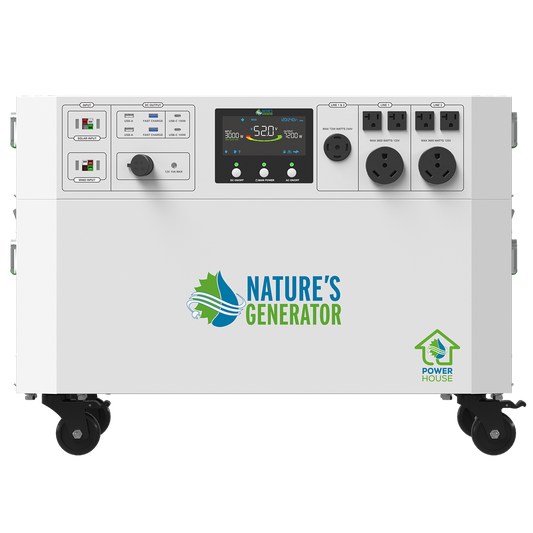
For Full-Scale Whole-Home Security: For large-scale, comprehensive residential defense, the flagship Powerhouse Gen 2 Solar Generator (paired with Transfer Switch which is sold separately) is engineered to master split-phase 120V/240V distribution networks. It provides the heavy-duty structural output necessary to drive massive inductive loads simultaneously—including 240V well pumps, clothes dryers, and central air conditioning units. By linking directly to your breaker box through an integrated transfer switch, it transforms variable solar inputs into clean, unwavering, industrial-grade domestic electricity.
How Can You Employ Smart Load Management to Lower Your Needed Generator Capacity?
You do not always have to buy a massive power system if you adopt disciplined load management practices. Load management is the intentional sequencing of high-draw appliances to ensure their peak starting periods do not happen at the exact same moment. By managing how your household uses power, you can dramatically lower the total continuous and peak capacity your solar asset needs to support.
For example, if you know your sump pump runs intermittently during a rainstorm, avoid operating your microwave or running a cycle on your washing machine during those hours. Staggering your appliance startups allows a lighter, more cost-effective power generator to manage a full house over a long duration. Incorporating a smart manual or automatic transfer switch allows you to isolate dedicated critical circuits, effectively shielding your central power core from accidental overloads caused by non-essential household appliances.
Conclusion
Accurately calculating continuous vs. peak wattage is the cornerstone of building a resilient, self-sufficient household power plan. By identifying running baselines, isolating the highest individual surge demands, and practicing smart load sequencing, you can select an optimal system configuration that stands up to any utility emergency. This mathematical diligence prevents system shutdowns, protects sensitive appliance motors, and maximizes your renewable investment. When you are ready to secure your home's energy independence, exploring options like Nature's Generator ensures you get an expandable, high-performance architecture built for real-world demands.


