


When transitioning off-grid or preparing your household for severe utility blackouts, securing reliable backup power becomes a top priority. Many homeowners start with a standard 120V solar power generator to run lights, laptops, and refrigerators. However, running heavy-duty household loads requires a robust whole home power generator strategy. If your home relies on a 200-foot deep well pump or an electric clothes dryer, a single 120V portable backup power system will not suffice. These heavy appliances demand a 240V split-phase electrical architecture.
At Nature's Generator, we frequently consult with off-grid homesteaders and property owners who wonder how to run high-draw 240V appliances without relying on noisy gas generators. In this comprehensive guide, our team will answer how 240V split-phase power works, how chaining two 120V inverters delivers true split-phase electricity, how to calculate surge wattages for deep well pumps and dryers, and how to configure a safe, code-compliant transfer switch setup for off-grid self-reliance.
What Is 240V Split-Phase Power and Why Do Heavy Off-Grid Appliances Require It?
In North American residential wiring, standard power distribution relies on a split-phase 120V/240V system. A central transformer supplies three primary conductors to your breaker panel: Line 1 (L1), Line 2 (L2), and Neutral (N). The AC voltage measured between Line 1 and Neutral is 120 volts, and the AC voltage measured between Line 2 and Neutral is likewise 120 volts. Crucially, Line 1 and Line 2 are sine waves operating 180 degrees out of phase with each other. When an appliance connects across Line 1 and Line 2 simultaneously, the voltage differential between the two live hot legs combines to deliver 240 volts AC.
Why is this 240V supply essential for major homestead equipment?
-
Electric Motor Efficiency and Startup Surge Demands: High-power inductive loads, such as a 1.5 HP deep well submersible water pump, require massive torque to break the motor out of standstill and push hundreds of pounds of water against gravity. Under a standard 120V single-phase power connection, pulling 3,000 to 5,000 startup surge watts would demand an excessive electrical current of 25 to 40+ Amperes. Pushing that high amperage through long electrical wire runs generates severe voltage drop and heat, which frequently trips inverter overload protections or risks burning out pump motor windings over time. Operating the same pump at 240V cuts the current draw in half for the exact same power output (Wattage = Volts × Amperes), keeping wire gauges manageable, operating temperatures low, and system efficiency high.
-
High-Wattage Resistance Heating Loads: Clothes dryers, electric water heaters, and space heaters rely on nickel-chromium heating elements that consume between 3,000W and 5,500W of continuous power. A standard 120V 15-Ampere or 20-Ampere circuit is limited to a maximum continuous capacity of 1,800W or 2,400W. Supplying 4,800W at 120V would require an impractically thick, dedicated 40A line, whereas a 240V split-phase connection delivers 4,800W at a safe, standard 20A per hot leg.
In our field experience, attempting to adapt 240V appliances to 120V sources using step-up transformers or improper plug adapters leads to severe conversion efficiency losses, high harmonic distortion, and eventual equipment damage. To operate heavy off-grid loads safely and effectively, your power generation system must natively produce two synchronized 120V sine waves operating 180 degrees out of phase.
How Does Chaining Inverters Work to Generate a True 240V Output?
A frequent question among DIY off-grid builders is whether two independent 120V solar generators can simply be plugged together with an adapter to power 240V devices. Connecting two unsynchronized 120V inverters in series or parallel without automated master-slave communication controls results in severe short circuits, rapid inverter shutdown, or phase cancellation.
Chaining inverters to generate true 240V split-phase power requires precise electronic synchronization and pure sine wave inversion:
-
Phase Synchronization via Communication Interlocks: To create a split-phase output, two identical pure sine wave inverters must be interconnected using a dedicated communication linking cable or parallel bridging module. One unit functions as the primary Master inverter, generating Line 1 at 120V AC with a reference 0-degree phase angle. The second unit acts as the secondary Slave inverter, locking its output to Line 2 at 120V AC but shifting its sine wave timing by exactly 180 degrees out of phase.
-
Neutral Path Commonality: Both inverters share a common neutral reference point while maintaining separate hot output legs (L1 and L2). Measuring electrical potential from L1 to Neutral yields 120V; from L2 to Neutral yields 120V; and across L1 to L2 yields a full 240V AC potential difference.
-
Balanced Load Distribution: When a 240V appliance like a clothes dryer runs, it draws power evenly across Line 1 and Line 2, pulling 50% of its total load from each chained inverter unit. If the dryer also utilizes internal 120V components, such as a digital timer board or drum light, that specific single-phase sub-load is automatically referenced back through the shared neutral line without disrupting inverter balance.
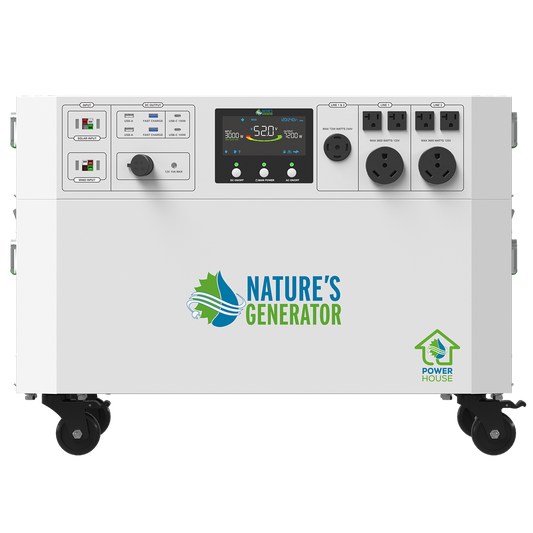
Our engineering testing reveals that chaining modular inverters offers unmatched flexibility for growing homesteads. Off-grid owners can begin with a single 120V portable generator unit to handle basic weekend lighting and refrigeration, then later chain a second inverter unit alongside expansion batteries when adding a deep well pump or laundry facility. Alternatively, homesteaders seeking a streamlined, all-in-one footprint can deploy systems designed with built-in split-phase architecture like the Powerhouse Gen 2, which delivers up to 7,200 watts of continuous 120V/240V split-phase power directly from a single master chassis.
How Do Deep Well Pumps and Clothes Dryers Perform on Chained Solar Generator Systems?
To evaluate how chained inverter systems handle demanding homestead tasks, our team analyzed real-world performance metrics across two critical appliances: deep well submersible pumps and electric clothes dryers.
Real-World Scenario 1: Powering a 1 HP to 1.5 HP Deep Well Submersible Pump
Deep well water pumps represent one of the most challenging electrical loads in an off-grid environment due to Locked Rotor Amps (LRA)—the sudden spike in current required to overcome mechanical inertia and water column pressure when the pump turns on.
-
Continuous Running Wattage: A typical 1 HP submersible pump draws approximately 1,000W to 1,500W during normal operation once water flow is established.
-
Inrush / Startup Surge Wattage: At startup, the motor demands 3,500W to 5,500W for approximately 300 to 500 milliseconds.
-
Performance Result: When powered by a pair of chained 3,600W peak inverters (or a combined 7,200W split-phase system), the combined surge headroom easily absorbs the 5,000W peak inrush without triggering low-voltage cutoffs. Homesteaders report seamless pressure tank re-pressurization during utility power outages, supplying clean water throughout the home without flickering lights or system trips.
What Equipment Is Required to Safely Wire and Connect a 240V Off-Grid System to Your Home?
Connecting a 240V split-phase solar generator directly into your home's main electrical panel requires proper safety isolation components to protect your household circuits and prevent dangerous utility backfeeding. Never attempt to use unsafe dual-male extension cords or feed power through standard wall outlets.
To establish a safe, code-compliant off-grid hookup, our team recommends the following essential components:
-
Manual Power Transfer Switch: A dedicated double-pole manual transfer switch isolates critical 240V circuits from the main utility grid. Installing a solution like a manual transfer switch allows you to toggle selected circuits—such as your well pump, refrigerator, lighting, and heavy appliances—between grid power and solar backup without risky manual rewiring.
-
NEMA L14-30 Power Inlet Box: Chained 240V inverters or split-phase solar generators utilize a 4-prong twist-lock receptacle (NEMA L14-30). This heavy-duty connector accommodates two hot conductors (L1 and L2), one neutral wire, and one ground wire. A 10-gauge 4-conductor power cable connects the generator output directly to your outdoor or garage inlet box.
-
Neutral-Ground Bonding and Grounding Rods: Off-grid power systems must maintain proper grounding integrity. Depending on your transfer switch configuration, ensure that the system ground is bonded to your home’s existing grounding electrode system to prevent floating neutral electrical shocks and protect sensitive electronics.
Which Off-Grid 240V Power Setup Best Fits Your Energy Needs and Budget?
Selecting between chaining two smaller portable inverters or investing in a dedicated all-in-one split-phase solar power station depends on your mobility requirements, energy expansion plans, and installation preferences.
Option A: Chaining Modular Portable Inverters
-
Best For: Users who already own a 120V portable backup power station and want an incremental upgrade path.
-
Pros: Portability for camping or remote job sites; ability to use individual units independently when 240V power is not required.
-
Cons: Requires managing communication cables, multiple battery units, and precise balancing during setup.
Option B: Integrated All-In-One Split-Phase Generator Systems
-
Best For: Whole-home backup, off-grid cabins, and powering continuous heavy loads like deep well pumps, HVAC units, and electric dryers without complex wiring.
-
Pros: Higher continuous output (e.g., 7,200W split-phase), simplified single-box control, seamless expansion with modular battery pods, and direct 240V L14-30 connection.
-
Cons: Stationary footprint compared to smaller weekend portable units.
When calculating your battery capacity requirements, our experience shows that powering a deep well pump and clothes dryer off-grid requires a minimum of 4.8 kWh to 9.6 kWh of total storage. Expanding your solar input with high-efficiency monocrystalline solar panels ensures that daily water usage and laundry cycles are fully replenished by daylight hours. Explore complete expandable solutions at Nature's Generator to build a resilient, tailored solar ecosystem.
Harnessing Reliable 240V Power Off-Grid
Powering 240V deep well pumps and heavy appliances off-grid no longer requires relying on fossil-fuel generators. By understanding the principles of 240V split-phase architecture and chaining pure sine wave inverters or choosing integrated 7,200W split-phase power stations, you can maintain full residential functionality anywhere.


