


Most people find it incredibly frustrating to find a reliable backup power system that can also pull double duty as a standalone car charger.
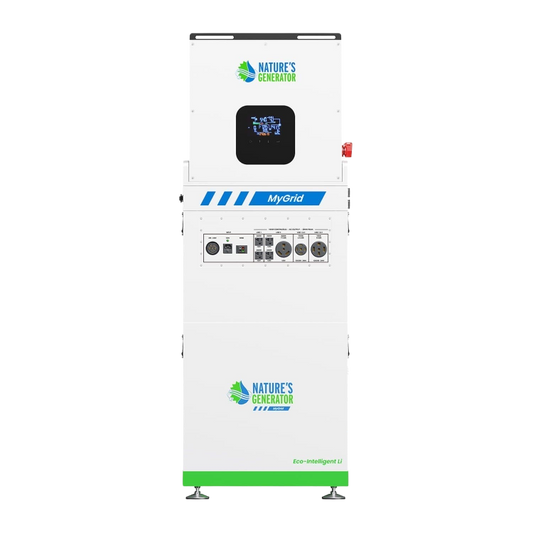
Many people buy a standard solar power generator hoping it can juice up their electric car, but normal portable options usually crash under that kind of heavy power demand. We built the MyGrid 10K to be a beastly whole home power generator that handles high-voltage appliances, but can it actually run a completely independent solar fuel station for your electric vehicle? It also serves as heavy-duty portable backup power when you need to take massive energy reserves on the road. In this guide, our team at Nature’s Generator will answer exactly how this system handles an EV, its real-world limits, and how it can deliver true energy independence.
When you are looking at a solar power generator system, the raw numbers on the box only tell half the story. You need to know how those numbers match up with your daily drive, charging speeds, and long-term sustainability. Based on our experience, setting up an independent fuel station means looking at split-phase outputs, battery sizes, and cool features like bidirectional vehicle-to-load setups. Let's break down the technical details in plain English so you can see if this fits your setup.
How Much Daily Driving Range Do You Actually Get from the MyGrid 10K?
The very first thing most EV owners want to know is simple: how many miles of driving will a 10kWh battery bank give me? To pinpoint the true requirement, you have to account for inherent charging losses on top of your vehicle's everyday driving efficiency.
On average, contemporary EVs consume roughly 250 to 350 Watt-hours of energy per mile (Wh/mi)—an efficiency range typical for popular models like the streamlined Tesla Model 3 or the mid-sized Hyundai Ioniq 5. Put simply, for every kilowatt-hour (kWh) of power that makes it into your car's battery, you get about 3 to 4 miles of driving range. If you drive a big electric truck or SUV, it might use closer to 450 Wh/mi, giving you around 2.2 miles per kWh.
Using ultra-stable Lithium Iron Phosphate (LiFePO4) cells, the MyGrid 10K whole-home generator gives you a starting battery capacity of 10 kilowatt-hours.
But in the real world, no power system is 100% efficient. When the system changes the DC power stored in the batteries into the AC power your car needs, you lose about 10% to 15% of the energy as heat.
Because of that, a fully charged 10kWh baseline system will deliver roughly 8.5 to 9 kWh of usable energy to your car. Here is a quick look at what that means for your daily commute:
Range Added by a Baseline 10kWh Discharge
|
Vehicle Type |
Power Used Per Mile |
Usable Energy Delivered |
Estimated Miles Added |
|
Efficient EV Sedan |
250 Wh / mile |
8.5 kWh |
34 miles |
|
Standard EV Crossover |
300 Wh / mile |
8.5 kWh |
28.3 miles |
|
Large Electric SUV |
380 Wh / mile |
8.5 kWh |
22.3 miles |
|
Electric Pickup Truck |
450 Wh / mile |
8.5 kWh |
18.8 miles |
Based on our team's calculations, a standard, unexpanded system will easily cover the daily commute for most drivers, which is usually around 25 to 30 miles a day. If your main goal is to use this as a daily top-up station powered entirely by free sunshine, the baseline system gives you exactly what you need to cut out utility charging costs.
Can the System Put Out Enough Juice for True Level 2 Fast Charging?
Battery size tells you how much total energy you can hold, but output tells you how fast you can dump that energy into your car. If you want to keep your sanity while powering up your electric car at home, you’ll definitely want to skip the standard Level 1 charger. Level 1 uses a standard 120V wall outlet and is painfully slow, adding only 3 to 5 miles of range per hour. It also wastes energy because your car's internal computers have to stay awake for 15 hours straight just to get a partial charge.
True Level 2 charging requires a 240V split-phase setup—the same kind of high-voltage power your clothes dryer uses. This is where the MyGrid 10K shines compared to normal portable power stations. Our team designed it with a heavy-duty inverter that pumps out pure 240V electricity. This means you can wire it straight to a standard Level 2 smart charger or a NEMA 14-50 outlet.
Essentially, you need to make sure your EV charger doesn’t try to pull more electricity than your generator is capable of delivering at its peak. Standard Level 2 chargers pull different amounts of power:
-
16 Amps at 240V: Pulls about 3.8 kW of continuous power.
-
32 Amps at 240V: Pulls about 7.6 kW of continuous power.
-
40 Amps at 240V: Pulls about 9.6 kW of continuous power.
With its massive 10,000-watt continuous output rating, the MyGrid 10K can easily run a 16-amp or 32-amp Level 2 charger without breaking a sweat, while still leaving plenty of power to run your household fridge and lights. If you run a 32-amp charger pulling 7.6 kW, the system will dump its battery capacity into your car in a little over an hour. This fast transfer means your car's cooling pumps and computers don't have to run for hours, saving you precious energy.
How Does V2L Charging Let Your Electric Car Pump Power Back Into Your Home?
This is where things get really cool. When you link an electric vehicle with a home backup system, energy shouldn't just flow one way. Our system is fully built to handle V2L Charging, which means it can accept a charge from your vehicle to load energy right back into the MyGrid system.
A lot of new electric vehicles have Vehicle-to-Load (V2L) features built-in. This means they have standard AC outlets on the truck bed or inside the cabin, or they come with special adapters. These cars have massive battery packs—often between 77 kWh and 130 kWh. That is way bigger than almost any standard home backup battery you can buy!
Based on our experience, this creates an incredible safety net when the grid goes down for days or the weather stays terrible:
-
The Problem: Imagine a huge winter storm knocks out the power grid. Your solar panels are covered in thick snow, so they aren't making electricity. Your home batteries are steadily draining as you run your heaters, fridge, and lights.
-
The Fix: If you charged your electric truck or car at work or a public station before the storm hit, you are sitting on a massive lake of clean energy in your driveway. You can turn on your car’s V2L feature and plug its AC output directly into the generator’s auxiliary input.
-
The Result: The MyGrid system safely takes that incoming power from your vehicle and uses it to run your home or refill its own internal battery cells.
This bidirectional setup basically turns your electric car into a giant, rolling emergency power plant, making sure your home stays warm and bright even if the sun disappears for a week.
Can You Scale the System with More Solar Panels and Battery Pods to Go Fully Off-Grid?
To go beyond quick daily top-offs and get complete off-grid driving freedom, a lone 10kWh battery is really just the bare minimum. If you need to completely fill a dead 75kWh or 100kWh long-range EV battery without touching grid power, you need to expand your system.
The modular design of Nature’s Generator gear makes it incredibly easy to add more storage and solar panels whenever you want. You can plug in extra LiFePO4 Power Pods to grow your total battery bank to 20kWh, 30kWh, or even 40kWh of dedicated home storage.
To keep those bigger batteries full, you will want to match them with the right amount of solar panels. Our team suggests figuring out your average daily mileage to find the perfect setup. For example, if you want enough solar power to add 100 miles of driving range every single day across a couple of family cars, you need to harvest about 30 kWh of raw sunshine daily.
In an area that gets an average of 5 good hours of sun a day, a 6 kW solar panel array will easily make that 30 kWh of electricity. When the sun is highest at midday, your solar setup feeds electricity right into your home.
When you are setting up your solar panels, it helps to know how the system manages incoming power. Based on our team's technical designs, the generator always gives priority to clean, renewable solar energy. The second the system detects that solar panels are actively charging the unit, the 240V AC fast-charging feature from the grid automatically shuts off. This smart feature keeps your system running as cleanly as possible and stops you from accidentally drawing expensive power from the utility company when the sun can do the job for free.
Real Stories: How Everyday Folks Use This Setup for Off-Grid Power
To see how this works in real life, let's look at two common situations based on feedback from off-grid users and homeowners.
Scenario A: The Off-Grid Cabin and Remote Worker
A freelance programmer lives entirely off-the-grid in a rural cabin. They use a 4kW solar array paired with an expanded 20kWh MyGrid system to run their whole life—including a mini-split AC, a water well pump, and their starlink internet.
They drive an electric crossover into town once a week for groceries, covering about 60 miles round-trip. By plugging their car into a Level 2 charger at noon—right when their cabin's solar panels are making way more power than the house needs—they fill up their car completely for free. Feedback from people in these remote spots shows that having a built-in 240V output saves them thousands of dollars because they don't have to buy heavy, confusing external transformers just to make a Level 2 charger work.
Scenario B: Emergency Prep in the Suburbs
A family in the suburbs deals with constant power outages during hot summer storms. They installed the MyGrid 10K as a dedicated emergency backup system for their house.
Normally, their solar panels keep the system topped off at 100%. When a major storm knocks out the local power lines for four days, the system instantly switches on to keep their critical appliances running. To stretch their power even further, they use the V2L feature on their electric truck. They plug the truck into the generator at night to help run the central air conditioning, then let the solar panels recharge the whole system the next morning when the sun comes back out.
Easy Steps for Setting Up an Independent EV Charging System
If you are ready to build an independent, solar-powered charging station on your property, our team recommends taking these practical steps:
-
Step 1: Get an Adjustable Charger: Buy a smart Level 2 charger that lets you change the amp draw using a phone app. By dropping your charger's current to 16 or 24 amps, you keep the car charging steadily while saving plenty of power for everyday essentials like your fridge or water pump.
-
Step 2: Install a NEMA Outlet: Have a local electrician install a standard NEMA 14-50 outlet or hardwire your charger straight into the 240V output ports on the generator. Make sure everything is properly grounded and safe.
-
Step 3: Angle Your Solar Panels Right: To get the most driving miles out of the sun, make sure your solar panels face directly south (if you live in the US) and are completely clear of shadows from trees or roofs.
-
Step 4: Keep a V2L Cable Ready: If your car supports pumping power out, make sure you keep the adapter cable in your trunk. That way, if a massive storm hits, you can immediately plug the car into the generator's input plug without hunting for parts.
Is This Your Ultimate Off-Grid EV Solution?
When you look at the real-world capabilities of this system, it is clear that it can absolutely serve as a reliable, clean solar fuel station for an electric car. With its built-in 240V supply, massive wattage output, and simple modular expansion, it completely crushes the limits that make cheap, budget batteries useless for EV charging.
Whether you want to secure a solid backup system for your home, stop paying for public charging stations, or create an emergency power loop using V2L car charging, this system gives you the tools to do it. By adjusting your solar panels and adding battery modules to match how much you drive, you can break away from both the gas station and the power company. If you are ready to take control of your own home power and transportation, starting a setup with Nature’s Generator is a massive step toward true self-reliance.


