


Are you wondering if your home’s electrical configuration—specifically what many homeowners refer to as two-phase power—will restrict your ability to install reliable backup power? Selecting the right solar power generator or a comprehensive whole-home power generator begins with a deep dive into your electrical panel’s specifications. At Nature’s Generator, we frequently encounter questions from users who are concerned that their 240V requirements might be too complex for modern portable power solutions. This blog will answer whether two-phase systems truly limit your choices and how you can achieve energy independence regardless of your current wiring.

What is the technical difference between two-phase and split-phase power?
To understand your backup options, we must first clear up a common industry misnomer. In the modern electrical landscape, true two-phase power is an extremely rare, vestigial system used in only a few historic areas (such as parts of Philadelphia or older industrial sites). It uses two phases of alternating current with a 90-degree phase shift.
However, when most homeowners ask about two-phase power, they are actually referring to split-phase power. This is the standard electrical delivery method for residential homes in North America. In a split-phase system, a 240V transformer output is split into two 120V legs that are 180 degrees out of phase with each other.
Based on our experience, this distinction is critical. If you have a standard 240V outlet for your dryer or air conditioner, you are likely working with a split-phase system. True two-phase power would indeed limit your options significantly because modern inverters are rarely designed for 90-degree phase shifts. Conversely, split-phase systems are highly compatible with advanced backup solutions, provided you choose an inverter system capable of "bridging" those two 120V legs to create a 240V output.
Does your home actually have two-phase power or a standard 240V split-phase system?
Before investing in a whole home power generator, you need to identify what is actually behind your breaker tallies. Our team suggests looking at your main breaker. A standard residential panel features two rows of breakers. If you see "double-pole" breakers (switches that are twice as wide and tied together), you are using both legs of a split-phase system to provide 240V to heavy appliances.
If you lived in an area with genuine two-phase power, your utility company would likely have provided specific documentation regarding your service, as it requires specialized transformers. For 99% of our customers, the "limitation" they fear is simply the challenge of finding a generator that can handle both 120V and 240V loads simultaneously.
The limitation isn't the power type; it's the inverter capacity. Most entry-level portable power stations only provide 120V output. This means that while they can charge your phone or run a lamp, they cannot communicate with the "other side" of your breaker panel to run your well pump or central AC. To overcome this, you need a system designed for split-phase integration.
Can a solar power generator run 240V appliances like well pumps and dryers?
The short answer is yes, but with specific hardware requirements. A standard, single-unit solar power generator usually outputs 120V AC. To run a 240V appliance, you need a system that can synchronize two inverters or a single high-capacity inverter designed for split-phase output.
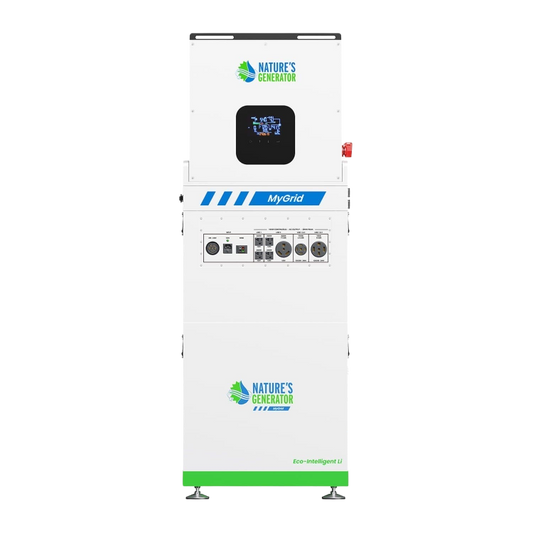
For example, our Nature’s Generator Powerhouse is specifically engineered to address this. It provides 120V/240V split-phase power natively. This allows you to back up heavy-duty items that traditional portable units simply cannot touch.
Common 240V appliances homeowners want to back up:
-
Well Pumps: Essential for rural properties; usually requires a high starting surge and 240V.
-
Electric Dryers: High wattage and 240V requirement.
-
Central Air Conditioning: Requires significant "push" (starting amps) and split-phase power.
-
Electric Water Heaters: Constant, high-draw 240V loads.
Based on our testing, trying to run these via a "converter" or a small 120V unit is not only inefficient but can damage your appliance motors. You need a dedicated 240V output to ensure the sine waves are properly aligned to power these motors safely.
What are the limitations of 120V portable power stations in a high-demand household?
If you choose a system that only supports 120V, you aren't necessarily "limited" in terms of survival, but you are limited in terms of lifestyle continuity. A 120V system can keep your refrigerator running, keep the lights on, and power your Wi-Fi router. However, in a "two-phase" (split-phase) home, the 120V unit only services half of your breaker panel if it's connected via a transfer switch.
This creates a scenario where the outlets on the left side of your kitchen might work, while the outlets on the right side are dead. Our team has found that this "half-house" backup can be frustrating during extended outages.
Furthermore, 120V systems cannot support the "High-Intent" appliances that define modern comfort. If your goal is a seamless transition during a blackout, a 120V unit acts as a temporary bandage, whereas a split-phase compatible system acts as a complete cure. For those looking for a robust middle ground, the Lithium 3600W offers incredible 120V performance, but for 240V needs, we always recommend stepping up to the Powerhouse series.
How do we design a whole-home power generator to handle heavy-duty electrical loads?
Designing a system for a split-phase home requires looking at "Peak Demand" versus "Continuous Load." When we help customers configure their systems, we use a three-step process:
-
Identify the Must-Run 240V Loads: Does the well pump have to run? If yes, the system must be split-phase capable.
-
Calculate Surge Current: Motors (like those in AC units) require 3x to 5x their running watts just to start. Your backup system must have a "Peak" rating high enough to handle this "In-rush" current.
-
Battery Sizing: 240V appliances pull power quickly. We recommend a minimum of 5kWh to 10kWh of storage for homes planning to run heavy appliances, ensuring you don't drain your entire reserve in thirty minutes.
We believe in a modular approach. Start with a core inverter that supports 240V, and then add Power Pods (extra batteries) as your budget and needs grow. This ensures that you aren't limited by your initial investment if you decide to add more solar panels or backup more circuits later.
Real-world feedback: How homeowners are navigating backup power for 240V circuits
This certain homeowner lived in a home with a 240V well pump. He initially bought a competitor’s 120V "large" portable station. During a summer storm, his lights stayed on, but his family had no running water because the 120V unit couldn't power the pump.
The customer switched to a split-phase Nature’s Generator system. He noted, "The difference was night and day. Being able to actually take a shower and flush toilets during a three-day outage changed our perspective on what 'backup' really means."
This real-world usage scenario highlights that the "limitation" isn't the power coming from the grid—it's the capability of the box sitting in your garage. If your lifestyle depends on 240V power, your backup must mirror that capability. Our team has seen many homeowners regret buying multiple small 120V units rather than one cohesive 240V system.
What should you look for when choosing a backup system for non-standard power configurations?
If you are concerned about your electrical setup, here are the non-negotiables you should look for in a backup solution:
-
Pure Sine Wave Inverter: Essential for sensitive electronics and modern 240V appliances.
-
Split-Phase Capability: The ability to output two 120V lines that can be combined for 240V.
-
Expandability: The ability to add more solar or battery capacity without replacing the main unit.
-
Transfer Switch Compatibility: The system should easily plug into a manual or automatic transfer switch installed at your main breaker panel.
Avoid systems that use "simulated" or "modified" sine waves, as these can cause 240V motors to hum, overheat, and eventually fail. Based on our experience, investing in a high-quality split-phase system upfront saves thousands in potential appliance repairs and system upgrades down the road.
Is it possible to expand a 120V system to support 240V loads later?
One of the most common questions our team receives is whether a homeowner can "link" two smaller generators to create 240V power. While some brands allow for "parallel" connection, this often only increases the wattage (total power) at 120V, not the voltage itself.
To get 240V from two units, they must be "phase-aligned." This requires a specific communication cable and an inverter designed for this "bridging" behavior. If you think you might need 240V in the future, it is significantly more cost-effective to buy a 240V-ready system from day one.
At Nature's Generator, we designed our flagship systems to be ready for these challenges out of the box. You shouldn't have to be an electrician to figure out how to get water from your well during a blackout.
Making the Right Choice for Your Home
In summary, having what you might call two-phase power—but is almost certainly 240V split-phase power—does not limit your backup options if you choose the right equipment. The limitation only exists if you attempt to use a standard 120V portable station to do a job that requires higher voltage and synchronized phases.
By selecting a Nature’s Generator Powerhouse system, you are ensuring that your home remains fully functional, regardless of how many 240V appliances you need to run. We have seen that the key to true energy autonomy is matching your backup system to the reality of your home’s wiring.
Whether you are looking for a solar power generator for occasional outages or a whole home power generator for total independence, understanding your phases is the first step toward a reliable backup power strategy. Don't let a misunderstanding of your electrical panel prevent you from securing your family’s comfort and safety.


