


When unexpected grid failures happen, securing reliable backup power becomes a primary concern for every homeowner. Many begin their energy independence journey with a simple portable backup power unit, but soon realize that running extension cords during an emergency is only a temporary fix. Transitioning to a dedicated solar power generator provides cleaner energy, but achieving true self-reliance requires a comprehensive whole home power generator setup. In this comprehensive blueprint, our team answers how you can scale your system from a single portable unit to a fully integrated whole-home generator ecosystem.
We will explore how the Nature’s Generator MyGrid 10K serves as the ultimate cornerstone for this transition, outlining exactly how to design a scalable energy fortress that grows alongside your family's electrical demands. Based on our extensive experience helping families navigate energy vulnerabilities, we know that upgrading your backup strategy requires clear information, realistic load assessments, and a clear vision of your final power goals. This guide provides the exact framework needed to transition away from utility grid dependency confidently. By building your system in structured phases, you can protect your household budget while continuously elevating your emergency preparedness.
Why should you transition from a standalone portable unit to a modular whole-home ecosystem?
What are the operational limitations of keeping power strictly portable?
Standalone portable power stations are excellent for tailgating, camping, or keeping a smartphone and laptop alive during a brief afternoon outage. However, when faced with an extended multi-day power outage caused by severe weather or grid strain, their practical limitations quickly become apparent. In our experience, relying entirely on a standalone portable unit means managing an inconvenient and potentially hazardous web of extension cords snaking through windows and hallways just to keep your refrigerator or freezer cold.
Furthermore, standard portable units typically output only 120V power, meaning they lack the electrical capacity to run high-load, heavy-duty 240V appliances. During severe winter storms or intense summer heatwaves, losing the ability to power these critical systems can compromise your home's safety, structural integrity, and basic comfort. Portable units also have a fixed battery capacity; once the internal battery runs dry, you are left without options unless you have a small, slow method of recharging it.
How does modular scalability save homeowners thousands of dollars upfront?
Purchasing a traditional, fossil-fuel-powered standby generator requires an immediate, massive capital investment. Between the unit itself, professional fuel line installations, concrete pouring, local permitting, and heavy-duty electrical work, upfront costs can easily skyrocket past ten thousand dollars. For many families, this massive initial expense delays their emergency preparedness plans indefinitely.
A modular ecosystem completely changes this dynamic. By starting with a core system component and scaling outward over time, you can distribute your investment across multiple phases. Our technical team frequently highlights this modular strategy as the most financially sensible path to total grid independence. You only buy the storage and generation capacity you need today, with the comforting knowledge that you can easily plug in additional battery pods, solar panels, or wind turbines later without rendering your initial equipment obsolete. This protects your hard-earned capital while ensuring your home is never left completely vulnerable.
How does the Nature's Generator MyGrid 10K transform your residential energy strategy?
What makes the MyGrid 10K uniquely suited for whole-house integration?
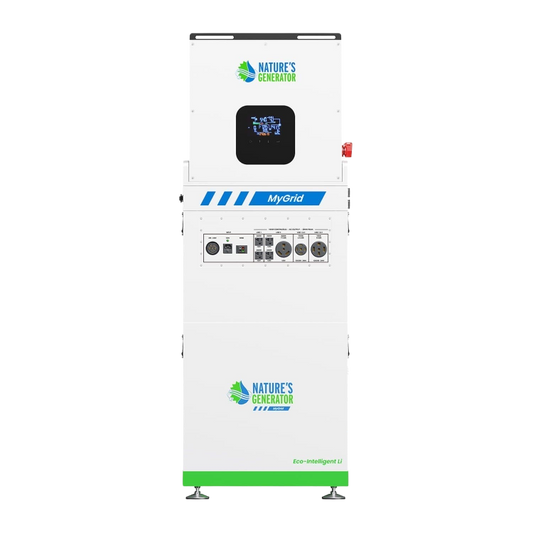
To bridge the gap between temporary emergency backup and a permanent whole-house power solution, an energy system must possess both immense power output and intelligent energy management. The Nature’s Generator MyGrid 10K is engineered specifically to fill this vital role in your home ecosystem. Boasting a massive 10,000-watt pure sine wave inverter, this unit delivers the clean, stable power necessary to run sensitive modern electronics alongside high-demand household appliances without the risk of damaging harmonic distortion.
Unlike basic portable systems, the MyGrid 10K natively supports split-phase 120V/240V output right out of the box. This crucial capability allows it to link directly into your home’s existing electrical panel via a manual or automatic transfer switch. By integrating directly at the breaker level, it eliminates extension cords entirely, restoring immediate power directly to your standard wall outlets, ceiling lights, and hardwired appliances.
Can you expand the system as your power requirements evolve?
The true genius of this platform lies in its unrestricted capacity for growth. The MyGrid 10K does not limit you to a fixed amount of storage or generation. Based on our technical evaluations of residential energy setups, its plug-and-play architecture allows users to expand their battery banks seamlessly by chaining additional power pods together.
Whether you want to prepare for a single afternoon blackout or build a system capable of sustaining your home entirely off the grid for weeks, the infrastructure adapts to your specific timeline. You can find compatible add-ons, heavy-duty cables, and system expansions on the Nature's Generator Accessories Page to systematically build out your system's capabilities. This eliminates the frustration of outgrowing your equipment, as every component you purchase continues to serve as a building block for your expanding energy fortress.
What real-world emergency scenarios justify upgrading to a whole-home generator ecosystem?
How does a modular system perform during extended multi-day grid blackouts?
Consider a real-world scenario involving an extreme weather event—such as an intense winter blizzard or a severe summer hurricane. When the municipal grid goes down for four or five consecutive days, a standalone portable battery will quickly deplete its charge within the first 24 hours if tasked with keeping food preserved and rooms climate-controlled. Once depleted, you are left in the dark unless you have a clean, safe way to replenish that energy.
A whole-home solar ecosystem resolves this issue entirely by combining heavy-duty storage with continuous, renewable generation. While the MyGrid 10K supplies uninterrupted current to your essential home circuits indoors, an array of solar panels outside works constantly to recharge the system during daylight hours. This creates a self-sustaining loop that keeps your lights on, your water running, and your communication lines open indefinitely without requiring dangerous trips to crowded gas stations during a regional crisis.
What do real homeowners say about shifting from fuel-reliant systems to solar backup?
Customer feedback frequently underscores the profound peace of mind that comes with breaking free from gasoline and propane generators. Many users note that traditional combustion generators are incredibly loud, emit toxic carbon monoxide fumes that demand careful outdoor placement, and require strict maintenance schedules including oil changes and fuel stabilization.
Based on our observations of customer experiences, homeowners who switched to a solar-powered ecosystem expressed immense relief at the completely silent operation. One customer living in a wildfire-prone region shared that during a utility power shutoff, their system automatically maintained power to their home water well pump and security systems silently. This allowed them to stay informed and safe without alerting the entire neighborhood with a roaring engine or worrying about fuel degradation during long storage periods.
How do you calculate your home’s electrical load to choose the right system size?
Which critical appliances require split-phase 240V power?
Before making a final decision on your backup system hardware, you must determine exactly what you intend to power. Many homeowners mistakenly assume that all household appliances operate on the same electrical standard. Standard items like lamps, televisions, microwaves, and laptop chargers run on standard 120V circuits.
However, major appliances that generate significant heat or drive large mechanical motors require 240V split-phase power. If your home relies on a deep well pump for fresh water, an electric clothes dryer, a central heat pump, or a dedicated EV charger, a standard portable station simply cannot activate them. The MyGrid 10K handles these heavy loads effortlessly, ensuring your basic survival needs—like running water and climate control—are never compromised during a prolonged power emergency.
How do starting watts differ from running watts when sizing a system?
When our team assists homeowners with load calculations, we always emphasize the critical distinction between running (continuous) watts and starting (surge) watts. Running watts represent the electrical power an appliance consumes continuously while operating normally. Starting watts refer to the brief, intense burst of power required to get an appliance's electric motor spinning from a dead stop.
A refrigerator might only need 700 running watts to keep your food cold, but it could demand up to 2,200 starting watts the moment the compressor kicks on. If your power station cannot handle that initial surge, the system will trigger an overload protection fault and shut down completely. To clarify these power requirements, review the typical electrical demands outlined in the reference table below:
|
Appliance |
Estimated Running Watts |
Estimated Starting (Surge) Watts |
Voltage Requirement |
|
Refrigerator / Freezer |
700 - 800 W |
2,200 W |
120V |
|
Deep Well Pump (1/2 HP) |
1,000 W |
2,500 W |
240V |
|
Sump Pump (1/3 HP) |
800 W |
1,300 W |
120V |
|
Central AC (3-Ton System) |
3,500 W |
5,000 W |
240V |
|
LED Lighting (Entire House) |
150 - 300 W |
150 - 300 W |
120V |
|
Microwave Oven |
1,200 W |
1,200 W |
120V |
By accounting for these surge requirements, you can easily see why a robust 10,000-watt inverter is essential for managing a fully functional household comfortably during an outage without constantly worrying about overloading your power source.
What is the step-by-step blueprint for scaling your power ecosystem from scratch?
Phase 1: Establishing your emergency power baseline
Your journey toward building an energy fortress begins by identifying your absolute non-negotiable power needs. For most families, Phase 1 focuses on food preservation, basic lighting, medical devices, and home communication networks. At this stage, integrating a core unit like the MyGrid 10K with your home's critical circuits provides an immediate, highly reliable safety net.
Even before adding extensive solar arrays, you can keep the core unit fully charged via standard grid power. This ensures that the very millisecond a blackout occurs, your most vital home systems remain energized. You can explore complete introductory packages on the Nature's Generator Solar Generators Collection to find the ideal starting point for your baseline needs.
Phase 2: Integrating solar panels and expanding battery storage
Once your baseline is secured and you have eliminated the immediate threat of a sudden blackout, the next phase focuses on extending your operational runtime indefinitely. This is achieved by adding localized solar generation and expanded energy storage capacity. By mounting solar panels on your roof or utilizing ground-deployed solar arrays, you turn your backup system into a true generator that produces its own clean electricity.
During this phase, you can also connect supplementary battery pods to the central MyGrid 10K system. This ensures that the excess energy collected during bright, sunny midday hours is safely stored for use during the night or during heavily overcast days, minimizing your reliance on utility companies and maximizing your energy resilience.
Phase 3: Moving to full sub-panel integration for hands-free transition
The final stage of the energy fortress blueprint transitions your setup from an emergency backup system into a seamless, integrated smart home microgrid. By installing a dedicated manual transfer switch or an intelligent sub-panel, you permanently tie your whole-home ecosystem into your residence's main electrical infrastructure.
When the utility grid fails, you no longer need to manually interact with your equipment or worry about power disruptions. The sub-panel routes the stored solar power directly to your pre-selected circuits automatically or with the flip of a single switch. This level of professional integration provides the ultimate protection, keeping your home fully functional, secure, and independent through any long-term utility failure.
Conclusion
Building a resilient energy backup system does not require an overwhelming, all-at-once financial burden. By implementing a strategic, modular approach, you can systematically scale your capabilities from localized emergency support up to a fully realized whole-home microgrid. The journey requires a clear understanding of your household's unique electrical loads, distinguishing between basic 120V devices and heavy-duty 240V appliances, and planning for critical starting surges. Investing in a scalable foundation ensures your household is prepared to face everything from brief local blackouts to prolonged multi-day grid failures caused by extreme weather conditions.
Choosing a dependable partner like Nature’s Generator provides the structural flexibility needed to expand your system efficiently over time without wasting your initial investments. If you are ready to transition away from noisy, high-maintenance gas equipment and embrace a clean, silent, and infinitely expandable power solution, the Nature’s Generator ecosystem offers the precise technology to secure your home. Take control of your energy future today by selecting a platform designed to grow along with your needs.


