


For modern suburban homeowners, achieving true energy independence does not require selling your property and moving out to the middle of the woods. You can easily change your neighborhood home to run partially off-grid by using a smart power system alongside your normal utility lines. This smart hybrid setup gives your household a completely reliable backup power system during emergencies while lowering your monthly bills. By setting up a clean solar power generator or a heavy-duty whole home power generator, you protect your family from blackouts and take total control over your electricity use. Using a modular portable backup power system lets you phase out your grid dependence easily without breaking city building codes or giving up your daily comforts.
In this straightforward walkthrough, the experts at Nature's Generator break down how to design a secure, fully compliant, semi-off-grid power system tailored for suburban homes. We will show you how to separate your most important appliances, use manual transfer switches, pick the right equipment size, and look at real-world examples so you can choose the absolute best option for your household.
Why Should You Consider Going Partially Off-Grid Instead of Completely Disconnecting?
What are the hidden legal and financial costs of full off-grid disconnection in suburban zones?
Trying to completely cut ties with your local utility company in a normal suburb can cause major legal headaches and cost a fortune. From what we’ve seen out in the field, going entirely off-grid in a suburb is legally tough. Most local codes and HOAs require full-time homes to stay hooked up to public power, city water, and sewer lines. If you decide to remove your power meter completely, local authorities can declare your house unsafe to live in. This can destroy your home value and bring expensive city fines.
From a purely financial standpoint, building a solar setup that is 100% independent for a standard neighborhood home requires you to buy way more equipment than you actually need. To keep your lights on through several days of bad winter storms or dark, cloudy weeks, you would have to buy a massive battery bank and a giant solar panel array. Buying all that extra equipment can make your upfront costs three to four times higher than a smart hybrid system. By choosing to take your home partially off-grid, you do not have to over-buy gear. The regular power grid stays attached as your safety net, allowing you to size your equipment around your normal daily use instead of a worst-case weather disaster.
How does a hybrid system protect you against grid instability and peak-load pricing?
Public power grids across the country are facing a lot of strain because of old equipment, extreme weather, and higher demand from growing neighborhoods. A hybrid power setup works like a protective shield between your home and these outside grid failures. When the local power company suffers from unexpected brownouts or broken equipment, a well-configured hybrid system instantly takes over your electrical needs so your lights do not even flicker.
On top of that, many power companies are switching to Time-of-Use (TOU) pricing rules. Under these schedules, the price of electricity spikes during the late afternoon and early evening hours. This is exactly when families get home from work and school, turning on appliances and using the most power. A partial off-grid plan lets you avoid these high prices through a trick called peak shaving. Our team discovered a great workaround: if you set your solar batteries to juice your main appliances during peak-demand hours, you can completely dodge those sky-high utility rates. During the night when power rates drop, you can switch back to grid power or use leftover battery energy to save money every single day.
Which Home Appliances Should You Shift to Your Solar Generator First?
How do you identify and isolate critical loads for partial off-grid operations?
The secret to a successful partial off-grid setup is dividing your home's electrical needs into two lists: essential (critical) loads and non-essential loads. Essential loads are the appliances you absolutely need to stay safe, keep your food from spoiling, maintain basic communication, and keep your home comfortable during a long power outage. Secondary or "non-essential" electrical loads refer to energy-heavy luxuries—such as jacuzzis, laundry dryers, and guest-room climate control—that can safely remain tied to the standard utility grid rather than a backup system.
To separate your essential loads, our team recommends making a list of your important appliances and tracking how much electricity they draw. To find an appliance's specific continuous and surge power requirements, check the manufacturer's specification label located on the rear or underside of the unit. Once you isolate these specific circuits, an electrician can route them to a separate subpanel or connect them directly to your alternative power equipment so your essential systems stay powered up around the clock.
Managing high-surge versus continuous draw appliances: A practical breakdown
A common mistake people make when switching to solar power is forgetting the huge difference between running watts and starting watts. Any appliance that uses an electric motor—like a refrigerator, a sump pump, or an air conditioner—needs a big burst of energy to get the motor spinning from a dead stop. This initial starting surge can require three to five times more power than what the appliance uses while running normally.
Let's look at a practical breakdown of normal household items:
-
Suburban Kitchen Refrigerator: Uses about 150 to 200 watts of continuous power to keep your food cold, but needs 800 to 1,200 watts just to start up its compressor motor.
-
Sump Pump or Deep Well Pump (0.5 HP): Uses around 800 running watts but demands a massive 2,100 to 2,500 watt surge just to turn on.
-
Home Internet Electronics & Medical Devices: Wi-Fi routers, modems, laptops, and CPAP machines use a steady, smooth stream of power, usually drawing between 40 and 120 watts without any starting surge at all.
When you are picking out your power equipment, you must make sure its inverter can handle these quick starting surges. If your system has enough running power but lacks surge capacity, your refrigerator and sump pump turning on at the exact same moment could trigger an internal safety fault and shut down the whole system right when you need it most.
How Do You Design a Suburban Hybrid Energy Infrastructure Without Rewiring Your Whole House?
Using a manual transfer switch versus a split-load panel configuration
Adding a solar backup system to an existing suburban home does not mean you have to tear open your walls or pay to replace your entire home electrical system. Homeowners usually choose between two safe, code-approved ways to connect alternative power straight into their home's wiring.
The first and most reliable option is installing a multi-circuit manual transfer switch right next to your main breaker box. A manual transfer switch acts like a mechanical traffic controller. It lets you pick individual essential circuits—like your kitchen outlets, home office, or living room lights—and flip a switch to change their power source between Line (the utility grid) and Gen (your alternative power system). This configuration completely stops dangerous backfeeding, which protects utility line workers while fully complying with the National Electrical Code (NEC).
The second option is a dedicated split-load subpanel. With this setup, an electrician moves your essential circuits completely out of the main breaker box and places them into a secondary, smaller panel. This subpanel runs off your alternative energy system full-time, using the regular utility grid strictly as a backup power source if your solar batteries run completely empty. This delivers a highly automated experience but requires a bit more upfront electrical work than a standard transfer switch setup.
Integrating portable backup power units directly into your home ecosystem
For individuals who want maximum flexibility, or those navigating strict rental agreements and HOA rules about visible outdoor equipment, a plug-and-play portable architecture is an ideal solution. Modern heavy-duty portable power units give you plenty of power without requiring permanent changes to the outside of your house.
By using heavy-duty, outdoor-rated extension cords or a code-compliant power inlet box, you can feed alternative energy from a portable system straight into your manual transfer switch. This means your power equipment can sit safely inside a utility room, garage, or enclosed patio while drawing clean power from low-profile, portable solar panels placed in your yard or on a balcony. If you choose to move or rearrange your property layout in the future, the entire system can be unplugged, packed up, and moved without leaving a trace or requiring costly structural fixes.
Pro-Tip for Suburban Off-Grid Success Always consult a licensed residential electrician before connecting any alternative power station to your home's permanent wiring. A professional installation of a manual transfer switch ensures your system satisfies all local building codes and maintains your homeowner's insurance validity.
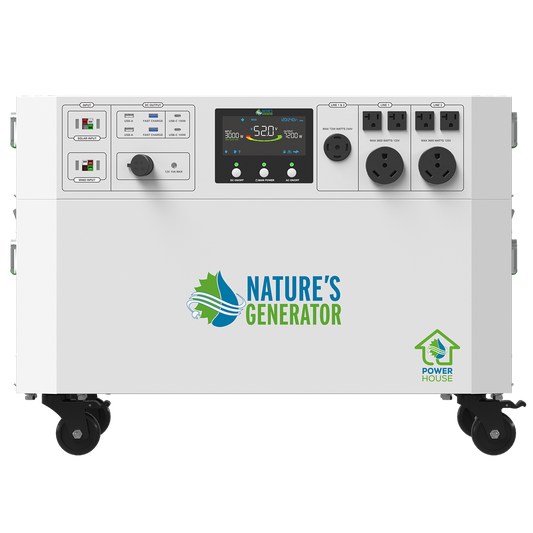
Nature’s Generator Elite vs. Nature’s Generator Powerhouse: Which System Fits Your Partial Off-Grid Goals?
Sizing your battery capacity and solar input for sustained daily use
Selecting the ideal hardware framework requires balancing your daily energy use against the amount of space you have for solar charging panels. To choose the right tier of equipment, you must determine whether your goal is to offset minor daily peak rates or to run a substantial portion of your household entirely independent of public utilities. You can explore the complete lineup of engineered solutions directly by visiting the Nature's Generator Official Store to review modular system options.
If your partial off-grid goals are focused on securing critical communication lines, home office hardware, refrigeration, and selective indoor lighting, a compact, high-output platform is highly effective. However, if your suburban household demands 240-volt split-phase power to handle heavy-duty systems like whole-house water pumps, complex security networks, or centralized climate blowers, you will need a heavy-duty power station capable of managing massive continuous loads and high-capacity battery expansion arrays.
Powering a suburban home office and baseline appliances during peak hours
To guide your selection process, let us examine a standard real-world deployment scenario. A remote professional working from a suburban residence experiences brief, unpredictable power drops that disrupt client communications and cause data loss. Additionally, their regional utility charges double for electricity consumed between 4:00 PM and 9:00 PM. This user decides to isolate their home office, internet router, kitchen refrigerator, and living room lighting circuit.
The baseline continuous consumption of these combined items sits at approximately 450 watts. Over a 5-hour peak utility window, this equates to 2,250 watt-hours (2.25 kWh) of energy consumption. By choosing a system that matches this capacity, the homeowner can run these circuits entirely off stored solar energy during peak hours, charging the batteries via clean solar input the following morning. This simple adjustment lowers their monthly utility bill while providing permanent protection against unexpected grid failures.
|
Technical Specifications |
Nature's Generator Elite System |
Nature's Generator Powerhouse System |
|
Continuous Power Output |
1,200 Watts Pure Sine Wave |
7,200 Watts Continuous Output |
|
Peak Starting Surge |
3,600 Watts Maximum Surge |
Highly Advanced Split-Phase Capability |
|
Voltage Options |
Standard 120V AC Outlets |
True 120V & 240V Split-Phase Output |
|
System Expansion |
Compatible with Elite Power Pods |
Highly Expandable Battery & Solar Arrays |
|
Best Suburban Use |
Critical loads, home offices, refrigerators |
Whole-house partial integration, heavy loads |
For comprehensive technical specifications and customized package configurations tailored to your specific circuit layout, you can view the advanced product capabilities by checking the Elite or explore the flagship whole-home systems which is the Powerhouse Gen 2.
What Real Suburban Homeowners Say About Transitioning to a Hybrid Power System?
Case study: Overcoming strict HOA rules with a low-profile solar power generator
Based on our experience, one of the most significant challenges for suburban homeowners is navigating strict homeowner association (HOA) visual guidelines. Traditional rooftop solar installations often require lengthy approval processes, structural engineering sign-offs, and can face rejection if the panels are visible from the main street. A real-world example involves a customer living in a highly restrictive community who wanted to take their home partially off-grid but faced immediate pushback regarding roof-mounted equipment.
The solution was deploying a low-profile, modular solar framework. Instead of mounting panels permanently to the roof, the homeowner used ground-mounted portable panels positioned in their fenced backyard, completely out of sight from the street. These panels were connected via a clean exterior inlet line directly to their indoor power equipment. This modular approach bypassed the HOA architectural review process entirely, enabling the homeowner to secure energy independence without violating community rules or compromising their home's curb appeal.
Customer feedback on long-term utility savings and system reliability
Aggregated customer feedback shows that homeowners who transition their critical circuits to a hybrid alternative power setup experience immediate, tangible benefits. Users consistently note that isolating high-use, low-draw circuits—such as home entertainment centers, refrigeration, and modern LED lighting networks—results in an immediate 15% to 30% reduction in their monthly public utility bills. This saving is driven by avoiding peak Time-of-Use rates and utilizing clean, free solar energy for daily operational baselines.
More importantly, customer reviews frequently highlight the immense peace of mind this setup provides. Homeowners share stories of major storms knocking out power to their entire neighborhood, leaving their streets dark for hours or days, while their own critical appliances, security systems, and internet connections remained fully functional. This real-world reliability demonstrates that a hybrid off-grid strategy is not just about saving money—it is about building a secure, resilient sanctuary for your family.
Conclusion
Transitioning your suburban property to a partial off-grid configuration is a smart, scalable, and highly effective way to secure energy independence without sacrificing grid reliability. By systematically isolating your critical household loads, deploying a code-compliant manual transfer switch, and selecting a system tailored to your daily consumption goals, you can effectively shield your family from rising utility rates and unpredictable grid failures.
Break free from total utility reliance today, courtesy of Nature's Generator. Our customizable, ultra-reliable, and simple-to-use power systems are built perfectly for the modern hybrid home.


