


Storms are inevitable. Blackouts don't have to be. Power your lights, protect your food, and keep your family safe. Many people think their electric car can handle the job using Vehicle-to-Home (V2H) technology. But relying on an electric vehicle (EV) alone often fails during multi-day emergencies. A dedicated solar power generator gives you true energy independence when you need it most. Having a whole home power generator keeps your essential appliances running smoothly without draining your car. Plus, setup flexibility from portable backup power means you can stay powered up anywhere.
Why V2H (Vehicle-to-Home) EV backup fails in long-term outages is an important question to ask before a major storm hits. At Nature’s Generator, our team tests emergency power systems in real-world blackout conditions. We have found that using your electric car as a house battery creates serious risks during multi-day outages—including running out of car charge, difficult off-grid recharging, high equipment costs, and losing your family transportation.
In this guide, we break down why V2H technology falls short during extended blackouts and why a dedicated system like the Nature’s Generator MyGrid 10K offers a safer, more reliable fix.
What Is V2H EV Backup and Why Does It Seem Like a Great Idea?
Vehicle-to-Home (V2H) power uses special charging hardware to take energy from your electric vehicle's big battery and send it into your house.
At first glance, this sounds like a smart plan. An electric vehicle battery is large—often 5 to 8 times larger than a standard wall battery you buy for your garage. Car companies market V2H as a two-in-one deal: drive your car every day, and plug it into your house if the power goes out.
However, based on our team's hands-on testing, turning your car into a house battery creates major problems the moment an outage lasts longer than a single day.
Why Does Vehicle-to-Home Backup Fail During Multi-Day Outages?
V2H can handle brief power flickers. But when bad storms, winter freezes, or heatwaves knock out power lines for three to seven days, the system breaks down for three main reasons.
1. Losing Transportation During Peak Emergencies
The biggest flaw of V2H is simple: your power source is also your car. When you plug your electric vehicle into your house to run your fridge, lights, and heat, you are constantly draining the battery you need for driving.
Imagine a severe storm or evacuation warning. Roads may open up, or your family might need to get medical help, buy clean water, or pick up emergency supplies. If your EV battery has dropped to 15% because it was powering your refrigerator for two days, you are stranded. You have to choose between keeping your home's heat on or keeping enough battery range to escape an emergency.
Customer Feedback: "During a 4-day winter power outage, my neighbor used his EV to power his home. By day two, his car battery hit 20%. He needed to drive to get extra supplies, but he couldn't leave because there were no working public chargers nearby."
2. Recharging an EV Off-Grid Is Almost Impossible
When blackouts last several days, every battery runs out and needs to be recharged. This is where V2H systems run into a huge obstacle: you cannot easily recharge an EV when the power grid is off.
-
Standard Roof Solar Shuts Off: Most standard roof solar panels automatically shut down during a power outage to protect line workers fixing the grid. Residential solar setups cannot juice up an electric car during a grid failure unless you fork over thousands more for specialized hardware.
-
Car Batteries Are Too Huge: Charging an EV battery takes a massive amount of solar energy. A typical home solar setup operating in cloudy weather simply cannot produce enough daily power to refill a car battery while powering your house at the same time.
-
Public Charging Stations Are Out: If power lines are down in your city, public fast-charging stations down the street will not work either.
3. High Upfront Costs and Battery Wear and Tear
Setting up V2H is far more complicated and expensive than most people realize:
-
Expensive Upgrades: Enabling V2H requires special bi-directional wall chargers, heavy-duty transfer switches, and professional electrical work. This equipment often costs between $4,000 and $10,000 extra.
-
Compatibility Locks: V2H chargers only work with specific car models. If you buy a different brand of car in a few years, your expensive home wall charger might not work anymore.
-
Faster Battery Wear: Repeatedly draining your car’s main battery to run heavy home appliances can shorten the lifespan of a car battery pack that costs $10,000 or more to replace.
How Does a Standalone Solar Generator Fix These Problems?
A standalone solar generator keeps your home backup power completely separate from your family car. It creates a dedicated, self-renewing power system for your house that runs whether your car is parked in the driveway or miles away down the road.
Unlike V2H, a dedicated home solar generator plugs directly into solar panels (and wind turbines). Throughout the day, the panels supply domestic electricity and concurrently top off the generator's internal energy cells. At night, the stored energy keeps your lights and appliances running.
Because it recharges every single day from sun and wind, a standalone generator can provide power indefinitely—no matter how many days the power grid stays dark.
Why Is the Nature’s Generator MyGrid 10K the Best Choice for Backup Power?
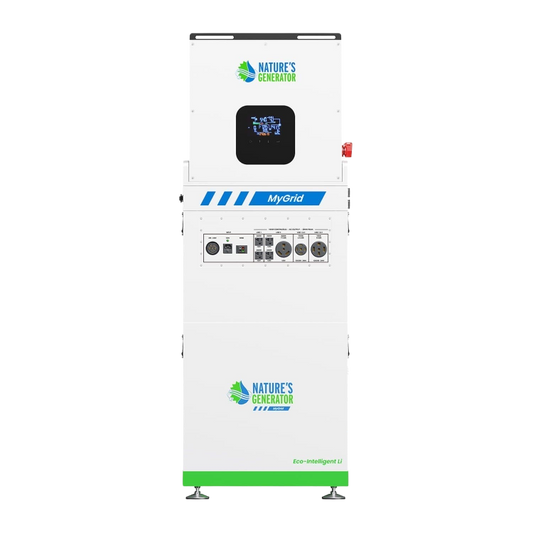
To solve the limits of V2H, our engineering team created the Nature’s Generator MyGrid 10K. It is built from the ground up to keep your entire home safe and operational during extended blackouts.
Big Power to Run Heavy Home Appliances (120V & 240V)
Small power banks cannot run major home equipment. The MyGrid 10K puts out 10,000 Watts of continuous power (with a 20,000 Watt surge capacity). It easily powers both standard 120V wall outlets and heavy-duty 240V appliances like well pumps, central air conditioning, and water heaters.
It uses a safe, long-lasting 10,496Wh Lithium Iron Phosphate (LiFePO4) battery bank designed to last over 6,000 charge cycles, providing reliable power for decades.
Charges with Sun and Wind Power
Weather during major storms is unpredictable. Dense overcast skies and downpours can cause a severe drop in total solar energy production.
We solved this problem by giving the MyGrid 10K multiple ways to recharge:
-
12,000W Solar Charging Capability: Dual MPPT inputs handle large solar panel arrays so you can collect maximum power even on overcast days.
-
Built-In Wind Turbine Input: A built-in 350W wind port lets you plug in a wind turbine. During stormy weather when the sun is blocked, wind speeds usually rise—allowing you to generate clean power day and night.
-
Fast Wall Charging: If power briefly comes back on, or if you use a gas generator, you can charge the battery up to 80% in just 2 hours.
Easy to Expand and Simple to Move
Permanent wall batteries cost thousands in permits and stay attached to your home forever. The MyGrid 10K gives you maximum flexibility:
-
Expandable Storage: You can add up to 7 extra battery units to build up to 73.4 kWh of total energy storage. You can also connect two MyGrid 10K units together to double your output to 20,000W continuous power.
-
Easy Installation & Relocation: It connects quickly to your home electrical panel using a 50A or 125A transfer switch. Should you list your house for sale or relocate to a new apartment, the unit easily disconnects so you can bring it along.
How Do V2H Systems Compare to Standalone Solar Generators?
Here is how a V2H electric car setup compares directly to the Nature's Generator MyGrid 10K in a multi-day power emergency:
|
Feature |
Vehicle-to-Home (V2H) EV Setup |
Nature’s Generator MyGrid 10K |
|
Main Power Source |
Your Electric Car Battery |
Dedicated 10.5kWh Battery (Expandable to 73.4kWh) |
|
Car Availability |
Risky (Drains battery needed for driving) |
100% Free (Car stays charged and ready to drive) |
|
Off-Grid Recharging |
Very Difficult |
Easy (Uses 12,000W Solar + Wind charging) |
|
Power Output |
2.4kW to 9.6kW |
10,000W Continuous / 20,000W Surge (120V & 240V) |
|
Wind Charging Support |
No |
Yes (Built-in 350W wind port) |
|
Installation Complexity |
High ($4,000–$10,000+, utility permits) |
Simple plug-and-play setup |
|
Portability |
Permanent fixture in one garage |
Relocatable (Move it whenever you switch homes) |
Example: A 5-Day Winter Storm
During a severe 5-day winter storm, local power lines snap under ice and snow.
-
With a V2H Setup: A family plugs their electric car into their house to run heat and lights. By day three, the car battery is down to 18%. Heavy storm clouds cripple home solar performance, leaving nearby public plug-in stations completely powerless. When an evacuation notice is issued for their neighborhood, the family car does not have enough charge to drive to safety.
-
With the MyGrid 10K Setup: A family uses their Nature’s Generator solar generator collection setup. The MyGrid 10K runs their home heat and water pump continuously. The wind turbine and solar panels keep the generator topped off. Meanwhile, their electric car stays parked with a 100% full battery, ready to drive at a moment's notice.
Can You Use an EV and a Standalone Solar Generator Together?
You do not have to choose between having an electric vehicle and owning a solar generator—they actually work great together!
Because the Nature's Generator MyGrid 10K provides standard 120V and 240V heavy-duty outlets, you can use extra power gathered by your solar panels to charge your electric car off-grid during the day.
Rather than siphoning energy from your vehicle to keep household lights on, the Nature’s Generator setup operates as a self-contained personal charging hub. It keeps your car charged while making sure your house stays warm and fully powered.
Frequently Asked Questions
How long can a 10,000W solar generator run my home during a blackout?
On battery power alone, the MyGrid 10K can keep essential home appliances (fridge, lights, Wi-Fi, television, and heating fans) running for 24 to 36 hours. When you plug in solar panels and a wind turbine, it creates new power every day, keeping your home running indefinitely during multi-week blackouts.
Is V2H worth the money if I already own an electric car?
V2H can work for short blackouts that last a few hours. However, high equipment installation costs, increased wear on your car battery, and the risk of stranding your vehicle make a standalone solar generator a safer and more reliable choice for major outages.
Can the MyGrid 10K run 240V appliances like well pumps and central air conditioners?
Yes. The MyGrid 10K produces 10,000 Watts of continuous 120V/240V split-phase power, with a 20,000 Watt peak surge. It easily starts and powers heavy motors in well pumps, central AC units, and heavy power tools.
Making the Right Decision for Emergency Power
While Vehicle-to-Home power is an interesting feature, relying on your car as your only power source during a major blackout creates real risks. Draining your primary mode of transportation when roads are dangerous and charging stations are offline can leave your family stranded.
A standalone home backup system keeps your transportation separate from your power supply. By choosing a dedicated system like the Nature’s Generator MyGrid 10K, you get reliable 10kW power output, flexible solar and wind charging, and complete off-grid protection. Explore how Nature’s Generator can help protect your home with clean, independent backup power tailored to your family's needs.


