


If your Duke Energy bill climbs in the evening, your solar panels might not be doing enough to help. They generate electricity during the day, but your household may use the most power after 4 PM, when peak rates kick in.
Battery storage can bridge that gap. Instead of sending all your excess solar energy to the grid, you can store it and use it later. That means buying less electricity during expensive hours without changing your entire routine.
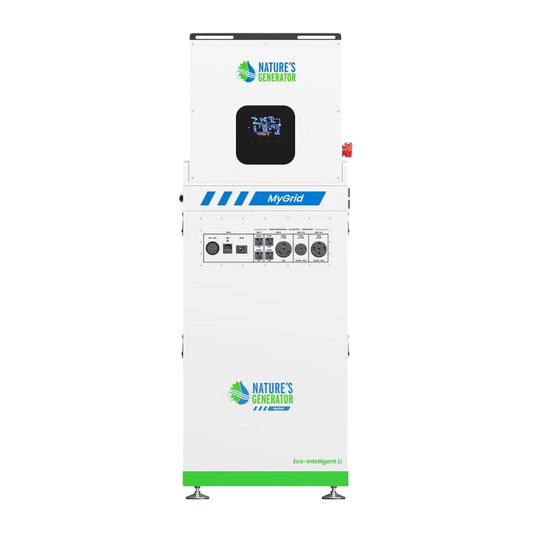
For homeowners looking for reliable backup power, a solar power generator, a whole home power generator, or portable backup power, Nature’s Generator offers home energy solutions worth considering, including the MyGrid 10K Gen 2.
This guide explains how AC-coupled solar storage works, how to estimate potential savings, and what to check before choosing a system for your home.
Why do Duke Energy’s 4 PM to 9 PM rates matter?
Time-of-use (TOU) pricing means electricity costs vary throughout the day. Under a plan with a 4 PM to 9 PM peak window, electricity consumed during those hours costs more than power used during designated off-peak periods.
Not every Duke Energy customer has the same rate schedule. Check your current tariff, service territory, and eligibility before assuming these hours apply to your account.
The timing can be inconvenient. You get home, turn on the air conditioning, prepare dinner, and start running appliances. Those everyday activities can push electricity consumption into the most expensive part of the day.
Suppose your household uses 8 kWh between 4 PM and 9 PM. At an illustrative peak rate of $0.30 per kWh, that costs $2.40. Supplying some of that electricity from a battery charged at a lower effective cost could reduce the amount you pay the utility.
The opportunity is simple: generate or buy electricity when it costs less, store it, and use it when rates rise.
How does AC-coupled solar storage reduce peak charges?
AC-coupled storage allows a battery to work alongside a solar installation. It can be especially useful if you already have rooftop solar and want to add storage without necessarily replacing your existing solar inverter.
Here is how the process works:
-
During the day: Solar panels power your home. If your setup supports it, any extra electricity can be used to recharge the battery.
-
Before 4 PM: The battery stores energy for later use. Some systems can also pull power from the grid when electricity rates are lower.
-
Between 4 PM and 9 PM: The battery supplies compatible household loads, reducing the electricity you need to purchase at peak rates.
AC coupling relies on compatible inverters, battery controls, and power-conversion equipment. Before buying, have an installer check that the proposed system works with your existing solar setup.
Also, adding a battery does not automatically mean your solar panels will operate during a blackout. Backup operation requires the right equipment and electrical configuration.
How much battery capacity do you need?
Start with your actual evening consumption, not the largest battery you can afford.
Review your electricity bills or smart-meter data to determine how many kilowatt-hours your home uses during the peak window. Pay particular attention to air conditioning, cooking appliances, refrigerators, lighting, and computers.
Let’s say your home uses 6 kWh of electricity between 4 PM and 9 PM. A battery with 10 kWh of usable capacity could handle that usage in theory, as long as it has enough charge to start with and can deliver the power your home needs.
But capacity is only part of the equation. You also need enough output to run your appliances together.
When comparing systems, check:
-
Usable capacity: How much stored energy can you draw?
-
Continuous output: How much power can the system deliver at once?
-
Surge capacity: Can it handle brief startup demands?
-
Backup reserve: How much energy will remain during an outage?
-
Expansion options: Can you add storage later?
These details help determine whether a system can handle your evening routine without leaving you short on energy.
Is the MyGrid 10K Gen 2 suitable for peak-rate management?
The MyGrid 10K Gen 2 is worth evaluating if you want substantial output and battery storage for home energy management and backup power.
Its published specifications include a 10,496Wh (10.496 kWh) LiFePO4 battery, 10,000W of continuous output, AC coupling support, and expandable storage. Check the product page for current specifications and supported configurations before purchasing.
|
Feature |
Why it matters |
|
10.496 kWh battery |
Stores energy for evening use or supported backup loads. |
|
10,000W continuous output |
Supports substantial loads within the system's operating limits. |
|
AC coupling support |
It may also work with your current solar setup, depending on whether the equipment is compatible. |
|
Expandable storage |
Provides room to increase capacity with compatible equipment. |
|
Multiple charging options |
Offers flexibility when replenishing stored energy. |
Remember that power and capacity measure different things. The 10,000W rating describes continuous power output; the 10.496 kWh rating describes stored energy.
For example, a 2,000W load would theoretically use 10 kWh in five hours. A fully charged 10.496 kWh battery could supply that load for roughly five hours under ideal conditions. Real runtime will be shorter because of conversion losses, reserve settings, and other loads.
Whether the MyGrid 10K Gen 2 can cover your entire peak window depends on your household's consumption and system configuration. Confirm what the package includes, whether extra batteries are needed, and what installation work your home requires.
How does MyGrid 10K Gen 2 compare with a conventional home battery?
If you already have rooftop solar, a conventional battery may be the simpler option, especially if it works with your existing equipment.
The MyGrid 10K Gen 2 is a good option to consider if you’re looking for reliable power output, compatibility with AC-coupled systems, and the flexibility to expand your battery storage down the line.
|
Consideration |
Conventional solar battery |
MyGrid 10K Gen 2 |
|
Solar compatibility |
Depends on the battery and inverter |
Requires a compatibility check |
|
Peak-rate savings |
Depends on capacity and settings |
Depends on capacity and household demand |
|
Continuous output |
Varies by model |
Rated at 10,000W |
|
Storage expansion |
Varies by system |
Supported with compatible equipment |
Neither option automatically delivers better savings. Installation costs, usable capacity, charging efficiency, warranty terms, and compatibility all affect the decision.
Ask an installer to quote both options where practical. Compare the full installed cost, what each system can power, and how much peak-period grid electricity it could replace.
You can also read Nature’s Generator's guide to solar generators and solar panels to understand the equipment involved.
How much could you save on peak electricity rates?
Let's use a straightforward example.
Assume your household uses 6 kWh during peak hours, the peak rate is $0.30/kWh, the off-peak rate is $0.10/kWh, and battery round-trip efficiency is 90%. These are illustrative rates, not actual Duke Energy tariffs.
Without storage, your peak-period electricity costs:
6 kWh × $0.30 = $1.80 per evening.
To deliver 6 kWh from a battery with 90% efficiency, you need approximately 6.67 kWh of charging energy. If you charge from the grid at $0.10/kWh, that costs about $0.67.
Your estimated saving is approximately $1.13 per evening, or around $34 over 30 days if usage and rates remain consistent.
That is not guaranteed savings. The calculation excludes installation, equipment costs, battery degradation, fixed utility charges, taxes, and other billing details.
Solar charging changes the numbers. If your panels generate surplus electricity that receives little compensation when exported, storing it for evening use may be more economical than buying electricity from the grid.
However, if your utility offers favorable solar export credits, using that energy yourself means giving up those credits. Compare the value of exporting electricity with the value of storing it.
The key is the difference between your charging cost and the peak rate, not the peak rate alone.
Should you charge the battery with solar or off-peak grid electricity?
Both can make sense, depending on your tariff and solar production.
If your panels generate more electricity than your household needs during the day, use that surplus to charge the battery when it is financially advantageous. You can then draw on the stored energy after sunset.
When solar production is low, off-peak grid charging may help. But the price difference must be large enough to cover battery losses.
A practical strategy is to:
-
Use daytime solar to power your home.
-
Store surplus solar energy for evening use.
-
Consider off-peak grid charging if your tariff allows it and the numbers work.
-
Keep enough energy in reserve for backup needs.
Check whether your system supports scheduled charging and discharging. Greater control makes it easier to align battery operation with your electricity rates.
For more guidance, see Nature’s Generator's guide to sizing a solar system.
What should you check before buying a home battery?
Before committing to a system, answer five questions.
1. Does your tariff use these peak hours? Confirm your current rate schedule, prices, and seasonal rules.
2. How much electricity do you use during peak hours? Use hourly consumption data rather than guessing. This helps you choose an appropriate battery size.
3. Can the system power your essential appliances together? Check continuous output, startup demands, and usable capacity.
4. Will it work with your existing solar equipment? Have a qualified installer make sure the inverter will work with your setup, the wiring and transfer equipment are suitable, and all local permit requirements are covered.
5. Do the savings justify the cost? Include installation, extra batteries, warranty coverage, and expected maintenance in your calculations.
Can one battery lower your bill and provide outage protection?
Yes, if the system is configured for both jobs.
Peak-rate management uses stored energy to reduce expensive grid consumption. Backup power uses stored energy when utility electricity fails. The same battery can support both, but you may need to balance daily savings against emergency readiness.
If you discharge the battery heavily every evening, less energy may remain for an unexpected outage. A reserve setting can help, if supported by your system.
Backup operation also depends on proper electrical integration. The system must safely isolate your home from the grid and supply the circuits you want to keep running. Solar panels may require additional compatible equipment to continue generating during an outage.
Decide which matters more: maximizing daily savings or keeping more energy available for essential appliances during emergencies. Your settings should reflect that priority.
Is AC-coupled solar storage worth it for Duke Energy customers?
If your electricity plan charges more during evening peak hours, battery storage can help you use energy when it costs less. Your savings will depend on your tariff, evening consumption, charging costs, and battery efficiency.
Start by checking your hourly electricity use. Then compare battery capacity, output, installation costs, and compatibility with your existing solar equipment.
Nature’s Generator's MyGrid 10K Gen 2 is worth considering if you want substantial storage, high continuous output, AC coupling support, and expansion options alongside home backup capabilities.
Get a compatibility assessment and a realistic installation quote before deciding. The best system for your home isn’t always the largest one. It is the one that fits your household, works with your electricity plan, and delivers enough savings and backup power to justify the cost.


