


A winter blackout can turn a house into an icebox in hours, transforming reliable backup power from a smart investment into a vital survival tool. Many people buy a standard solar power generator to prepare for outages, but short winter days and heavy snow can quickly stop solar panels from working. If you need a whole home power generator to keep your heat running or a portable backup power unit for essential devices, you need equipment designed for extreme weather.
In this guide, our team breaks down why the Nature’s Generator Powerhouse is the best choice for winter power outages. We will answer why relying on solar alone isn't enough, how combining wind and solar power solves the winter energy problem, and how this hybrid system keeps your critical home appliances running when temperatures drop.
Why do standard solar-only setups fail during winter storms?
Relying on solar panels alone during a multi-day winter storm leaves your home vulnerable to power loss. Based on our testing and real-world experience, standard solar setups struggle in winter for three main reasons:
-
Shorter Daylight Hours: In the winter, days are much shorter. A solar panel setup that gets eight full hours of sunlight in July might only get two or three hours of weak sunlight in December.
-
Lower Sun Angle: The sun sits lower on the horizon during winter months. This means light hits your solar panels at an angle, producing far less electricity than it does during the summer.
-
Snow and Ice Cover: Even a thin layer of snow blocks sunlight from reaching your solar panels. If you have roof-mounted panels, cleaning off heavy snow during an active freezing storm is unsafe and often impossible.
When snow covers your panels and storm clouds block the sky, a solar-only system quickly drains its battery reserves. Once that battery dies, you are left without heat or lights until the weather clears.
How does combining wind and solar power keep your lights on all winter?
To solve the winter power problem, you need more than one way to make electricity. This is where a hybrid energy setup—combining wind and solar power—changes the game.
Wind and solar work like dynamic partners during extreme weather. When a winter storm rolls in, dark clouds block the sun and snow covers your panels. However, those same storm systems usually bring strong, continuous winds. Instead of sitting with an empty battery, a hybrid system uses a wind turbine to generate power continuously day and night.
A Quick Example:
Imagine a three-day winter blizzard.
-
Days 1 and 2: Heavy snow and dark skies completely block your solar panels. High winds spin your turbine, keeping your batteries full.
-
Day 3: The storm passes. The wind dies down, but the sun comes out bright over the white snow. Your solar panels take over, collecting strong sunlight.
This combination ensures your home receives continuous power no matter what the weather is doing. To prepare your home for winter emergencies, exploring specialized home backup power solutions with dual-input capabilities is the safest choice.
What makes the Nature’s Generator Powerhouse different from other systems?
Most portable power stations on the market are built strictly for solar panels. If you try to plug a wind turbine into a standard solar generator, you can burn out the internal electronics because wind creates sudden voltage spikes during strong gusts.
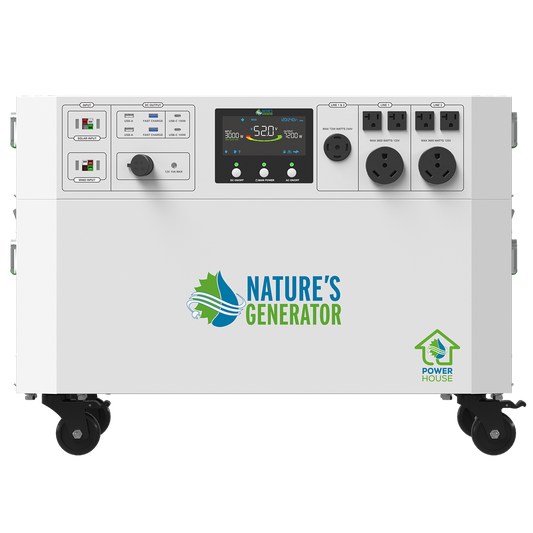
Our team recommends the Powerhouse Gen 2 because it is engineered with built-in hybrid charge controllers. It has dedicated ports built specifically to handle both solar panels and wind turbines safely at the same time. You do not need complex wiring, extra adapters, or electrical expertise—it is a simple, plug-and-play solution.
Pure Power for Heavy Appliances (120V vs. 240V)
Standard portable power stations only output 120-volt power. While 120V can charge phones, power lamps, or run a small fridge, it cannot power heavy-duty winter appliances.
The Powerhouse provides built-in 120V and 240V split-phase power. This means it can connect directly to your home's breaker panel using a transfer switch. It powers heavy 240V appliances like:
-
Central home heating systems
-
Electric water heaters
-
Deep well water pumps
Which essential home appliances can the Powerhouse run in a blackout?
During a freeze, keeping key appliances running is vital to protect your health and prevent costly property damage (like frozen, burst pipes). Here is a clear look at what this system can run:
|
Home Appliance |
Why It Matters in Winter |
Powerhouse Capability |
|
Furnace / Heating |
Keeps your living spaces warm and pipes thawed. |
Powers furnace blowers and heating controls effortlessly. |
|
Deep Well Pumps |
Provides running water for drinking, cooking, and toilets. |
Handles the high 240V electrical surge needed to start the pump. |
|
Refrigerator & Freezer |
Prevents hundreds of dollars in food from spoiling. |
Runs small and large kitchen units continuously. |
|
Medical Devices & Wi-Fi |
Powers CPAP machines, oxygen concentrators, and routers. |
Delivers clean, safe power that will not damage delicate electronics. |
Why is a hybrid system better than a gas generator in sub-zero weather?
Gas generators have been the traditional choice for backup power, but they come with serious risks and drawbacks during winter storms:
-
Gas Engines Freeze: Gas generators are hard to start in freezing cold. Engine oil thickens into sludge, carburetors freeze, and pulling a hard starter cord in sub-zero temperatures is difficult. The Powerhouse starts instantly with the push of a button.
-
Fuel Runs Out: During major storms, gas stations lose power or run out of fuel, and icy roads make driving dangerous. A gas generator stops working the moment you run out of fuel. A hybrid setup uses wind and sun to generate its own endless power.
-
Deadly Fumes: Gas generators emit poisonous carbon monoxide gas and must stay far outdoors in the snow and rain. The Powerhouse produces zero fumes and operates completely silently, allowing you to safely store and use it indoors.
How do real families use the Powerhouse during severe winter storms?
In our experience, seeing how a system performs in real-life situations is the best way to judge its value.
For example, homeowners living in ice-storm regions commonly experience fallen power lines that take days or weeks to repair. In these scenarios, families use connected wind turbines to harness continuous storm winds while their solar panels are iced over. This allows them to run their central heat, keep their water flowing, and stay warm without worrying about running out of gas.
Additionally, families love the modular expandability of the system. You can add extra battery pods over time to increase your energy storage, giving you extra peace of mind for multi-week power outages.
Conclusion
Preparing your home for winter power outages requires a system you can rely on when the weather is at its worst. Standard solar generators fail when covered in snow, and traditional gas generators are noisy, hard to start, and dangerous to run.
By combining the natural power of winter winds with clear-day sunlight, you can keep your power bank charged throughout any storm. The Nature’s Generator Powerhouse is the most practical, powerful solution for dual wind-and-solar energy inputs. It delivers the heavy 240V power your home needs to keep the heat on, the water running, and your family safe all winter long.


