


Outsmart severe weather and sudden outages with reliable backup power that keeps your life running without straining your budget.
While the Tesla Powerwall is frequently advertised as the premier residential battery, the reality behind its upfront price tag leaves many buyers experiencing severe sticker shock. Complex electrical panel overhauls, high utility approval fees, mandatory installer markups, and rigid hardwired installation constraints usually double the true cost of getting a system online. Fortunately, transitioning to a versatile solar power generator or an expandable whole home power generator built on a modular hybrid architecture offers energy freedom at a fraction of the cost. Whether you need an adaptable unit for emergency preparedness or flexible portable backup power for unpredictable outages, modular hybrid configurations eliminate hidden installation expenses. At Nature's Generator, our engineering team has analyzed thousands of home battery installations to reveal how modular hybrid technology delivers identical grid security while keeping thousands of dollars in your pocket.
In this comprehensive guide, we will explore why fixed wall-mounted batteries carry such inflated labor costs, how plug-and-play modular systems eliminate electrical overhead, and why flexibility is the ultimate advantage in modern emergency power design. Based on our field experience and real customer deployments, you will gain actionable insights into selecting a scalable backup energy solution tailored specifically to your home, budget, and power requirements.
Why Are Tesla Powerwall Installation Costs So High Compared to Initial Quotes?
When reviewing advertised pricing for fixed home batteries like the Tesla Powerwall 3, consumers usually focus on the hardware sticker price—typically quoted around $9,300 for the battery unit itself. However, once certified installers conduct a site assessment, final quotes frequently exceed $18,000 to $25,000 for a single-battery installation. Based on our experience in home energy architecture, this massive delta is caused by mandatory structural and electrical infrastructure modifications required by fixed high-voltage AC-coupled systems.
Hardwired Electrical Modifications and Main Panel Upgrades
Installing a Tesla Powerwall requires integrating a high-voltage battery directly into your home's main electrical service panel. For standard homes with 100-amp or 200-amp electrical panels, this process almost always triggers a full main panel upgrade (MPU). Electricians must install a dedicated Gateway transfer panel, re-route heavy-gauge conduit, and separate emergency circuits into a subpanel to prevent backfeeding the grid during an outage. These physical electrical upgrades alone routinely add $3,500 to $6,500 in labor and materials before a single kilowatt-hour of power is stored.
Soft Costs: Certified Installer Premiums and Permitting Hurdles
Unlike plug-and-play systems, fixed wall batteries cannot legally or safely be self-installed. Homeowners are locked into hiring proprietary certified installer networks. These certified contractors carry steep overhead costs and apply high labor markups. Additionally, integrating stationary energy storage directly into the local power grid demands intricate construction permits, structural wall safety audits, and lengthy utility permission-to-operate (PTO) approvals. In many jurisdictions, waiting for utility approval takes three to six months, adding administrative expenses and extended delay to your backup power setup.
Key Takeaway on Fixed Battery Costs: The sticker price of a Tesla Powerwall represents only 40% to 50% of the true installed project cost. Labor, panel upgrades, permitting, and certified installer markup make up the remaining 50% to 60%.
How Does a Modular Hybrid System Save Thousands on Installation?
A modular hybrid power system operates on an entirely different engineering philosophy. Rather than forcing your home's existing electrical infrastructure to adapt to a high-voltage wall unit, a modular system adapts seamlessly to your existing household wiring. By utilizing DC-coupled architecture, integrated smart power management, and standardized transfer switches, modular hybrid systems eliminate the most expensive labor line items associated with home energy storage.
Plug-and-Play Transfer Switches vs. Complete Rewiring
Instead of rebuilding your primary electrical distribution panel, a modular hybrid system connects directly through a manual or automated transfer switch, such as a standard 6-circuit or 12-circuit power inlet panel. A licensed electrician can complete a full transfer switch installation in under two hours—a process costing around $400 to $800, compared to $5,000+ for a Powerwall Gateway installation. Once the transfer switch is mounted, the modular unit simply plugs in using heavy-duty quick-connect cables. There is no need for invasive wall mounting, wall reinforcement, or wall tearing.
Zero Mandatory Utility Interconnection Red Tape
Because modular hybrid systems can operate as off-grid or hybrid-islanded backup systems, they do not require utility grid tie-in approval (PTO) to provide immediate emergency backup. You own the power generation and storage directly on your side of the meter. This complete operational independence eliminates municipal permit delays, utility application fees, and mandatory grid-interconnection standby charges.
Tesla Powerwall vs. Modular Hybrid Solar Generators: Real-World Performance Comparison
When comparing backup power solutions, performance extends beyond raw capacity numbers. Homeowners must evaluate continuous output power, surge capability, expandability, and long-term battery chemistry longevity. Based on our field testing and real-world deployment data, modular hybrid systems match or exceed fixed wall batteries in essential performance areas while maintaining unprecedented user flexibility.
Continuous Power Output vs. Peak Surge Handling
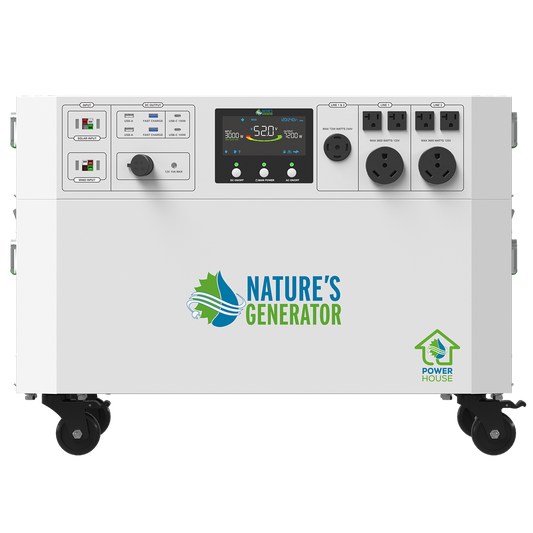
A major limitation of fixed single-battery installations is their continuous output ceiling. If a central air conditioner, well pump, or electric dryer draws high starting surge wattage (often 6,000W to 10,000W), a single fixed battery may overload and trip. High-capacity modular hybrid setups, such as the Nature's Generator Powerhouse Gen 2, deliver 120V/240V split-phase continuous output up to 7,200W, with peak surge capacity reaching 14,400W. This massive surge headroom allows you to start heavy-duty 240V appliances without requiring expensive soft-start kits or secondary battery units.
Expandability and Battery Chemistry Longevity
The Tesla Powerwall features a fixed enclosed capacity (13.5 kWh). If your household energy needs increase over time, adding a second Tesla battery requires another massive capital outlay for hardware and additional mounting labor. In contrast, modular hybrid architectures let you scale capacity organically. By adding stackable battery pods, you can expand storage incrementally from 4.8 kWh up to over 28 kWh as your budget allows. Furthermore, premium modular generators utilize non-toxic, highly stable Lithium Iron Phosphate (LiFePO4) or heavy-duty sealed lead-acid chemistries rated for thousands of charge cycles, ensuring reliable operation for decades.
Can a Modular System Truly Power an Entire House During an Extended Blackout?
A common misconception propagated by traditional battery installers is that portable or modular generators are only suitable for charging phones and running desktop lamps. Advanced high-capacity modular power units are built to run entire households through prolonged power outages.
Managing Essential Whole-Home Loads
In a real-world blackout scenario, household circuits can be divided into essential survival loads and discretionary loads. Through a connected transfer switch, a modular system effortlessly energizes critical 120V and 240V circuits, including:
-
HVAC & Heating: Central air conditioning units (240V), ductless mini-splits, or furnace blowers.
-
Food Preservation: Full-sized kitchen refrigerators, chest freezers, and ice makers.
-
Water Systems: 240V deep well pumps, sump pumps, and water filtration units.
-
Lighting & Electronics: Whole-house LED lighting, Wi-Fi routers, security systems, and medical devices.
Real-World Load Profile: An average home during a power outage draws between 1,200W and 2,500W of continuous load. A modular setup with 14.4 kWh of storage capacity can easily sustain basic household operations for 12 to 24 hours without any solar input—and indefinitely when paired with continuous solar harvesting.
Multi-Day Autonomy with Dual Wind and Solar Harvesting
While wall-mounted batteries rely strictly on roof-mounted solar arrays, modular hybrid systems offer multi-input harvesting capabilities. You can connect high-wattage rigid or ground-mounted solar panels alongside specialized wind turbines. During stormy weather when solar generation drops, wind harvesting continues generating power overnight, providing true round-the-clock energy security that single-source wall batteries cannot replicate. To explore complete, ready-to-deploy off-grid kits, review the Nature's Generator systems designed for severe weather autonomy.
What Is the Process for Expanding and Tailoring a Modular Energy Setup as Needs Grow?
One of the biggest financial drawbacks of fixed wall batteries is the requirement to pay 100% of the project costs upfront. If your budget only allows for 5 kWh of storage today, fixed battery manufacturers offer no viable entry point. Modular hybrid systems solve this issue through phased deployment.
The Phased Investment Strategy: Start Small and Expand
With a modular design, homeowners can customize their system based on present needs and future financial flexibility. The expansion pathway operates seamlessly:
-
Phase 1 (Core Unit): Purchase a base solar generator to handle emergency portable power, essential refrigeration, and device charging. For entry-level emergency preparedness, units like the Elite provide robust starting capacity.
-
Phase 2 (Transfer Switch Integration): Install a manual transfer switch at your breaker box to enable direct subpanel power during grid outages.
-
Phase 3 (Capacity Expansion): Add plug-and-play battery expansion pods to increase total runtime without requiring additional electrical labor.
-
Phase 4 (Renewable Array Expansion): Expand your solar input array using heavy-duty solar panels or wind turbines to achieve complete grid independence.
What Is the Real-World ROI and Payback Period of Modular Hybrid Systems?
Calculating the true Return on Investment (ROI) for energy storage requires comparing the total purchase and installation cost against utility bill savings and outage loss prevention. High upfront installation fees destroy the ROI of fixed wall batteries, often extending the payback period beyond the battery's warranty life.
Payback Period Comparison: Fixed Wall vs. Modular Hybrid
Because a Tesla Powerwall setup costs $20,000+ installed, offsetting that investment through time-of-use (TOU) load shifting or solar self-consumption takes approximately 14 to 18 years. Because numerous high-voltage inverters come with a 10-year warranty, you might face expensive maintenance expenses before realizing a full return on investment.
Conversely, a high-capacity modular hybrid system costs roughly $4,500 to $6,500 fully installed with a transfer switch and solar array. By utilizing time-of-use peak shaving—charging the battery during off-peak hours and powering your home during peak utility rates—a modular system can yield $800 to $1,400 in annual utility bill reductions. This slashes the real-world financial payback period to just 4 to 6 years, delivering positive financial returns for the remainder of the equipment's operational lifespan.
Making the Right Choice for Long-Term Energy Independence
Achieving energy security for your home should not require tens of thousands of dollars in contractor fees, invasive electrical panel overhauls, or months of utility red tape. While fixed batteries like the Tesla Powerwall offer sleek marketing, their rigid architecture creates exorbitant installation costs that offer little extra functional value to the average homeowner. Choosing a modular hybrid solar generator gives you full control over your home's power infrastructure, allowing you to start with what you need today and expand seamlessly as your energy demands grow.


