


https://drive.google.com/file/d/1QAlybSu2T3-hlB6_Om-EqC5dCUhHj4VB/view?usp=drive_link]
When the power goes out, your solar panels need to do more than sit in the sun. They need to put enough power back into your battery to actually help when you need it most. That's where choosing the right panel setup matters.
If you're getting ready for a power outage, Nature’s Generator has two options to consider: rigid 440W bifacial solar panels and a folding 400W panel. One is built for a more permanent installation; the other is made to move. Both can help keep your backup system charged, but the better choice depends on how you plan to use them at home. If you're shopping for reliable backup power, comparing a solar power generator or a whole home power generator, or putting together a source of portable backup power, here's what to keep in mind before buying a solar panel system.
Which solar panel setup makes more sense for your home?
First, think about how you'll actually use the panels. If they'll stay outside in a designated spot, rigid panels deserve a closer look. If you'd rather set them up when you need them and pack them away afterward, the folding panel is probably the better fit.
The two Nature’s Generator products also differ in their rated output. The rigid package includes two 440W panels, while the folding model provides 400W per panel.
|
What matters |
Rigid 440W bifacial panels |
Folding 400W solar panel |
|
Combined rated output |
880W for the two-panel package |
400W for one panel |
|
Construction |
Framed panels with rigid glass surfaces |
Foldable monocrystalline panel |
|
Weight |
54 lbs per panel |
17 lbs |
|
Placement |
Roof or ground mounting with suitable hardware |
Freestanding placement using included stands |
|
Rear-side electricity generation |
Possible with reflected sunlight |
Not a bifacial design |
|
Moving and storage |
Awkward to relocate frequently |
Designed to fold and travel |
|
A good fit for |
Permanent residential or off-grid arrays |
Flexible home backup, RVs, and temporary setups |
The rigid 440W bifacial panel package is the higher-capacity choice when compared with a single 400W folding panel. That doesn't automatically make it the better purchase. Having more panels doesn't automatically mean better results. You’ll still need a good spot to set them up, and your power station needs to handle the electricity they produce.
So, how much faster can you recharge your battery with 880W of solar power?
Quite a bit on paper. Two 440W panels have a combined rated capacity of 880W, which is 2.2 times the rating of one 400W panel.
Let's put that into a daily charging example.
Imagine your panels receive five equivalent peak-sun hours. Under that simplified assumption, the calculations look like this:
-
880W rigid array: 880 watts × 5 hours = 4.4kWh.
-
400W folding panel: 400 watts × 5 hours = 2kWh.
These are theoretical energy estimates, not predictions of what your system will deliver every day. Real output falls as conditions change. Clouds, shade, panel temperature, conversion losses, and the power station's charging limit all affect the amount of energy that reaches your battery.
Still, the comparison gives you a useful starting point.
Say you're running the fridge, a few lights, your Wi-Fi, and your phone chargers through the night. By morning, your battery has already lost a good chunk of its charge. That's where daytime sunlight comes in handy. When the sun’s out, that’s your best chance to put some charge back into your battery. An 880W array has more rated capacity available to do that job than one 400W panel, provided there's enough sunlight and the system can handle the input.
If you have a smaller power station or don't use much electricity, one smaller panel might be all you need. If you're preparing for repeated outages, though, it's worth calculating how much energy your household uses over 24 hours instead of buying panels based on wattage alone.
Also, remember that the rigid package's 880W rating comes from two panels working as an array. One 440W panel just can’t match the combined output of two panels working together.
What does bifacial technology add to the rigid panels?
Its bifacial design lets the back of the panel capture sunlight, too, helping generate additional electricity when conditions are right. That can be useful, but the conditions underneath the panels matter.
Nature’s Generator uses N-type TOPCon solar cells in its rigid panels. They're also built with a bifacial design, which means they can collect sunlight from both the front and the back. The front surface collects incoming sunlight as you'd expect. The rear can collect light reflected off the ground or other nearby surfaces.
Think about where you'd put them. A raised panel above a bright, reflective surface may receive more useful light on its backside than one installed close to dark soil. The spacing underneath the panels, their angle, surrounding objects, and the amount of shade all affect the result.
That's why we wouldn't promise a specific percentage of extra power from every bifacial setup. The added energy depends on the site.
For homeowners planning a ground-mounted array, the ability to capture reflected light is worth considering when deciding where the panels will go. If your installation leaves very little room for light to reach the rear, that feature may contribute less than you expect.
The folding 400W model takes a simpler approach. It uses monocrystalline cells and focuses on being easy to move and position. It isn't designed around the same rear-side collection advantage.
So the choice isn't simply bifacial versus non-bifacial. It's whether the rigid panel's design makes sense for the place where you'll actually use it.
Will you be better off with panels you can carry outside?
A folding panel can be the easier choice when your solar setup doesn't have a permanent home.
Nature’s Generator lists the 400W folding panel at 17 pounds, with folded dimensions of approximately 38.3 × 24 × 3.4 inches. The package includes metal stands, a carrying case, and a user guide. Once unfolded, the panel measures roughly 97 × 38.3 inches.
That makes it easier to store between uses or transport to another location. You could set it up in a clear part of the yard during a blackout, then put it away when you need the space back. The same panel may also suit an RV trip or a temporary off-grid arrangement, assuming the connected equipment supports it.
There is still some work involved. You'll need to find a sunny spot, set the panel on a stable surface, position it appropriately, and keep the cables out of walkways. Strong wind and changing weather also deserve attention.
Rigid panels have a different trade-off. Each one weighs 54 pounds and measures approximately 67.8 × 44.6 inches. They're designed for mounting rather than frequent relocation, and the required mounting hardware is sold separately.
That sounds less convenient, but consider what happens after installation. A properly mounted array can stay in place, ready to collect sunlight, without being unpacked and set up whenever you want to charge a battery.
If your solar equipment will remain in one location, a rigid setup may be less of a hassle over time. If you need to move it, the folding design has a clear advantage.
Which panel type suits different outage plans?
The answer depends on what you're trying to keep running and how often you'll use the system.
You're preparing for outages that could last several days
A larger rigid array may be worth the extra installation work. Its combined 880W rating gives you more potential solar input than one folding panel, which can help when you're trying to replace energy used overnight.
But solar production and household demand have to be considered together. A refrigerator and a few lights require a different amount of energy from an entire home running air conditioning, cooking appliances, and other high-draw equipment.
Work out which appliances matter during an outage. Then estimate their daily consumption. Those numbers will help you judge whether the rigid array's capacity is useful for your needs or whether you need a different combination of panels and battery storage.
You want one setup for the house and your travels
The folding panel is more appealing if the equipment will serve multiple purposes. You may use it to recharge a power station at home, then take the same equipment to a campsite, RV, or remote work area.
It also avoids committing to a single installation location. That's helpful when roof mounting isn't practical or the yard has only certain spots that receive good sunlight at different times of day.
The compromise is its 400W rating per panel. If you need more charging capacity, look into adding panels only after confirming that your power station supports the intended arrangement.
You're building a larger residential backup system
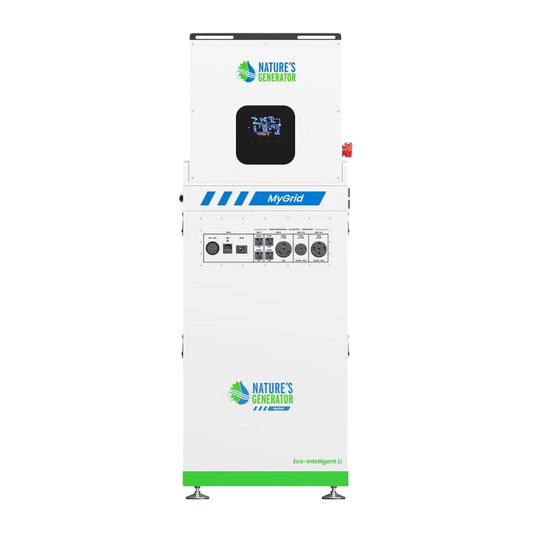
For a system such as the MyGrid 10K Gen 2, panel selection needs to account for the system's electrical requirements, not just the size of your available space.
A whole-home backup system may use a different solar configuration from a small portable power station. Decide on the power system first, review its solar input limits, and then determine which panel arrangement meets those requirements.
That order can save you from buying equipment that doesn't work together as planned.
Can you connect either panel to your existing power station?
Possibly, but check the exact model before ordering. The fact that two products use MC4-compatible connectors doesn't mean every combination will work safely.
Nature’s Generator publishes compatibility information for both panel options. Its current listings specify a minimum of four panels connected in series for the MyGrid 10K. For the Powerhouse 7200 and several other listed systems, the rigid panel chart specifies two panels in series. The folding panel chart includes similar requirements for some models, while other compatible units have different support arrangements.
This matters because the rigid package contains two panels, and the folding product is sold as one 400W panel. You shouldn't assume either package meets the requirements of every system by itself.
Before connecting an array, check these details:
-
Voltage: The complete panel arrangement must remain within the power station's supported input range.
-
Current and wattage: The array must stay within the unit's permitted solar input limits.
-
Number of panels: Confirm the required minimum and how the panels must be connected.
-
Cabling: Check the included cables, connector requirements, and any extension or branch cables you'll need.
-
Future expansion: Make sure adding panels later won't push the system beyond its limits.
Follow the instructions for your exact model. If you're unsure about the wiring arrangement, have Nature’s Generator support or a qualified installer verify it before connecting the equipment.
What should you work out before buying your solar panels?
Before choosing a panel, spend a little time figuring out what your backup system actually needs.
First, list the loads you want to run. A household that needs a refrigerator, lights, and internet access during an outage has different energy requirements from one that also expects to run air conditioning or an electric water heater.
Next, look at the sunlight around your home. Trees, nearby buildings, fences, and rooflines can cast shadows across an array. Good placement can matter as much as the rated capacity you're paying for.
Then decide whether the panels will stay in one place. Permanent mounting takes planning and may add installation costs. Folding panels avoid that commitment, but you'll need to handle setup and storage yourself.
Check the full system cost. Don't compare the advertised panel prices until you've accounted for mounting hardware, cables, and any required accessories.
Finally, confirm that the panel arrangement works with your power station. Get the electrical requirements right before making the purchase. A larger array is only useful when the equipment can accept its output.
Which should you buy: rigid 440W bifacial panels or folding 400W panels?
The rigid package is the one to consider when you want an 880W rated array and have a suitable location for a lasting installation. Its bifacial design gives you another way to collect solar energy, provided reflected light can reach the back of the panels.
The folding 400W panel is a better match for people who need their solar equipment to travel or store away between uses. It's lighter, folds down into a manageable package, and comes with stands for freestanding setup.
Neither panel type guarantees that your battery will recharge fully every day. The result depends on the weather, sunlight, power station, and your household's energy use. That's why the best decision starts with your actual backup plan, not the largest number on a product page.
Get the panel setup right before the next outage
Rigid and folding solar panels solve different problems. The rigid 440W bifacial package offers greater combined capacity and the possibility of collecting reflected sunlight. The folding 400W panel gives you more freedom to move and store your equipment.
For a planned residential array, Nature’s Generator's rigid panels may be the better fit. For a backup system that needs to move between locations, the folding panel deserves a look.
Before you buy, check your daily energy needs, the available sunlight, and your power station's input requirements. Get those pieces right, and you'll be in a much better position to recharge your battery when the grid isn't available.


