


When modern grid infrastructure fails, securing a reliable backup power solution becomes a matter of safety and operational continuity. Many homeowners turn to a standalone solar power generator or a dedicated whole home power generator to keep their lights on. However, relying on a single resource can leave you vulnerable during extended storms or winter weeks. At Nature’s Generator, our team has pioneered ways to combine technologies into a versatile portable backup power system. This blog will answer exactly how to engineer a hybrid configuration, comparing solar panels vs. wind turbines to achieve maximum uptime and complete energetic self-sufficiency.
Evaluating solar panels vs. wind turbines is no longer an either-or proposition; based on our experience, the ultimate resilient framework integrates both. When you build a hybrid renewable energy system, you effectively eliminate the environmental blind spots inherent to each individual technology. If your primary goal is securing uninterrupted electricity for your family, understanding how these systems interact within a cohesive ecosystem is paramount. Throughout this comprehensive guide, we will analyze performance metrics, structural layout designs, financial realities, and real-world deployment cases so you can confidently choose the optimal solution for your property.
Why Relying on a Single Energy Source Fails During Seasonal Shifts?
The Reality of Solar and Wind Intermittency
Relying solely on one clean energy type exposes your household to meteorologic vulnerabilities. Solar configurations depend entirely on solar irradiance, which fluctuates drastically based on the time of day, cloud coverage, and changing seasons. During peak winter months, the available peak sun hours drop significantly, sometimes providing less than three hours of usable generation per day in northern latitudes. Furthermore, heavy snowfall can completely cover panels, dropping their output to zero until cleared.
Conversely, standalone wind systems depend on moving air masses governed by local pressure differentials. If a high-pressure system settles over your region, wind speeds can drop below the cut-in speed of a turbine for days at a time. In our view, treating either resource as a solo solution for critical backup operations creates an unnecessary single point of failure.
Real-World Scenario: The 48-Hour Winter Storm Test
Consider a practical scenario based on regional weather patterns we frequently analyze. A home located in the Midwest experiences a severe winter storm. The first 24 hours bring heavy, wet snow that accumulates on roof-mounted solar panels. Even with a high-capacity solar setup, the system generates negligible wattage.
However, this exact meteorological front introduces a powerful, low-pressure system with sustained winds ranging from 15 to 25 miles per hour. While the solar side of the system is incapacitated, a properly positioned wind turbine spins continuously through the day and night. It effortlessly handles the baseline electrical load of the house—including the furnace blower motor, well pump, and refrigeration units—while keeping the storage batteries fully topped off. When the storm passes and the winds die down, the sun emerges, allowing the cleared solar panels to assume the primary charging duties. Without both inputs, the property would have faced a depleted battery bank within the first 12 to 18 hours of the blackout.
How Does a Hybrid Solar and Wind System Optimize Energy Production?
The Complementary Microclimate Dynamics
The core benefit of a hybrid configuration lies in the natural, inverse relationship between solar and wind resources. In many microclimates across North America, wind speeds are statistically higher during the night and throughout the turbulent weather of winter and spring. Solar energy peaks during the calm, clear days of summer.
By combining both inputs, you create a balanced generation profile that flattens out the steep peaks and valleys typical of single-source production. Our technical assessments indicate that a hybrid setup can increase your overall system capacity factor by up to 35% compared to an isolated solar array of equivalent nominal wattage.
|
Environmental Condition |
Solar Panel Output |
Wind Turbine Output |
System Status (Hybrid) |
|
Clear Summer Day |
Maximum |
Low / Negligible |
Fully Operational (Solar Dominant) |
|
Stormy / Overcast Day |
Low / Reduced |
High |
Fully Operational (Wind Dominant) |
|
Clear Winter Night |
Zero |
Moderate to High |
Fully Operational (Wind Dominant) |
|
Calm, Cloudy Shoulder Season |
Moderate |
Moderate |
Balanced Operational Baseline |
Maximizing Battery Bank Charge Cycles and Longevity
Deep cyclical discharges are the primary driver of battery degradation in off-grid and backup systems. In a solar-only system, your battery storage must endure a continuous discharge cycle lasting from late afternoon until the following morning—often 14 to 16 hours of continuous drain. This deep drawdown places substantial stress on internal battery chemistry.
When you integrate a wind turbine into the configuration, it acts as a nocturnal charging source. Even a moderate breeze generating a steady 100 to 200 watts overnight provides a continuous trickle charge to the battery bank. This mitigates the depth of discharge (DoC), preventing the batteries from slipping into low state-of-charge thresholds. By keeping the average state of charge higher throughout the night, you significantly extend the total lifecycle of your energy storage investment.

Which Component Mix Do You Need for a Whole-Home Hybrid System?
Sizing Your Solar Array vs. Wind Turbine Capacity
To engineer an efficient hybrid platform, you must calculate your daily watt-hour consumption and map it against your local geographic assets. For instance, if your property requires a baseline of 8,000 watt-hours (8 kWh) per day to run critical appliances, you should avoid sizing your components symmetrically. Instead, look at which resource is more dominant in your area.
For a balanced geographic region, our team recommends a 3:1 or 2:1 ratio of solar-to-wind capacity. For example, combining a 1,200-watt solar array with a 400-watt wind turbine provides an excellent equilibrium. The solar array captures high bulks of energy during prime daylight hours, while the 400-watt turbine works continuously in the background whenever wind conditions permit, covering your baseline idle loads.
Integrating the Nature's Generator Powerhouse Platform
Historically, building a hybrid system required complex, customized engineering. You had to source external charge controllers, diversion loads, three-phase AC-to-DC rectifiers, and custom fusing blocks. This DIY approach introduced numerous points of failure and required professional electrical certification.
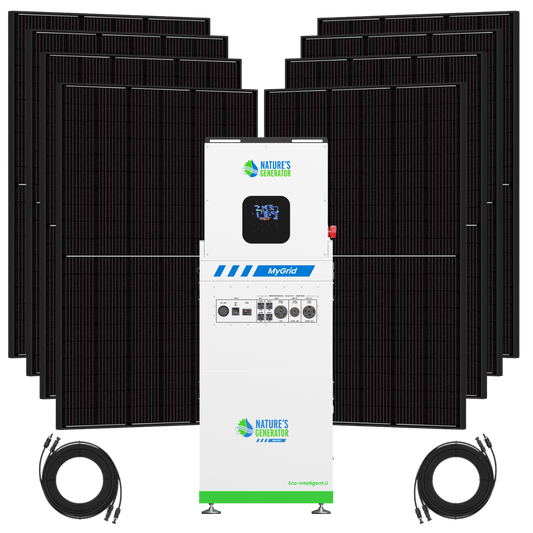
The Nature's Generator Powerhouse resolves this complexity by serving as a unified, central command platform for your hybrid ecosystem. Our engineers specifically designed this heavy-duty unit with dedicated, independent input ports for both solar power and wind turbine arrays.
The system features sophisticated internal circuitry that handles the distinct voltage curves of both inputs simultaneously. It manages the incoming direct current from your solar panels while safely accepting and rectifying the power coming from the wind turbine, directing the combined energy straight into its expandable, high-capacity internal battery ecosystem.
What Are the Real-World Cost and Installation Comparisons?
Upfront Capital Expenditure vs. Long-Term Resource Yield
When conducting a financial comparison, solar panels generally offer a lower upfront cost per watt. Solar technology has achieved massive manufacturing scale, making the panels affordable and exceptionally easy to install on various mounting racks. Because they feature no moving parts, their ongoing operational maintenance cost is virtually non-existent over a 25-year lifespan.
Wind turbines carry a higher initial investment per watt, largely due to the mechanical engineering involved and the structural support required for safe operation. A turbine contains moving components—including precision bearings, heavy-duty alternators, and aerodynamic blades—that experience mechanical stress. However, based on our experience, the long-term resource yield of a turbine can surpass solar in specific locations. Because a wind turbine can generate power 24 hours a day, its total kilowatt-hour yield over a turbulent week can easily outperform a solar array that is structurally limited by daylight hours and weather fronts.
Spatial and Zoning Requirements for Residential Wind Turbines
Before deploying a hybrid system, you must evaluate the spatial realities of your property. Solar panels are highly flexible; they can be mounted flat on a residential roof, fixed to an outbuilding, or placed on low-profile ground mounts in a yard. They require no zoning permits in the vast majority of residential areas, provided they conform to basic building codes.
Wind turbines require careful spatial planning to operate efficiently. To capture clean, laminar air, a turbine must be elevated above the turbulent boundary layer caused by trees, buildings, and nearby obstructions. Ideally, a turbine should be mounted on a tower that places it at least 20 to 30 feet higher than any obstacle within a 300-foot radius.
Furthermore, you must consult local zoning laws, municipal ordinances, and Homeowners Association (HOA) rules. Some urban or suburban areas place strict height limitations on residential structures or have specific noise ordinances, making rural or semi-rural properties the ideal candidates for wind integration.
How to Configure a Plug-and-Play Hybrid System Without Complex Engineering?
Step-by-Step Integration Using the Nature's Generator Ecosystem
If you want to bypass the frustrations of custom electrical design, our team has developed a true plug-and-play hybrid experience. This allows you to scale up your energy independence safely without handling bare wires or custom programming.
-
Position the Central Hub: Place your central system or the Nature's Generator Elite unit in an indoor, climate-controlled utility area or sheltered space near your primary electrical transfers.
-
Deploy the Solar Array: Mount your solar panels in an unshaded, south-facing location. Run the heavy-duty, weatherized PV cables directly from the panels into the marked solar input port on the back of the generator housing.
-
Erect the Wind Turbine: Assemble the Nature's Generator Wind Turbine using a compatible, secure tower or pole kit. Ensure it is anchored firmly to withstand local wind gusts.
-
Connect the Turbine Cable: Run the specialized wind turbine output cable directly from the base of the tower to the dedicated wind input port on your generator unit. The internal charge controller automatically detects the input and begins managing the incoming current safely.
Conclusion
Building a hybrid renewable energy system that balances solar panels vs. wind turbines is the most reliable strategy for achieving maximum uptime and true grid independence. By understanding how these two energy profiles naturally complement one another, you can protect your home from seasonal drops in production and eliminate the vulnerability of relying on a single weather-dependent source.
Whether you are prepping for unexpected grid emergencies or powering a remote property, combining the daytime bulk generation of solar with the nocturnal resilience of wind ensures your battery bank remains charged through every season.


