


Maintain continuous energy for essential appliances during major power disruptions with reliable backup power. Choosing the right system comes down to deciding whether a traditional fixed battery or a flexible solar power generator fits your home best. Whether you need a heavy-duty whole home power generator to run air conditioners and water pumps, or want a system with portable backup power options, looking closely at real-world details is key. Our team compares the Nature’s Generator MyGrid 10K against the Tesla Powerwall 3 to see how they stack up on total costs, wind charging, DIY setup, and overall performance.
Based on our testing and evaluation of home energy systems, we know how frustrating long installation delays and hidden fees can be. The Nature's Generator MyGrid 10K offers a straightforward, modular off-grid approach, while the Tesla Powerwall 3 follows the standard utility-installer model. Here is how both systems perform in plain, practical terms.
How Do Upfront Costs and Installation Expenses Compare Between the MyGrid 10K and Tesla Powerwall 3?
The retail price tag on a home battery rarely tells the whole story. The real cost comes down to required labor, local permits, and potential electrical panel upgrades.
The Tesla Powerwall 3 costs around $9,200 for the unit alone. However, Tesla requires certified professionals to handle the installation to keep your warranty valid. Once you add gateway hardware, high-voltage wiring, permits, utility hookup fees, and labor, installer quotes usually land between $12,000 and $16,500. If your home has an older electrical panel, you may need a panel upgrade that adds another $1,500 to $3,500 to your bill.
In comparison, the Nature’s Generator MyGrid 10K costs between $5,099.99 and $5,999.99 for a 10,000W continuous inverter paired with a 10.5 kWh LiFePO4 battery. Because it uses a plug-and-play setup, you can plug essential appliances straight into the unit on day one with $0 extra installation fees. If you want to connect it directly to your home's breaker panel, a standard manual transfer switch usually costs $300 to $600 for hardware and quick setup.
Can You Charge the Tesla Powerwall 3 with Wind Power, or Is Wind Charging Exclusive to Nature’s Generator?
A big risk with solar-only backup systems is relying entirely on clear sunny weather. During severe winter storms, cloudy weeks, or heavy blizzards, solar panels get covered in snow or produce minimal energy.
The Tesla Powerwall 3 only accepts solar panel input and grid power. It does not come with native connections for wind turbines. Trying to add a wind turbine to a Powerwall 3 system requires extra third-party inverters and custom wiring, which can void warranties and disrupt system controls.
The Nature’s Generator MyGrid 10K is designed for true off-grid flexibility with built-in dual charging. It includes dedicated MPPT solar inputs (handling up to 12,000W) and a dedicated wind turbine port (supporting 350W+). Pairing the system with a wind turbine and solar panels lets you build a hybrid setup that charges day and night.
Example Scenario: Bad Weather Resilience
During a five-day storm when solar panels produce little to no energy, wind speeds are often high. While a solar-only battery slowly runs out of juice, a MyGrid 10K hooked up to a wind turbine continues to trickle-charge overnight, keeping refrigerators, lights, and medical devices running.
Is DIY Installation Really Possible with Nature’s Generator MyGrid 10K vs. Tesla Powerwall 3?
If you want a system you can set up quickly without waiting months for contractors, installation style matters a lot.
Installing a Tesla Powerwall 3 is a major construction project. The main unit weighs about 287 lbs and must be mounted to wall studs or a concrete pad. Because it hooks directly into your grid power, it requires town permits, electrical inspections, and utility company sign-off. The full process from ordering to turning it on can take 4 to 12 weeks.
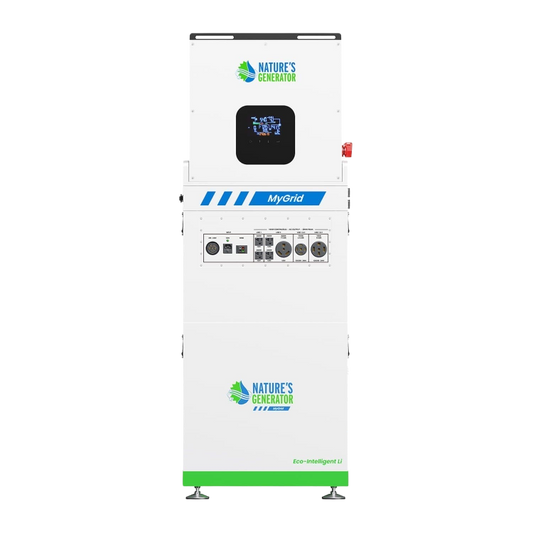
In contrast, our evaluations show that the Nature’s Generator MyGrid 10K is truly plug-and-play. It arrives in manageable parts—a 152 lb inverter unit and a 213 lb battery module—with built-in handles. Two people can unpack and set up the system in under an hour.
Out of the box, the MyGrid 10K features an integrated power panel with:
-
4 x standard 120V 20A household outlets
-
1 x NEMA TT-30R (120V 30A) outlet for RVs and equipment
-
1 x NEMA L14-30R (120V/240V 30A) twist-lock outlet
-
1 x NEMA 14-50R (120V/240V 50A) heavy-duty outlet
You don't need permits to unbox it and plug your appliances in right away. Plus, if you move, you can pack up the MyGrid 10K and take it with you.
How Do Power Output, Battery Capacity, and System Expansion Compare for Whole-Home Backup?
Running a house during a power outage requires strong continuous wattage, plus extra surge power to kick-start large motors in air conditioners, well pumps, and freezers.
The Nature’s Generator MyGrid 10K delivers 10,000W (10kW) continuous output at 120V/240V split-phase, with a massive 20,000W (20kW) peak surge capacity. It uses safe, long-lasting Lithium Iron Phosphate (LiFePO4) battery cells rated for over 6,000 charge cycles. That translates to 15 to 20 years of everyday use.
The Tesla Powerwall 3 offers 11.5kW of continuous power with 13.5kWh of battery capacity, but its lifespan is covered by a standard 10-year warranty. Expanding a Powerwall 3 requires buying heavy expansion units ($5,900 each) that must be hardwired by an electrician.
The 20,000W surge capability on the MyGrid 10K means heavy water pumps or central AC compressors start smoothly without tripping circuit breakers. You can also connect up to 7 expansion batteries to build 73.4 kWh of total storage.
Which Whole-Home Generator System Is Right for Your Power Needs and Budget?
Here is a quick way to decide which system fits your home and budget best:
Choose Nature’s Generator MyGrid 10K if:
-
You want to avoid $3,000 to $6,000+ in installation and permitting costs.
-
You need wind charging capability to generate power at night or during storm conditions.
-
You want a flexible DIY system that works out of the box and can move with you.
-
You want durable LiFePO4 batteries rated for 6,000+ charge cycles.
-
You need high 20,000W surge power for well pumps and heavy equipment.
Choose Tesla Powerwall 3 if:
-
You are building a new custom home with a large budget for professional installation.
-
You already own a Tesla EV and want all your gear under one app.
-
You prefer a wall-mounted setup and don't mind waiting weeks for permits and utility approval.
Conclusion
Both products are high-quality power solutions, but they serve different goals. The Tesla Powerwall 3 is designed for permanent, contractor-installed solar setups. However, high labor costs, long permit wait times, and no wind charging options can be limiting if you want straightforward self-reliance.
With 20,000W surge power, wind and solar dual-charging, expandable LiFePO4 batteries, and zero installation fees, Nature’s Generator gives you complete control over your home's backup energy.


