


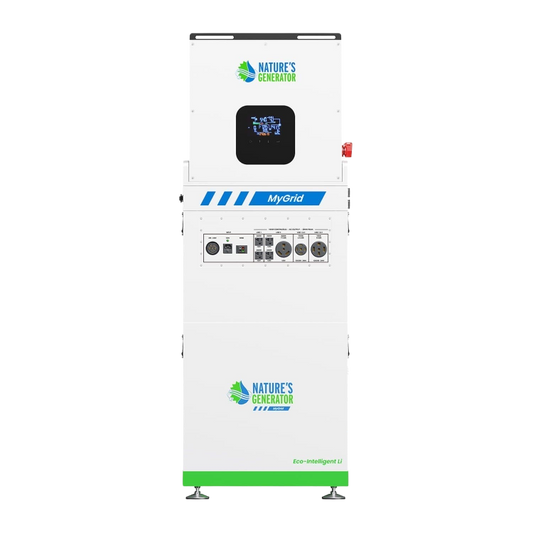
When designing a resilient off-grid or grid-tied residential energy architecture, selecting a reliable backup power strategy is paramount to securing your family's safety. Modern eco-conscious homeowners demand more than a simple emergency battery; they require a high-capacity solar power generator capable of operating as an uncompromised whole home power generator. While some individuals initially search for a compact, highly portable backup power unit, true long-term property resilience demands a heavy-duty, expandable configuration. The Nature's Generator MyGrid 10K represents a massive paradigm shift in home energy storage. However, unlocking its full potential requires understanding a sophisticated engineering principle: how to correctly design and scale a solar panel layout using High-Voltage MPPT Solar Charging.
Our engineering team frequently receives inquiries from homeowners trying to understand the technical nuances of string sizing, voltage thresholds, and watt-hour matching. Sizing a solar solar array incorrectly can lead to poor charging performance during overcast days or, worse, irreversible damage to your equipment. In this comprehensive technical guide, we will answer exactly how to calculate the ideal number of solar panels for your system, configure them in series or parallel strings, and respect the strict electrical boundaries of the unit to maximize your return on investment and achieve complete energy independence.
Why Does High-Voltage MPPT Solar Charging Outperform Low-Voltage Alternatives?
What are the core differences between traditional low-voltage charging and high-voltage MPPT engineering?
Traditional portable solar systems frequently rely on low-voltage configurations, often operating between 12 and 48 volts direct current (Vdc). While low-voltage frameworks are relatively straightforward for small-scale applications, they become highly inefficient when scaled to power an entire house. To transport thousands of watts of solar power at a low voltage, the electrical current (amperage) must be exceptionally high. According to Joule's Law, power loss in a wire is directly proportional to the square of the current multiplied by the resistance (expressed as Current Squared times Resistance, or I2 x R). Consequently, low-voltage systems suffer from heavy energy drops unless you install incredibly thick, expensive, and heavy copper wiring over short distances.
High-Voltage MPPT (Maximum Power Point Tracking) solar charging alters this equation completely by elevating the voltage and dropping the amperage. By pushing operating voltages upward into the hundreds of volts, the system can transfer massive amounts of clean energy across standard, thin solar PV cables without experiencing significant resistance losses. Based on our experience, this engineering choice allows homeowners to mount their solar arrays on a distant roof, workshop, or ground mount without worrying about voltage drop degrading their charging speeds.
How does the integrated MPPT tracking system maximize daily solar yield?
The solar charge controller within the unit acts as an intelligent supervisor that continuously tracks the relationship between voltage and current coming from your panels. Solar panels fluctuate in output based on moving clouds, atmospheric haze, and changing sun angles. A standard controller simply clamps the panel voltage to match the battery voltage, discarding substantial amounts of potential power.
Conversely, the high-voltage MPPT system constantly calculates the absolute sweet spot where your array produces its peak wattage. It then steps that high voltage down to the exact level required by the integrated 51.2V Lithium Iron Phosphate (LiFePO4) battery pack while simultaneously boosting the charging current. Our field tests confirm that this intelligent tracking mechanism yields up to thirty percent more usable energy per day compared to older pulse-width modulation alternatives, ensuring your home battery backup stays topped off even during subpar weather conditions.
What Are the Specific Solar Input Limits of the MyGrid 10K?
What are the minimum and maximum threshold parameters for voltage and wattage?
Before picking up tools or purchasing equipment, you must firmly understand the absolute boundary conditions of the integrated solar charge controller. The system features a sophisticated high-voltage input window that supports a solar charging capacity of up to 12,000 watts. This massive threshold allows homeowners to build an exceptionally large array designed to fast-charge the system or maintain continuous operations under heavy household loads.
The electrical voltage limits are exceptionally strict and must be memorized during the array design phase:
-
Minimum Solar Input Voltage: 120 Vdc
-
Maximum Solar Input Voltage: 550 Vdc
If the collective voltage of your solar array fails to reach the 120 Vdc floor, the internal MPPT controller will not engage. The system will remain dormant, and no power will flow into your battery pack. On the opposite end of the spectrum, exceeding the 550 Vdc ceiling will trigger an overvoltage condition that can bypass internal safety circuits and permanently destroy the sensitive solid-state electronics inside the charger.
How do the specifications of standard rigid panels fit into these limits?
To ground these boundaries in a practical example, let us look at the official Nature's Generator 410-watt rigid monocrystalline solar panels, which are frequently bundled with the system. To size an array correctly, you must analyze two primary metrics from the panel spec sheet: Open-Circuit Voltage (Voc) and Maximum Power Voltage (Vmp).
For the 410W rigid panel, the values are:
-
Open-Circuit Voltage (Voc): 37.12 V
-
Maximum Power Voltage (Vmp): 31.35 V
The Vmp represents the voltage the panel produces when it is operating at peak efficiency under standard test conditions. The Voc represents the maximum voltage the panel can generate when it is disconnected from a load. When calculating your maximum string size to protect the 550 Vdc limit, you must always base your calculations on the cumulative Voc of the panels.
How Do You Calculate the Optimum Panel Layout and String Configuration?
How many panels can you safely place in a single series string?
When you connect solar panels in series—meaning the positive terminal of one panel links directly to the negative terminal of the next—their voltages add together while their current remains identical to a single panel. To find the absolute minimum number of panels required to turn the charger on, we divide the 120V minimum requirement by the panel Vmp:
Minimum Panels = 120 V / 31.35 V = 3.82 (which requires 4 Panels in series)
Therefore, you must link at least 4 of the 410W panels in series to form a viable working string. Anything fewer will result in a dormant system that cannot charge from the sun.
To calculate the maximum number of panels in series, we must account for an important law of physics: solar panel voltage increases as ambient temperatures drop. If you calculate your string layout solely based on a warm summer day, an unexpected winter freeze will cause the array voltage to spike, exceeding 550 Vdc and ruining your equipment. Based on our experience, implementing a conservative fifteen percent cold-weather safety multiplier is the standard for professional system design.
Safe Winter Voc per Panel = 37.12 V x 1.15 = 42.69 V
Maximum Panels in Series = 550 V / 42.69 V = 12.88 (which caps at 12 Panels in series)
This math proves that you can safely string up to 12 of these 410W rigid panels together in a single series chain without risking overvoltage damage during a deep freeze.
How do you utilize the dual solar input ports to maximize your total wattage?
The system comes equipped with two independent solar input ports. This design feature allows you to run two entirely separate strings of panels into the generator. Instead of forcing all your panels into one long chain, you can break them into parallel configurations across both inputs to ramp up your total power without pushing the voltage past safe operating limits.
For instance, if your goal is to build a high-capacity residential backup framework, you can deploy a 24-panel array. By building two distinct strings of 12 panels wired in series, each string will produce a safe nominal operating voltage well within the MPPT window. You then plug one string into Solar Input Port 1 and the second string into Solar Input Port 2. This configuration yields a massive 9,840-watt array capable of rapidly re-energizing your storage system.
|
Configuration Profile |
Total Panels |
Wiring Layout |
Combined Wattage |
Expected Open-Circuit Voltage (Voc) |
Target Application Use-Case |
|
Starter Backup Array |
4 Panels |
4 in Series x 1 String |
1,640 Watts |
~148.5 Vdc |
Minimal backup for critical loads (fridge, lights) |
|
Mid-Tier Daily Hybrid |
8 Panels |
8 in Series x 1 String |
3,280 Watts |
~297.0 Vdc |
Daily utility offsetting and standard outage safety |
|
High-Capacity Estate |
12 Panels |
12 in Series x 1 String |
4,920 Watts |
~445.4 Vdc |
Robust off-grid performance and heavy appliance support |
|
Maximum Power Matrix |
24 Panels |
12 in Series x 2 Strings |
9,840 Watts |
~445.4 Vdc per port |
Ultimate whole-home autonomy and rapid dual-port charging |
What Real-World Factors and Electrical Tolerances Safeguard Your System?
How do temperature coefficients and shading patterns alter live performance?
In the real world, solar array engineering is rarely static. Beyond the temperature-induced voltage spikes mentioned earlier, thermal heat can also impact your overall efficiency. On blistering summer afternoons, solar panel temperatures can easily soar past 140 degrees Fahrenheit. As solar cells heat up, their operational voltage drops slightly. Our team advises clients that a drop in hot weather voltage is completely normal and highlights why designing your strings well above the 120V minimum threshold is crucial. If you build a marginal 4-panel string, a hot summer day might drop your operating voltage close to the cutoff limit, reducing your charging windows.
Shading is another variable that demands strict planning. When solar panels are connected in a series string, shading a single panel can act like a kink in a garden hose, choking off the current for the entire chain. If a nearby tree casts a shadow over part of your roof in the afternoon, we recommend split-string configurations. By routing unshaded panels to one solar input port and shaded panels to the other, you isolate the environmental interference and keep the unshaded portion of your array operating at maximum output.
What does customer feedback reveal about real-world usage scenarios?
Customer feedback from families utilizing the MyGrid 10K Whole-Home Generator emphasizes the incredible convenience of high-voltage setups. Many homeowners who migrated from old-fashioned, low-voltage battery backups note that the high-voltage system begins capturing usable energy much earlier in the morning and continues later into the evening.
A customer living in northern Michigan shared that during an ice storm that knocked out local utility lines for four days, their properly sized 12-panel series array cleared itself of light snow quickly. Because the high-voltage string only required a small amount of sunlight to hit the 120V turn-on threshold, the system began harvesting power at dawn, keeping their heating blowers, well pump, and medical equipment running without a single interruption.
How Does a Correctly Sized Array Convert to Financial Savings and Outage Survival?
What can you realistically power when your solar array matches your battery capacity?
Sizing your solar array correctly is about creating harmony between your energy collection potential and your total storage capacity. The base unit contains a heavy-duty 10,496-watt-hour (Wh) Lithium Iron Phosphate battery paired with a monstrous 10,000-watt continuous pure sine wave inverter. This means the system can handle a peak surge of up to 20,000 watts, allowing it to start heavy motor-driven appliances like central air conditioning units, sump pumps, and full-sized washing machines.
When you couple this storage capacity with an optimized 4,920-watt or 9,840-watt solar matrix, you create a perpetual energy cycle. During a prolonged blackout, an optimized array can fully replenish the core battery pack in just two to three hours of peak sunlight. While the sun is shining, the incoming solar energy powers your active household loads directly, bypassing the battery entirely. As night falls, your household seamlessly transitions to drawing from a fully charged 10,496Wh reserve, ensuring zero downtime.
How does smart scheduling maximize utility bill reduction?
An optimized solar array does not just sit around waiting for an emergency; it can actively work to lower your monthly utility expenses. By leveraging the smart plug scheduling features outlined on the MyGrid 10K Energy Saving Page, you can configure the system to charge exclusively from your solar panels during the morning. Then, during peak utility hours when power companies raise electricity rates, you can program the system to disconnect from the grid and run your home entirely on stored solar energy.
Homeowners who maximize their solar arrays can dramatically accelerate their return on investment. While traditional permanently installed residential solar arrays can take anywhere from seven to ten years to pay for themselves due to high permitting and specialized labor costs, the plug-and-play, relocatable nature of the Nature's Generator framework slashes installation barriers. Our data shows that an optimized setup often achieves a complete payback period in roughly three years, giving you decades of free, clean power.
The Path to Energy Independence
Mastering high-voltage MPPT solar charging is the ultimate way to unlock the true potential of your residential backup setup. By understanding that a minimum of 4 panels is required to engage the internal charger, and that a maximum of 12 panels can be safely placed in a single series string to prevent cold-weather overvoltage failures, you can design a system that operates flawlessly across every season.
Whether you choose a starter setup or opt for a maximum power configuration across both input ports, sizing your array correctly ensures your home remains safe during unexpected grid disruptions while actively slashing your monthly electric bills. The flexibility, scalability, and rapid return on investment provided by Nature's Generator products make it easier than ever to secure complete energy independence.


