


When a bad storm knocks out the power grid, keeping your household running smoothly is all about having the right gear.
If you want a reliable backup power option, you need a high-quality solar power generator or a robust whole home power generator that gives you the flexibility of portable backup power without the hassle. In this guide, we will answer exactly how our system handles heavy appliance startup spikes, how our intelligent APL tech works, and what to expect during real-world blackouts. A common issue homeowners face during a power outage is dealing with inductive load surges from heavy motorized appliances, and understanding how your backup system manages them is key to keeping your home safe.
What Are Inductive Load Surges and Why Do Major Household Appliances Cause Them?
To understand how our equipment protects your home, it helps to look at how different appliances use electricity. Not all electrical loads are created equal. In fact, the electronics in your house generally fall into two very different categories: resistive loads and inductive loads.
Resistive loads are simple and predictable. Devices like incandescent light bulbs, electric frying pans, toasters, and space heaters use a steady, unchanging amount of power from the moment you turn them on to the moment you turn them off. They function immediately without needing an external boost.
Inductive loads are a completely different animal. These are found in any appliance that relies on an electric motor, a compressor, or a transformer to do its job. Think of your refrigerator, your chest freezer, your central air conditioning unit, your well pump, or a heavy-duty sump pump in your basement.
When a motorized appliance first kicks on, it has to overcome physical inertia to get its parts moving, and it has to establish a magnetic field inside its motor coils. Because of this, it requires a massive, instantaneous burst of extra electricity just to start up. This quick spike is what we call an inductive load surge or an inrush current.
A standard kitchen refrigerator might only need 700 to 800 watts of power to keep running throughout the day. However, when the compressor kicks in, power consumption can briefly spike to between 2,100 and 2,400 watts
If your home backup system cannot supply that quick burst of massive power, the system will assume there is a dangerous short circuit. To protect itself, a standard inverter will instantly trip its safety breakers, shutting off power to your entire house and leaving you in the dark.
How Does the Nature's Generator MyGrid 10K Manage a 20,000W Peak Startup Demand?
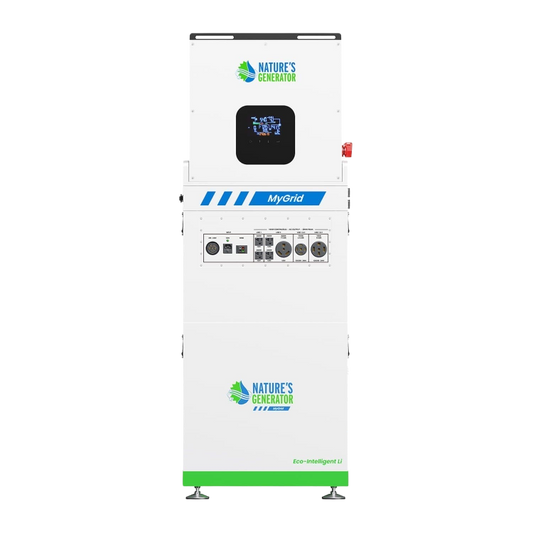
When our team engineered the MyGrid 10K Whole Home Generator, we knew it had to do much more than just charge phones and run a few LED lights. True whole-house power means being able to handle multiple heavy-duty appliances cycling on and off at the same time. The secret behind this muscle is the internal pure sine wave inverter system.
Under normal conditions, a single unit provides 10,000 watts of continuous running power. This gives you plenty of capacity to run your kitchen appliances, home office, television, and lighting networks simultaneously. But the real magic happens when a heavy motor turns on. The system features a massive peak startup capacity of up to 20,000 watts. This huge power buffer exists purely to absorb those brief, intense inductive load surges without breaking a sweat.
|
Power Output Metric |
Single MyGrid 10K Unit |
Dual Connected Setup |
|
Continuous Running Power |
10,000 Watts |
20,000 Watts |
|
Peak Startup Surge Capacity |
20,000 Watts |
40,000 Watts |
|
Base Battery Storage Capacity |
10,496 Watt-hours |
Scalable up to 73.4kWh |
Having that 20,000-watt peak limit means your lifestyle doesn't have to change just because the power grid went down. Even if your sump pump activates while the refrigerator is operating, the system immediately supplies the necessary power without any dip in voltage.
Even better, our system is completely modular. If your power needs grow in the future, you can connect two units together using a simple combiner cable setup. By doing this, you instantly achieve 20,000 watts of continuous power and a maximum surge capability of 40,000 watts—delivering the high-tier performance usually limited to large-scale industrial systems.
What Is Automatic Power Load (APL) Mode on the MyGrid 10K and How Does It Protect Your Home?
To manage these sudden, massive swings in energy safely, the system uses an intelligent feature we built in called Automatic Power Load mode, or APL. This is a smart power manager programmed directly into the digital brain of the generator.
When multiple large appliances are running, homeowners often wonder how the generator keeps from crashing. When a heavy inductive load demands a massive chunk of electricity, the APL system spots that rapid change instantly. Instead of letting the voltage drop or forcing the entire unit into a hard overload shutdown, APL mode steps in to stabilize the system.
When APL mode activates, the generator dynamically widens its operational parameters to accommodate the shifting load. It keeps the electrical frequency steady and ensures that a clean pure sine wave continues flowing to your home breaker panel. This process is incredibly important because sensitive electronics—like your laptop, smart TV, or home Wi-Fi router—can easily be damaged by dirty power or sudden voltage drops. APL acts like a premium shock absorber, protecting your sensitive gadgets while giving your heavy appliances the massive punch of energy they need to start up.
What Triggers the Flashing APL Indicator on the MyGrid 10K LCD Screen?
When you check the digital display on your unit during a blackout, you might occasionally see the APL indicator flashing on the LCD screen. Based on our experience, seeing a flashing light on a piece of high-tech equipment can make people feel a bit anxious, causing them to worry that something is wrong with their backup system.
We want to reassure you that a flashing APL indicator is completely normal. It is not an error message, and it doesn't mean your system is failing. It is simply a status light letting you know that the generator is actively optimizing its power output to keep your home stable.
The Automatic Power Load feature usually starts flashing when the unit is adapting to changing energy demands or handling multiple power sources at once. For example, if you are running a few different appliances that turn on and off automatically while the generator is balancing its internal battery storage, the system enables APL mode to keep everything perfectly balanced. It is just a visual confirmation that the smart brain inside the generator is doing the heavy lifting for you.
Can the MyGrid 10K Handle Inductive Surges While Charging from Multiple Power Sources?
A common question our team gets from people designing their home backup strategy is whether the generator can still protect against heavy appliance startup surges while it is plugged into solar panels or other charging sources. The answer is a clear yes, but knowing how the system prioritizes its incoming power can help you get the absolute most out of your setup.
The system is incredibly versatile when it comes to recharging. It supports up to 12,000 watts of solar input through its dual MPPT controllers, 350 watts of wind turbine power, and standard wall charging. However, our engineering team designed a specific rule into the system to maximize efficiency: the MyGrid 10K cannot charge using solar power and a 240V AC input at the exact same time.
When the system detects that you are harvesting clean solar energy from your panels, the 240V AC super charging feature automatically turns off. We built it this way on purpose to prioritize free, renewable energy and stop your home from drawing expensive power from the utility grid unnecessarily. If a large appliance kicks on and creates a massive inductive surge while you are charging via solar, the APL mode handles the power demand perfectly, ensuring your household items keep running without interrupting your solar collection.
How Does the MyGrid 10K Perform Under Real-World Appliance Challenges?
When you are exploring your options on the Nature's Generator website, looking at real-world scenarios and customer feedback can give you a much better idea of what to expect than just browsing a list of technical specs. Families who live in areas hit by severe seasonal storms need to know how a system holds up when things get tough.
Let's look at a practical example. Imagine an intense summer storm knocks out the power, and the temperature outside is hitting 95 degrees. You have a few non-negotiable items that must stay online: your kitchen refrigerator, a deep freezer full of food, your home internet router, and a 1/2 horsepower sump pump to keep your basement from flooding.
On paper, these items don't use a ton of power while running. But if your sump pump and your refrigerator compressor happen to turn on at the exact same fraction of a second, a traditional gas generator or a cheap battery backup will often choke, stall, or flip a breaker.
Our customers tell us all the time how much they love the peace of mind they get from our heavy-duty design. For instance, a homeowner recently shared on an online forum that during a multi-day blackout, their system handled their refrigerator, tools, and pump cycles without a single glitch or power blink. Another long-term user mentioned that having a reliable setup with clean power pass-through meant they didn't have to worry about their expensive electronics getting fried during storm season.
Because the system uses a premium 10,496Wh Lithium Iron Phosphate battery pack built to last for over 6,000 cycles, it provides steady power all day while letting the 20,000-watt peak inverter handle the tough startup spikes. You can check out more details in this blog to see how it compares to noisy, old-school gas options.
Conclusion
Dealing with heavy inductive load surges is one of the toughest challenges for any home backup setup. Thanks to a strong 10,000-watt continuous pure sine wave inverter, a 20,000-watt peak surge capacity, and our smart Automatic Power Load technology, the MyGrid 10K keeps your most important appliances running smoothly without any risk of system crashes.
Finding the right backup option is all about protecting your family and gaining true energy independence. By choosing a clean, expandable solution from Nature’s Generator, you can comfortably ride out unpredictable blackouts while moving away from noisy fossil fuels.


