


Solar panels struggle on cloudy days, usually dropping to 10% of their normal power. If you use a generator and solar power setup, you don't have to wait days for a full charge. Here is how to speed up your power solar generator when the sun isn't out.
Why Low Light is a Buzzkill for Solar
To beat the clouds, you have to understand them. Solar panels don't just "turn off" when it’s cloudy; they switch to capturing "diffuse" light rather than "direct" light.
The problem? In heavy overcast conditions, your panels might only produce 10% to 25% of their rated capacity. If you have a Nature's Generator or a similar high-capacity system, that trickle charge can feel agonizingly slow. The goal is to maximize the "surface area" of energy capture and minimize any internal resistance.
1. The "Over-Paneling" Strategy
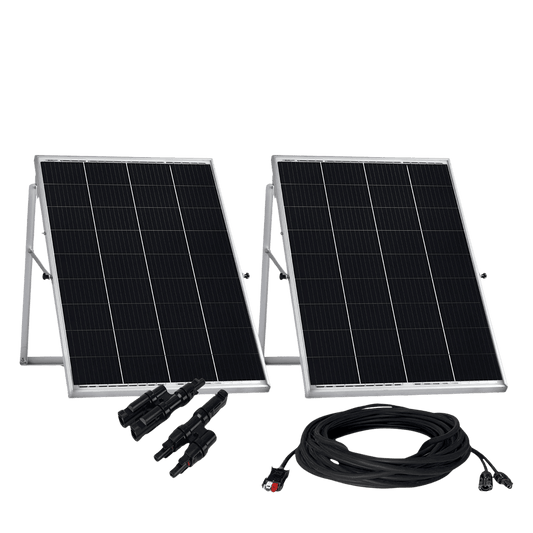
One of the most effective ways to combat low light is simply to bring more muscle to the fight. If your power solar generator can handle more input wattage than your current panels provide, add more.
-
The Logic: If one 100W panel produces only 20W in the shade, three 100W panels will produce 60W.
-
The Benefit: This gets you closer to a "normal" charging speed even when the environment is working against you. Just be sure to stay within your generator’s maximum Volts and Amps limits so you don't fry the internal circuitry.
2. Positioning: Hunt the "Brightest" Patch
It sounds counterintuitive, but positioning matters more when it’s cloudy.
-
Look for the "Hot Spot": Even behind clouds, one part of the sky is usually brighter than the rest. Point your panels toward that specific area rather than just "up."
-
Tilt for the Season: In low-light winter months, the sun sits lower on the horizon. Tilting your panels at a steeper angle (usually latitude + 15 degrees) helps catch those fleeting photons more effectively than laying them flat.
3. Keep It Clean (Seriously)
When you have 1,000 watts of direct sun hitting a panel, a little dust doesn't hurt much. But in low light, every single photon is precious.
A thin layer of dust, pollen, or dried rain spots can act like a second layer of "clouds" on your panel. Use a microfiber cloth and a bit of water to keep the glass pristine. It’s the easiest 5% efficiency boost you’ll ever get.
4. Prioritize MPPT Technology
If you are in the market for a solar power generator portable unit, ensure it features Maximum Power Point Tracking (MPPT) rather than PWM (Pulse Width Modulation).
Why it matters:
-
PWM is like a basic light switch; it’s either on or off and isn't very smart.
-
MPPT is like a smart transmission in a car. It constantly adjusts the voltage and current to find the "sweet spot" where the panel produces the most power. In low light, an MPPT controller can be up to 30% more efficient than a PWM controller.
5. Use the "Dual Charging" Hack
Most modern units allow for "Dual Charging." If you’re at home prepping for a storm and the clouds are rolling in, don't rely on the sun alone.
Plug the unit into a wall outlet (AC) while simultaneously having the solar panels connected. This "Fast Charge" mode uses every available avenue to top off the battery before the grid goes down. If you're on the road, many units allow you to charge via your car’s 12V DC port while the solar panels sit on the roof.
6. Minimize the Load While Charging
It’s a simple math problem: if you’re pulling 50W out of the generator to run a fridge while the panels are only bringing in 40W, you’re still losing ground.
In low-light scenarios:
-
Turn off the AC inverter if you aren't using it. Inverters draw "idle power" just by being on.
-
Charge devices directly via USB ports, which is much more efficient than using a standard wall plug.
-
Wait for the "Bulk" stage: Let the generator reach at least 80% charge before you start plugging in heavy appliances.
Living off-grid or prepping for emergencies requires a bit of flexibility. While a generator and solar power setup is best friends with the sun, these tweaks ensure you aren't left in the dark when the weather turns. By using MPPT technology, keeping your panels spotless, and maybe adding an extra panel to your array, you can keep your power solar generator humming along quite nicely.


