


Choosing reliable backup power means looking beyond battery size. A solar power generator needs enough output for your essential appliances, while a whole home power generator also needs a practical way to connect to your home's circuits. For many households, portable backup power means keeping the fridge, Wi-Fi and lights running. For others, it means powering a well pump, air conditioner or other 240V appliances.
This comparison looks at Nature’s Generator Powerhouse Gen 2 vs. Anker SOLIX F3800 with those real-world needs in mind. We’ll compare battery expansion, 240V output, charging options, home integration and customer feedback to help you decide which system fits your home.
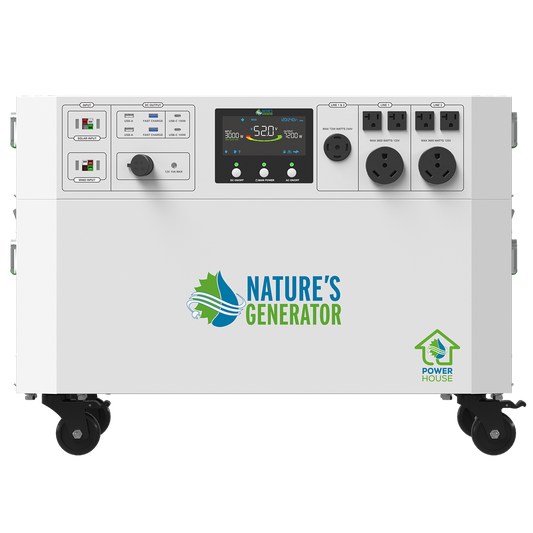
Which is better: Nature’s Generator Powerhouse or Anker SOLIX F3800?
The Nature’s Generator Powerhouse Gen 2 offers more power from a single unit, while the Anker SOLIX F3800 can reach a higher maximum system capacity when two units are combined.
The Powerhouse provides 7,200W of continuous 120V/240V split-phase power and starts with a 4,800Wh battery. It can expand to 28.8kWh with five Power Pods and can also be combined with additional Powerhouses.
The F3800 delivers 6,000W of continuous output and starts with 3,840Wh of battery capacity. One F3800 can expand to 26.88kWh with six BP3800 batteries. Two F3800 units can be combined for a listed maximum of 53.8kWh of storage and 12,000W of output.
So, which one wins?
Choose the Powerhouse for stronger single-unit output and more flexible renewable charging. Choose the F3800 for LFP battery technology and greater maximum multi-unit expansion.
How do the Powerhouse and F3800 compare?
The key difference is that the Powerhouse starts bigger, while the F3800 can scale further when you combine two base units.
How much can the Nature’s Generator Powerhouse expand?
The Powerhouse starts with 4.8kWh of battery storage. Each Power Pod adds another 4.8kWh.
That means:
-
1 Powerhouse = 4.8kWh
-
1 Power Pod = 9.6kWh total
-
3 Power Pods = 19.2kWh total
-
5 Power Pods = 28.8kWh total
That modular setup is useful because you can expand as your needs change instead of buying the largest configuration immediately.
For example, a homeowner might begin with a Powerhouse for short outages and later add a Power Pod when longer blackouts become a concern. You can also expand the renewable side of the system with additional solar and wind equipment.
Nature’s Generator also lists configurations using up to three Powerhouse units, providing as much as 21,600W of output.
How does F3800 battery expansion compare?
The F3800 uses smaller expansion steps.
The base unit provides 3.84kWh, and each BP3800 expansion battery adds another 3.84kWh. With six expansion batteries, one F3800 can reach 26.88kWh.
That is slightly less than the Powerhouse's 28.8kWh single-unit capacity.
Where Anker changes the equation is multi-unit expansion. Two F3800 units can be combined to reach a listed 53.8kWh of total battery capacity and 12,000W of output.
This gives the F3800 a significant advantage for buyers planning a very large battery system over time.
The trade-off is that reaching that capacity requires a larger multi-unit setup rather than simply adding Power Pods to one base unit.
Which system has better 240V output?
The Powerhouse has the higher continuous output from one unit.
It provides 7,200W of continuous 120V/240V split-phase power, compared with 6,000W from the F3800.
That extra 1,200W can matter when several appliances are operating at once.
Think about a summer outage. Your refrigerator is running, your internet equipment is on, lights are operating and your air conditioner needs to start. A higher output ceiling gives you more room before the system reaches its limit.
The Powerhouse also has a listed 14,400W peak output, which provides additional startup headroom for appliances with motors and compressors.
The F3800 offers 9,000W of surge output, which can still handle demanding loads, but the Powerhouse has the larger single-unit rating.
For buyers comparing the two specifically for 240V applications, the Powerhouse has the clear advantage on raw inverter output.
Can either system power a whole house?
Yes, but 240V capability alone does not make a system a whole-home generator.
A backup power station needs compatible transfer equipment to connect safely to household circuits. Both systems offer home integration options designed around this type of setup.
Nature’s Generator supports compatible transfer switches and power inlet equipment for connecting the Powerhouse to selected home circuits.
Anker also offers F3800 configurations designed for home backup with transfer-switch equipment.
The important point is that a 240V-capable generator does not mean every appliance in the house can run simultaneously.
You still need to consider:
-
Appliance running wattage
-
Startup or surge requirements
-
Which circuits are backed up
-
Total load when multiple appliances operate together
A qualified electrician should confirm the appropriate installation and determine which circuits your system can safely support.
Which is better for a well pump or air conditioner?
The Powerhouse's higher output gives it an advantage for high-demand appliances.
Well pumps, central air conditioners and similar equipment can create a large startup surge. The appliance might have a manageable running load but require considerably more power for a moment when the motor starts.
This is why simply adding up appliance wattages can produce a misleading result.
A better approach is to check the running and startup requirements of your largest appliances first, then add the smaller essentials around them.
For example, a rural home might want to keep a well pump, refrigerator, freezer, lighting and internet equipment running during an outage. The Powerhouse's 7,200W continuous rating provides more single-unit headroom for that type of mixed load.
That does not mean every well pump or HVAC system will work automatically. Compatibility still depends on the equipment's electrical requirements.
Which system offers better charging flexibility?
This is one of the Powerhouse's biggest advantages.
The system supports solar, wind and AC charging. Nature’s Generator lists up to 2,000W of solar input and 1,000W of wind input.
That can be useful during extended outages.
Solar generation can drop on cloudy days, while wind may be available at different times. Having both renewable charging options gives you another way to replenish stored energy.
The Powerhouse with Solar Panel is built around this approach.
The F3800 has the higher solar input rating at 2,400W, making it attractive for users who want to focus on solar charging.
So the difference is straightforward:
F3800: higher solar input.
Powerhouse: solar plus native wind charging.
If your goal is a broader renewable charging setup, the Powerhouse offers more flexibility.
Which system is better for short outages?
For short outages, the Powerhouse has an advantage because it starts with more stored energy.
The Powerhouse provides 4.8kWh, compared with 3.84kWh for the F3800.
For illustration, if your essential loads averaged 500W continuously, a 4.8kWh battery represents roughly 9.6 hours of theoretical energy before losses, while 3.84kWh represents roughly 7.7 hours.
Real runtime will vary because appliances cycle on and off, batteries are not 100% efficient and output conditions change.
Still, the larger starting battery means the Powerhouse can provide more energy before you need to add an expansion battery.
Which system is better for long outages?
For long outages, battery capacity and recharging ability become equally important.
The F3800 has an advantage if you plan to build a very large two-unit system, with a listed maximum of 53.8kWh.
The Powerhouse takes a different approach. It combines battery expansion with solar and wind generation, allowing you to build a renewable charging system alongside your storage.
For a multi-day outage, this matters.
A large battery helps, but once it is empty, you need a way to put energy back into it. That makes renewable input an important part of the buying decision.
The Powerhouse Power Addition can help homeowners increase storage and continue expanding their system as energy needs grow.
Which system should you buy?
Choose the Nature’s Generator Powerhouse if you want:
-
Higher single-unit output
-
A larger starting battery
-
120V/240V split-phase power
-
Up to 28.8kWh with one base unit and five Power Pods
-
Solar and wind charging
-
A system that can grow with your household
Choose the Anker SOLIX F3800 if you want:
-
LFP battery technology
-
Higher solar input
-
App-based energy management
-
26.88kWh with one F3800 and six expansion batteries
-
A path toward a larger two-unit system with up to 53.8kWh
Powerhouse or F3800 for 240V expandable backup?
The Nature’s Generator Powerhouse and Anker SOLIX F3800 are both capable home backup systems, but they are built around different priorities.
For homeowners focused on 240V appliances and higher output from a single unit, the Powerhouse makes a strong case. For buyers planning an oversized lithium battery system over time, the F3800 offers more total expansion potential.
The best choice ultimately comes down to your actual loads. Start with the appliances you need during an outage, check their running and startup requirements, decide how long you want them operating, and then consider how you'll recharge the system.


