


Living in an era where unpredictable weather and grid instability have become the new normal, ensuring your family stays comfortable during a blackout is no longer a luxury—it is a necessity. If you have ever sat in the dark wondering how long does power outage last, you already know the frustration of being unprepared. According to recent 2025 reports, the average length of the longest power outages has climbed to nearly 13 hours, with some regions facing much longer stretches due to extreme weather.
Choosing the right backup solution requires more than just picking a brand; it involves matching technology to your specific lifestyle and the duration of the disruptions you face. In this guide, we will explore how to select the ideal home solar generators by looking at outage patterns, power phases, and reliable brands like Nature's Generator.
Understanding Your Local Outage Profile
Before you invest in hardware, it is vital to analyze the "why" and "how long" of your local power failures. Not all blackouts are created equal, and your strategy should shift based on the duration you typically encounter.
The Short "Blip" (1–4 Hours)
These are often caused by localized issues like a fallen tree limb or a minor equipment failure. For these short durations, you primarily need to keep the Wi-Fi running, charge phones, and perhaps keep a few LED lights on. A compact unit with a 1kWh to 2kWh capacity is usually plenty.
The Standard Outage (4–12 Hours)
This is becoming the most common scenario across the country. At this stage, your refrigerator becomes the priority. To prevent food spoilage, you need a generator that can handle the "surge" of a fridge compressor starting up while maintaining a steady flow of power for several hours.
The Multi-Day Event (24+ Hours)
When a major storm hits, you could be without grid power for days. This is where high-capacity home solar generators shine. You need a system that not only has a large battery but also enough solar panel input to "refill" that battery while you are still using it.
Decoding the Technical Specs: 2 Phase vs. 3 Phase
As you shop for a heavy-duty backup system, you might encounter technical jargon that sounds like it belongs in a physics textbook. One common point of confusion is the difference between 2 phase and 3 phase power. While this might seem like "engineering talk," it actually dictates what you can and cannot plug into your generator.
What is 2 Phase (Split-Phase) Power?
In most North American residential settings, what people commonly call "2 phase" is actually "split-phase" power. This setup uses two 120V lines that are 180 degrees out of phase. When combined, they provide 240V. This is what runs your heavy-hitters:
-
Central Air Conditioning
-
Electric Clothes Dryers
-
Well Pumps
-
Electric Ranges
If your goal is to keep the AC running or draw water from a well during an outage, you must ensure your solar generator supports a 240V split-phase output.
What is 3 Phase Power?
You will rarely find 3 phase power in a standard home. This system uses three separate alternating currents, each 120 degrees apart, to provide extremely smooth and efficient power for massive industrial motors and data centers.
The primary difference between 2 phase and 3 phase is the application. While 3 phase is more efficient for giant factories, a split-phase (2 phase) system is the gold standard for high-demand residential appliances. Most high-end home solar generators are designed to mimic this residential split-phase power to ensure your HVAC system doesn't skip a beat.
Why Nature's Generator is a Top Contender
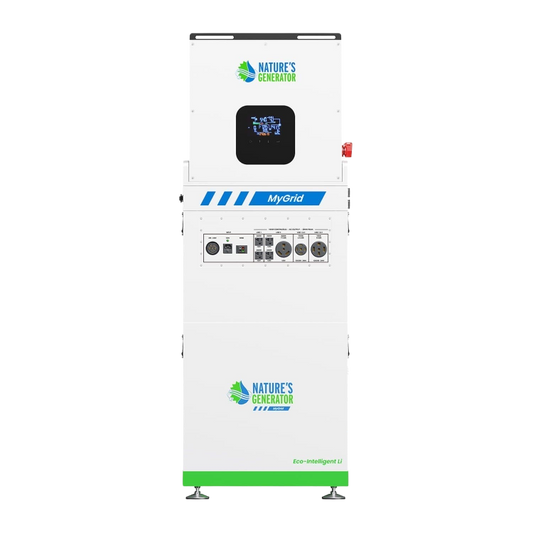
When searching for a system that can grow with your needs, Nature's Generator consistently earns its spot in the conversation. Unlike "closed" systems that force you to buy a whole new unit if you need more power, this brand focuses on modularity.
Modular Expansion
The Lithium 3600 Power Station from Nature's Generator is specifically designed for users who want to start small and expand. You can add Power Pods (extra battery units) or more solar panels as your budget or power needs increase. This flexibility is a lifesaver.
Dual Charging Capability
One of the unique features of a Nature's Generator setup is the ability to incorporate wind energy alongside solar. If a storm is blowing through at night—meaning your solar panels are idle—a wind turbine can keep your batteries topped off. This "hybrid" approach is one of the most reliable ways to handle long-term outages.
Sizing Your System: The Math Made Simple
To choose the best unit, you need to calculate your "Daily Watt-Hour" (Wh) requirement. You can find this by multiplying the wattage of an appliance by the hours you plan to use it.
|
Appliance |
Average Watts |
Hours of Use |
Daily Total (Wh) |
|
Refrigerator |
150W |
24 (Cycling) |
1,200 Wh |
|
LED Lights (x5) |
50W |
6 |
300 Wh |
|
Wi-Fi Router |
15W |
24 |
360 Wh |
|
Laptop/Phone |
60W |
4 |
240 Wh |
|
Total |
2,100 Wh |
In this scenario, a 2kWh battery would barely last a day without sun. To be safe, you would want a system with at least 4kWh of storage and 800W of solar panels to ensure you can recharge even on cloudy days.
Installation: Portability vs. Integration
How you interact with your generator is just as important as its capacity. There are two main ways to set up home solar generators for an outage.
1. The "Extension Cord" Method
This is the simplest approach. You keep the generator in a central location and run heavy-duty extension cords to your fridge, lamps, and electronics. It requires zero electrical work but can be a tripping hazard and doesn't help with hardwired items like well pumps or furnaces.
2. The Transfer Switch Method
For a "human-centric" experience, many homeowners install a manual transfer switch. This allows you to plug the generator directly into your home's electrical panel. With a flip of a switch, your existing wall outlets and ceiling lights come back to life. Brands like Nature's Generator often offer specialized transfer switch kits to make this process seamless.
Longevity and Battery Chemistry
If you are buying a generator today, pay close attention to the battery type. Most modern home solar generators use one of two chemistries:
-
Lithium-Ion (NMC): Lighter and more portable, but usually rated for about 500 to 1,000 charge cycles.
-
Lithium Iron Phosphate (LiFePO4): Heavier and slightly more expensive, but significantly safer and rated for 3,000 to 6,000 cycles.
If you expect frequent outages over the next decade, the LiFePO4 option is the smarter long-term investment. It will likely outlast the components of the generator itself.
Preparation is the Ultimate Peace of Mind
Ultimately, the best solar generator is the one that fits your specific reality. If you live in a region where you frequently ask how long does power outage last only to find the answer is "three days," then a high-capacity, expandable system like those from Nature's Generator is your best bet.
By understanding the difference between 2 phase and 3 phase power, you can ensure your big appliances stay running. By calculating your daily needs, you avoid the heartbreak of a dead battery in the middle of a cold night. Transitioning to solar backup isn't just about "going green"—it is about taking control of your home's resilience


