


Choosing the right generator setup starts with understanding how electricity moves from your power source into your home or RV. Whether you want reliable backup power during a storm or off-grid power from a solar power generator, getting the right plug and outlet matters. At Nature’s Generator, our mission is to make whole home power generator setups and portable backup power simple and safe for everyone. In this guide, our team breaks down common generator plugs—NEMA L14-30, L5-30, TT-30, and 14-50—so you can connect your system with confidence.
When the power goes out, you need your backup system ready to go. But if your generator plug doesn't match your home's inlet box, or if your extension cord is too thin, your generator won't be able to do its job safely. Below, we break down how these plugs work, what the numbers mean, and how to pick the right setup for your needs.
What Are the Main Differences Between NEMA L14-30, L5-30, TT-30, and 14-50 Plugs?
NEMA stands for the National Electrical Manufacturers Association. They created standard shapes and sizes for electrical plugs so that equipment from different companies fits together safely.
Reading NEMA plug names is simple once you know the code:
-
L means Locking. Plugs with an "L" twist into place so they cannot be accidentally pulled out or shaken loose by generator vibration.
-
TT stands for Travel Trailer. This is a straight-prong plug designed specifically for RVs.
-
The First Number (5, 14, or TT) tells you the wiring layout and voltage.
-
The Second Number (30 or 50) tells you the maximum current (Amps) the plug can handle.
Why do some plugs have 3 prongs while others have 4?
A 3-prong plug (like the L5-30 or TT-30) carries one Hot wire, one Neutral wire, and one Ground wire. It can only power standard 120-volt electronics and appliances.
A 4-prong plug (like the L14-30 or 14-50) carries two Hot wires, one Neutral wire, and one Ground wire. Each Hot wire provides 120 volts. Combined, they deliver 240 volts. This extra power is what allows you to run heavy-duty household appliances like central air conditioning, well pumps, and electric water heaters.
How Does the NEMA L14-30 Plug Work for Home Backup Power?
The NEMA L14-30 is the most popular plug for connecting a generator to a house. If your home has a manual transfer switch installed next to your breaker panel, it almost certainly uses an L14-30 inlet box on the outside wall.
Inside an L14-30 plug, you will find four wires:
-
Hot 1 (Black Wire): Delivers 120 volts.
-
Hot 2 (Red Wire): Delivers 120 volts.
-
Neutral (White Wire): Completes the circuit.
-
Ground (Green Wire): Protects against electrical shocks.
Because it uses curved prongs, you push the plug in and turn it clockwise to lock it. This keeps the cord connected securely, even if the generator vibrates or it is windy outside.
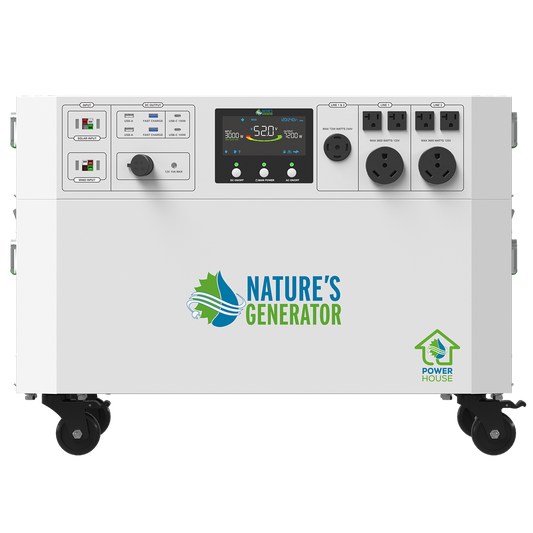
When you plug an L14-30 cord into a transfer switch, it sends power to both sides of your home's main electrical panel. Our team designed the Nature's Generator Powerhouse Gen 2 with 120V/240V output options to connect directly to these standard switches.
Feedback from our customers shows how easy this makes outage management: you simply plug one heavy-duty cable from your generator into your house inlet box, switch your breaker transfer switches over, and keep your lights, fridge, and water pump running smoothly.
NEMA L5-30 vs. TT-30: Which 120V Plug Do You Need?
People often confuse the L5-30 and TT-30 plugs because both are rated for 30 Amps and 120 Volts (up to 3,600 Watts). However, their prongs are shaped differently, so they will not fit into the same outlets without an adapter.
What is a NEMA L5-30?
The L5-30 is a 3-prong twist-lock plug. It is common on medium-sized portable generators, construction sites, and boat docks because it locks tight and will not pull out accidentally.
What is a NEMA TT-30?
The TT-30 is a 3-prong straight-blade plug built specifically for travel trailers and campers. If you drive an RV, the main power cord on your camper is almost certainly a TT-30.
Can you connect an L5-30 outlet to a TT-30 RV cord?
Yes! Because both plugs carry the exact same electrical capacity (120V, 30A), you can use a basic adapter block or short adapter cable (often called a dogbone adapter).
If you use a compact power generator like the Elite, an adapter lets you plug your camper's TT-30 power cord straight into the generator’s 30A outlet. Just make sure to buy an adapter rated for a full 30 amps so it handles heavy loads like your camper's air conditioner without overheating.
Why Is the NEMA 14-50 Used for Big Generators and EVs?
If your power needs go beyond 7,200 watts, a 30-amp plug is no longer large enough. That is where the NEMA 14-50 plug comes in. Rated for 50 amps at 120/240 volts, it can handle up to 12,000 watts of continuous power.
The NEMA 14-50 is a heavy-duty 4-prong straight plug with three flat pins and a round top ground pin:
-
Side Pins: Two Hot wires (120V each, or 240V combined).
-
Bottom Pin: Neutral wire.
-
Top Pin: Ground wire.
What thickness wire do you need for a 14-50 plug?
Because 50-amp circuits carry a lot of current, you must use thick wire to keep the cable from getting hot:
-
For short distances (Under 50 feet): Use 6 AWG copper wire.
-
For longer distances (50 to 150 feet): Upgrade to 4 AWG copper wire so power isn't lost over the long distance.
A 50-amp 14-50 connection is ideal for large whole-home systems, electric vehicle (EV) charging, or large RVs with multiple air conditioning units.
How to Connect Your Generator Plug to Your Home Safely
Connecting a generator to your house requires the right gear to protect both your home and power company workers.
Important Safety Rule: Never use a double-sided male cord (sometimes called a suicide cord) to plug a generator directly into a standard wall outlet. This sends dangerous electricity back out into the power lines (backfeeding), which can injure or kill utility line workers trying to restore power.
The Right Way to Connect Your System
-
Generator Outlet: The power plug on your generator (e.g., L14-30 or 14-50).
-
Generator Extension Cord: A heavy-duty, outdoor-rated cable sized for your plug’s amperage (10 AWG wire for 30A; 6 AWG wire for 50A).
-
Power Inlet Box: A weatherproof box mounted outside your house with recessed prongs.
-
Manual Transfer Switch: A special panel installed inside near your breaker box that safely switches circuits from power company power to generator power.
To make home hookups simple, installing a transfer switch lets you pre-select the essential lights, outlets, and appliances you want to run during a blackout.
What is floating neutral vs. bonded neutral?
You might see these terms when looking at generator specs:
-
Bonded Neutral: The Neutral wire is attached to the generator's metal frame inside the unit.
-
Floating Neutral: The Neutral wire is separated from the metal frame.
When connecting a generator to a house transfer switch, your home's main electrical panel is already grounded to the earth. A floating neutral generator works best for home backup because it prevents double-grounding issues that can trip safety switches or cause electrical noise.
Choosing the Right Plug Adapter for Your Setup
Sometimes your generator outlet and your power cord don't match. Here are three common situations where a safe adapter solves the problem:
1. NEMA L14-30 (Generator) to NEMA 14-50 (50A RV or Inlet)
-
How it works: A 30A-to-50A adapter lets your 30-amp generator plug into a 50-amp cord.
-
Keep in mind: You are still limited to 30 amps (7,200 watts) of total power from the generator. The adapter changes the plug shape, but it does not add extra power.
2. NEMA L5-30 (120V 30A) to Standard Wall Outlets
-
How it works: A splitter adapter converts one 30-amp twist-lock outlet into two or three normal 3-prong wall outlets.
-
Keep in mind: Make sure the adapter has built-in breakers so you don't overheat smaller extension cords.
3. NEMA TT-30 (RV Plug) to NEMA L14-30 (Home Inlet)
-
How it works: An adapter splits one 120V line into both sides of a 4-prong home inlet cord.
-
Keep in mind: This lets you power 120V household lights and outlets on both sides of your main panel, but it will not run 240V appliances.
Using smart accessories helps ensure all your connections stay safe and balanced.
Getting the Right Setup
Understanding generator plugs comes down to four basic things: voltage (120V vs 240V), current rating (30A vs 50A), number of prongs (3 vs 4), and whether the plug twists to lock. Plugs like the L14-30 and 14-50 give you the split-phase power needed for whole-home backup, while L5-30 and TT-30 plugs handle lightweight 120V power for campers and job sites.
Taking a few minutes to match your generator outlet to your home's inlet box ensures everything runs smoothly during an emergency. At Nature’s Generator, we design clean, expandable energy systems made to work seamlessly with standard home electrical setups so you always have reliable power when you need it most.


