


As temperatures drop, many homeowners look for efficient ways to stay warm without skyrocketing their utility bills or overloading their electrical circuits. One of the most common questions we receive is: How many watts does a space heater use? Understanding this number is crucial—not just for managing your monthly expenses, but for planning your whole home backup power strategy.
In this comprehensive guide, our experts will break down the exact wattage requirements of various space heaters, calculate the real-world costs of operation, and explain how you can use a Nature’s Generator system to keep your home warm during a power outage or while living off-grid. We will answer everything from basic energy consumption to choosing the right reliable backup system for high-wattage heating appliances.
How Many Watts Does a Standard Space Heater Actually Consume?
When you walk into a hardware store, you will notice that almost every standard electric space heater is rated at 1,500 watts. This isn't a coincidence. Most residential electrical circuits in the United States are 15-amp circuits. At 120 volts, a 15-amp circuit can technically handle 1,800 watts, but safety standards (the 80% rule) recommend not exceeding 1,440–1,500 watts for continuous loads.
Based on our experience testing various heating units, here is the typical breakdown:
-
High Setting: 1,500 Watts
-
Medium Setting: 750 to 1,000 Watts
-
Low/Eco Setting: 500 to 750 Watts
While 1,500 watts is the industry standard, smaller personal "desk" heaters might only pull 200 to 500 watts. Conversely, heavy-duty industrial or garage heaters might require a 240V outlet and pull 3,000 to 5,000 watts. For the average homeowner looking to heat a bedroom or office, the 1,500-watt figure is the baseline you must use for your energy calculations.
How Much Does It Cost to Run a Space Heater Hourly and Monthly?
Determining the cost of staying warm requires a simple mathematical formula. To find the cost, you need to know your local electricity rate, which is measured in cents per kilowatt-hour (kWh). As of 2024, the average U.S. residential electricity rate is approximately $0.16 per kWh, though this varies significantly by state.
The Formula: (Wattage × Hours of Use) / 1,000 = Total kWh Total kWh × Electricity Rate = Cost of Operation
Real-World Example:
If you run a 1,500-watt heater for 8 hours a day during a cold snap:
-
1,500W × 8 hours = 12,000 Watt-hours (12 kWh)
-
12 kWh × $0.16 = $1.92 per day
-
$1.92 × 30 days = $57.60 per month
Our team regularly hears from customers who are shocked by a $100+ increase in their winter power bill. This usually happens when multiple heaters are used in different rooms. This high cost is one reason many of our users transition to solar panel system to offset these seasonal spikes by utilizing free energy from the sun.
Can a Solar Generator Run a Space Heater During a Power Outage?
This is a decision-stage question for many of our customers. The short answer is yes, but it requires a system designed for high-output loads. Because space heaters are "resistive loads," they pull a constant, heavy amount of electricity.
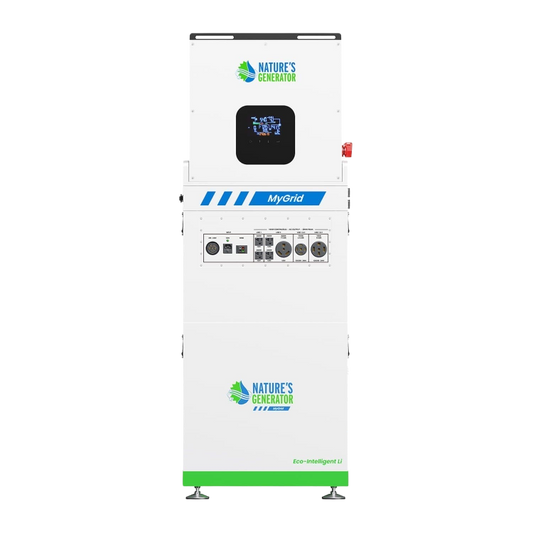
A standard portable power station with a small battery will be depleted in less than an hour by a 1,500-watt heater. However, our Powerhouse V2 is specifically engineered to handle these high-demand appliances.
Why the Powerhouse is the Right Choice:
-
Continuous Power Output: The Powerhouse provides 7,200W of continuous power, meaning it can easily handle the 1,500W draw of a space heater while simultaneously running your refrigerator, lights, and internet router.
-
Expandable Capacity: We all know that heating is the biggest challenge during a winter grid failure. By adding Power Pods (specifically for the Powerhouse system), you increase your watt-hour capacity, allowing the heater to run for extended periods throughout the night.
If you are preparing for emergency scenarios, we recommend using the heater on its "Medium" or "Low" setting (750W) when running on battery power to double your runtime without sacrificing too much localized warmth.
What Are the Different Types of Space Heaters and Which Are Most Efficient?
Not all watts are created equal when it comes to how they make you feel. Based on our team’s evaluation of various heating technologies, the "efficiency" of a heater depends more on the application than the wattage.
1. Ceramic Fan-Forced Heaters
These are the most common. They use electricity to heat a ceramic element, and a fan blows the heat into the room.
-
Best for: Quickly warming up a small to medium room.
-
Efficiency: High, but the heat dissipates quickly once the unit is turned off.
2. Infrared Heaters
Infrared heaters emit electromagnetic waves that heat objects and people directly rather than the air.
-
Best for: Specific "spot" heating. If you are sitting at a desk or on a couch, an infrared heater can keep you warm while using less energy because it doesn't need to heat the entire volume of air in the room.
-
Pro Tip: Our customers often find that a 1,000W infrared heater feels as warm as a 1,500W ceramic heater, saving 33% on energy consumption.
3. Oil-Filled Radiators
These look like old-fashioned radiators but are powered by electricity. The heating element warms the oil inside, which then radiates heat.
-
Best for: Consistent, long-term heating in a bedroom.
-
Efficiency: They take longer to heat up but stay warm long after the power is cut, making them excellent for use during intermittent power cycling.
How Do I Choose the Best Nature’s Generator System for Winter Heating?
When choosing a backup solution for heating, you must look at both the Inverter Rating (can it handle the 1,500W surge?) and the Battery Capacity (how long will it last?).
The Entry-Level Option: Nature’s Generator Elite
The Elite system has a 3,600W peak / 2,880W continuous inverter. It can easily handle a 1,500W space heater. With a 1,200Wh internal battery, it will run a heater on high for about 45–50 minutes. We suggest this for short-term emergency use or for powering smaller 500W personal heaters for several hours.
The Whole-Home Option: Nature’s Generator Powerhouse
For those serious about winter preparedness, the Powerhouse V2 system bundle is the gold standard. With its 120V/240V output, it can even support certain 240V baseboard heaters or large-scale space heaters.
-
Scenario: A customer in Maine reported using their Powerhouse system with four solar panels to keep an 800W oil-filled radiator running in their "safe room" during a 48-hour blizzard outage. By focusing on one room, they maintained a comfortable 68°F while the rest of the house dropped to near freezing.
How Can I Reduce a Space Heater’s Power Consumption?
Efficiency is as much about conservation as it is about power generation. Our team recommends the following practical steps to maximize your heater's effectiveness:
-
The "Zone Heating" Strategy: Instead of cranking up your central furnace (which might use 5,000+ watts or heavy amounts of gas/oil), stay in one room and use a space heater. This is almost always more cost-effective.
-
Check for Drafts: Use a door snake or weather stripping. A space heater pulling 1,500 watts in a drafty room is fighting a losing battle.
-
Use a Timer or Thermostat: Many modern heaters have built-in thermostats. Set it to a specific temperature rather than "Max" so the unit cycles on and off, significantly reducing total watt-hour consumption.
-
Lower the Ceiling Fan: If you have a ceiling fan, run it in reverse (clockwise) at a low speed. This pushes the warm air that has risen to the ceiling back down to the floor level where you actually need it.
Safety Considerations: Can I Plug a Space Heater into a Power Strip?
No. Based on our experience and fire safety standards, you should never plug a space heater into a power strip or extension cord. Because a heater pulls a near-maximum load for hours at a time, it can easily overheat the smaller gauge wiring found in most power strips, leading to a fire hazard.
When using a Nature’s Generator, always plug the heater directly into the AC outlets on the front of the generator. Our systems are built with heavy-duty internal wiring designed to handle continuous high-current draws, providing a much safer alternative than daisy-chaining cheap extension cords.
Balancing Warmth and Wattage
Knowing exactly how many watts a space heater uses is the first step in taking control of your home’s energy independence. While 1,500 watts is the standard, the way you manage that power—whether through choosing more efficient infrared technology or utilizing a solar backup system—makes all the difference.
At Nature’s Generator, we believe that no one should have to choose between a high electric bill and staying warm. By integrating Nature’s Generator products into your home, you gain the ability to run essential heating appliances using clean, renewable energy. Whether you are preparing for the next big storm or just looking to lower your monthly overhead, understanding your wattage is the key to a smarter, warmer home.


