


If you already have solar panels on your roof, you might assume they will keep your lights on when the utility power goes out. Unfortunately, during a blackout, standard rooftop systems shut down automatically. That is why so many homeowners ask how to add battery storage without throwing away their perfectly good solar inverter.
Whether you need reliable backup power during severe weather, a clean solar power generator setup to capture excess sunlight, a heavy-duty whole home power generator to run major appliances, or portable backup power for essential gear, retrofitting is surprisingly straightforward.
In this guide, our team explains how you can easily connect batteries to your current solar panels. We will break down how AC coupling works, step-by-step installation options, ways to lower your monthly electric bills, and how adding energy storage keeps your home powered around the clock.
Why Do Traditional Grid-Tied Solar Panels Shut Down During a Power Outage?
It comes as a big surprise to many solar owners: the sun is shining brightly during a daytime power outage, yet none of the outlets in the house work. In our experience working with home solar installations, people often think their system is broken. In reality, your solar setup is doing exactly what it was designed to do for safety reasons.
The Safety Switch Behind the Shutdown
Standard rooftop solar systems are tied directly to the utility grid. By law, grid-tied inverters must include an automatic safety feature called anti-islanding.
When power lines go down during a storm or emergency:
-
The utility grid stops sending electricity to your home.
-
Your solar inverter detects that loss of power and turns itself off in a fraction of a second.
-
This shutdown stops your panels from sending dangerous electricity back onto the power lines, protecting line workers who are making repairs.
Why Panels Cannot Power Your Home Alone
Your rooftop solar panels make direct current (DC) electricity, which your solar inverter changes into alternating current (AC) electricity for your home appliances. However, traditional grid-tied inverters need a steady electrical signal from the power company to keep working.
Without that signal from the grid:
-
Your solar inverter loses its timing guide.
-
The system stays completely shut down.
-
Zero solar power reaches your appliances, even on a clear, sunny afternoon.
To keep your solar panels working during a blackout, you need a system that can create its own local electrical signal. This signal tricks your existing solar inverter into turning back on safely while disconnecting your home from the main grid.
How Can You Add Batteries to Solar Panels Without Buying a New Inverter?
You do not need to tear down your current system or buy an expensive hybrid inverter to add battery storage. The easiest way to upgrade an existing rooftop system is through a process called AC coupling.
How AC Coupling Works in Plain English
In a standard solar setup, your panels send power to your existing inverter, which turns it into AC electricity for your home. When you add an AC-coupled battery system, you plug the battery system directly into your home's main electrical panel or a subpanel on the AC side.
Here is how energy flows through an AC-coupled system:
-
Normal Daytime: Your rooftop panels generate solar power and send AC electricity into your home panel as usual.
-
Charging the Battery: Any extra solar power that your home does not use right away flows straight into your new battery backup unit to recharge it.
-
During an Outage: An automatic switch safely disconnects your home from the power company. The battery system immediately starts generating its own internal AC power signal.
-
Continuous Solar Power: Your existing solar inverter detects this new signal, turns back on, and keeps powering your lights while charging your batteries with daytime sunlight.
AC Coupling vs. Total System Replacement
AC coupling is the most cost-effective path for retrofitting an existing rooftop array. You get full blackout protection while preserving every dollar you already spent on your solar installation. You can learn more about how AC coupling solutions keep existing solar setups running without replacing equipment.
How Does the Nature’s Generator MyGrid 10K Power an AC-Coupled Solar Retrofit?
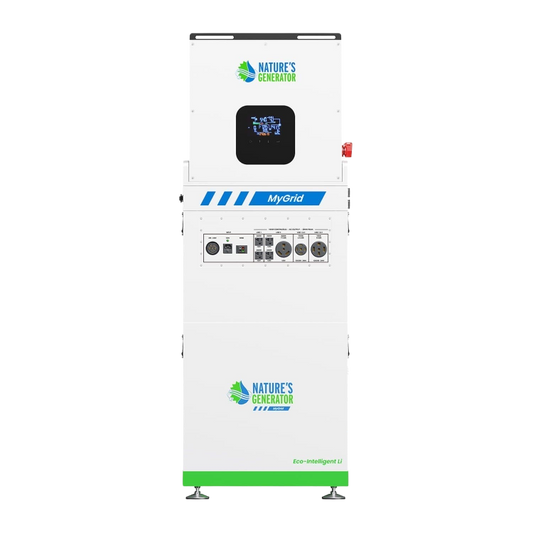
To run heavy household appliances and keep your existing solar panels online during a blackout, you need a strong, dependable energy storage hub. The Nature’s Generator MyGrid 10K Whole Home Generator was created to serve as a high-output battery system that integrates smoothly with existing grid-tied solar arrays.
Key Capabilities of the MyGrid 10K System
Our technical team designed the MyGrid 10K with features that make retrofitting simple and reliable:
-
Massive Power Output: Provides 10,000 Watts of continuous power with a 20,000-Watt surge capacity. This allows it to easily start and run 120V and 240V appliances like central air conditioners, well pumps, water heaters, and refrigerators.
-
Safe, Long-Lasting Battery: Built with a 10,496Wh Lithium Iron Phosphate (LiFePO4) battery pack. LiFePO4 chemistry is exceptionally safe, resists overheating, and lasts for over 6,000 charge cycles—meaning years of daily use.
-
Easy Capacity Expansion: You can expand the storage capacity up to 73.4kWh by plugging in additional battery expansion units as your family's energy needs grow.
-
Fast Power Switching: Connects to an automatic transfer switch that senses grid failures and switches your home over to battery power in less than 20 milliseconds.
-
Dual Charging Options: Charges directly from your existing solar panels via AC power, recharges from a wall outlet, or accepts up to 12,000W of direct DC solar input from additional ground panels if you want to expand your solar array later.
When connected to your electrical system, the MyGrid 10K supplies the steady AC signal your rooftop solar inverter needs. That means during an outage, your panels keep making energy, your home stays fully powered, and any extra solar energy charges your battery bank for nighttime use.
What Is the Step-by-Step Process for Installing an AC-Coupled System?
Retrofitting your home with battery backup is simpler than putting in a brand-new solar system. In our experience, breaking the project into clear, manageable steps makes the installation process fast and stress-free.
Step 1: Figure Out Your Essential Energy Needs
Start by making a list of the appliances you must run during a blackout. While a 10,000W output system can handle most whole-home needs, knowing your main energy draws—like refrigerators, medical gear, well pumps, or air conditioning—helps you decide how much total battery capacity you need.
Step 2: Install an Automatic Transfer Switch or Subpanel
A licensed electrician installs an automatic transfer switch or a critical loads panel between your main circuit breaker box and your essential household appliances. This switch acts as a safety gate. When the neighborhood power drops, it shuts off the connection to the street so your power does not leak onto the public grid.
Step 3: Wire the AC Coupling Connection
Your electrician connects the AC output from your current solar inverter panel to the input on your new battery storage system. This allows power to move both ways: solar energy charges the battery during the day, and the battery powers your home at night or during blackouts.
Step 4: Test the System
Once everything is wired, your electrician simulates a power outage by flipping the main utility breaker. The transfer switch flips instantly, the battery system creates its local AC signal, and your rooftop solar panels keep producing electricity without skipping a beat.
Example Scenario: Keeping the Power On in California
Take Mark, a homeowner in northern California who has a 6.5kW rooftop solar system with microinverters. During summer heatwaves and wildfire season, local power companies often turn off the grid for days. Mark's rooftop panels used to shut down, leaving his house without light or refrigeration despite bright, clear weather.
Local solar installers quoted Mark over $18,000 to replace his working microinverters with a proprietary battery brand. Instead, Mark retrofitted his setup using the Nature’s Generator MyGrid 10K along with an automatic transfer switch. An electrician completed the hookup in a single afternoon. Now, when the neighborhood grid goes dark, Mark’s rooftop panels stay active, running his refrigerator, home office, well pump, and mini-split air conditioner while storing extra energy to carry his family through the night.
How Does Adding Battery Storage Lower Your Energy Bills Every Month?
Adding a battery retrofit does far more than protect your family during emergency blackouts. It can also save you money on your electric bill every single day. Power companies across the country are changing how they charge for electricity, making home battery storage a smart financial decision.
Beat High Evening Electricity Rates
Many utility companies use Time-of-Use (TOU) pricing, where electricity costs much more during peak hours—usually between 4 PM and 9 PM when everyone gets home from work. Unfortunately, this is right when rooftop solar production starts to drop off for the evening.
With an AC-coupled battery setup:
-
Your solar panels power your home and charge your battery bank during the cheap, sunny daytime hours.
-
When expensive peak rates kick in at 4 PM, your system automatically switches over to run your house on stored battery power.
-
You stop buying overpriced electricity from the power company during peak hours, cutting your monthly power bill significantly.
Charge During Cheap Overnight Hours
If you live in an area with cold winters or long cloudy periods where solar output is lower, you can program your battery system to charge from the grid overnight when power rates are lowest. You can then use that cheap stored power during the day when utility rates go back up.
How Much Battery Capacity Do You Need for Your Home?
Choosing the right amount of battery storage comes down to what appliances you want to run and how long you need backup power if the sun is not shining.
Typical Household Appliance Power Usage
Essential Backup vs. Whole-Home Independence
-
Essential Circuit Backup (10.24 kWh): A single MyGrid 10K base system provides 10,496Wh of power. That is plenty of energy to keep your critical loads—like your refrigerator, lights, Wi-Fi, television, and well pump—running for 24 to 48 hours without any sun at all. When paired with active daytime solar panels, your backup runtime can extend indefinitely.
-
Whole-Home Power (20 kWh to 73.4 kWh): If you want to power heavy 240V loads like central air conditioning, electric heat pumps, or electric vehicle chargers without worrying about energy use, you can stack extra battery units onto your system. The modular design lets you start with what fits your budget today and add more battery modules whenever you choose.
What Mistakes Should You Avoid When Upgrading Your Solar Setup?
Retrofitting battery storage is simple, but avoiding a few common missteps will ensure your system works safely and efficiently for years to come.
1. Buying a System That Cannot Handle 240V Power
Many standard portable power stations only supply 120V power. However, large household appliances like central air conditioners, well pumps, and electric water heaters require split-phase 120V/240V power. Make sure your retrofit battery system naturally provides 120V/240V split-phase output so you can run every appliance in your house without needing complicated adaptors.
2. Choosing an Inflexible, Non-Expandable System
Your family’s power needs might change over time. You might buy an electric car, add a heat pump, or build an addition onto your home. Buying a rigid, non-expandable battery locks you into a fixed capacity limit. Choosing a system with modular plug-and-play battery add-ons allows you to grow your power storage easily without buying a new system.
3. Forgetting About Automatic Transfer Switches
Connecting a powerful battery system directly to your breaker box without an automatic transfer switch is unsafe and violates electrical codes. An automatic transfer switch ensures that power switches cleanly from the grid to your battery within milliseconds, keeping your family safe and protecting power company line workers.
Conclusion
Retrofitting battery storage onto your existing rooftop solar array does not have to be complicated or expensive. By using AC coupling, you can connect modern battery storage straight into your existing electrical panel without replacing your current solar inverter or voiding your original equipment warranties.
When you upgrade your system, you turn a standard daytime solar setup into a 24/7 home power system that keeps your family safe, comfortable, and fully powered through blackouts while lowering your monthly energy bills. If you want a dependable, expandable, high-output energy hub, Nature’s Generator offers reliable home backup solutions designed to bring complete energy independence to your household.


