


The dream of absolute energy independence boils down to one cool image: a Tesla sitting in the driveway, sipping nothing but pure sunshine. As folks across the country ditch the gas pump for the plug, the conversation is pivoting from "how do I save a buck?" to "how do I cut the cord entirely?" Making that leap isn't just about sticking a few panels on the roof; it requires a rock-solid plan for reliable backup power so you aren't left high and dry when the clouds roll in. While the tech is definitely there, juicing up an EV with a solar power generator is a bit of a balancing act involving heavy-duty math and the right gear.
In our neck of the woods, we’ve seen it all—from DIY disasters to seamless off-grid setups. At Nature’s Generator, we’ve spent years tinkering with systems designed to bridge that gap between a hobbyist’s solar kit and a legit, self-sufficient powerhouse. This blog is going to lay it all out: how much sun you actually need to harvest, the hardware that’s a total deal-breaker, and whether a 100% sun-powered Tesla is actually doable for a regular person. To make it happen, you’ll need a whole home power generator that doesn't blink at high loads, plus maybe some portable backup power for those weekend trips off the beaten path.
How much "juice" does a Tesla actually gulp down for a daily commute?
Before you go off-grid, you’ve got to know the size of the "tank" you’re filling. A Tesla Model 3 or Model Y usually sports a battery somewhere in the 75 kWh to 82 kWh neighborhood. If you tried to fill that from empty to full in one go, you’d be pulling more power than a typical American house uses in two whole days. That’s a tall order for any setup.
But let’s be real: most of us aren't draining the battery to zero every single day. Based on what we see from our community, the average person is doing maybe 30 or 40 miles a day. Since a Tesla gets about 3 or 4 miles per kWh, you’re looking at needing to replace roughly 10 to 15 kWh daily.
Here’s the kicker, though: charging isn't 100% efficient. You lose energy to heat and the "middleman" conversion from DC to AC and back again. To cover that 40-mile trek, your solar rig needs to churn out about 17 kWh of dedicated power—and that’s after you’ve accounted for your fridge, the lights, and the AC.
Is the MyGrid 10K the right scale for charging an EV?
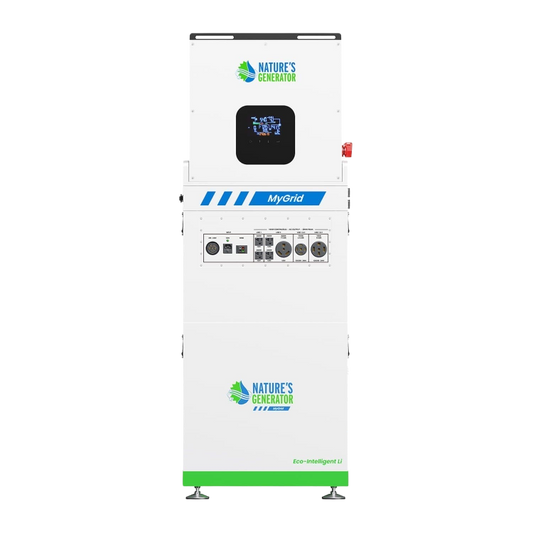
When we talk about serious energy needs, our team points customers toward the Nature's Generator MyGrid 10K. If you are trying to balance the needs of a modern home with the charging demands of a Tesla, you can't rely on tiny backup batteries. The MyGrid 10K acts as a robust whole home power generator that provides a massive 10kWh storage capacity right out of the gate.
The real beauty of this system is that it’s designed to be the primary energy hub. Based on our experience, having a 10,000-watt output capacity means you aren't just "getting by." You can actually run your home's essentials while still having enough headroom to plug in your vehicle. For many of our users, the MyGrid 10K is the best choice where off-grid living stops feeling like a sacrifice and starts feeling like a smart, high-tech upgrade.
How many solar panels do you need to keep a Tesla moving without the grid?
This is where the math gets a little hairy. You can't just match the panel's sticker price to the car's battery. You have to account for "Peak Sun Hours"—which is basically how much prime-time sunlight your backyard actually gets.
Let’s look at this example:
-
The Goal: 17 kWh (daily drive + efficiency losses).
-
The Sun: 5 solid hours of peak light.
-
The Math: 17,000 Watts divided by 5 hours = 3,400 Watts of panels.
If you’re using 400W panels, you’d need 9 of them just for the car. Total energy independence usually means you’ll want to over-build your array by at least 20% to handle the "gray days." Systems like the Nature’s Generator Powerhouse Platinum System are built to scale up, which is a lifesaver when you realize you need more surface area to catch those rays.
Why a whole home power generator is the "secret sauce" for night charging
Unless you're a homebody, your car is usually out and about during the day when the sun is actually shining. Since panels don't work in the dark, you have to catch the energy during the day, store it in a massive battery bank, and then dump it into the car at night.
This is exactly why having reliable backup power is the engine of the whole operation.
-
The Direct Way: You plug in at high noon. Panels feed the car directly. Super efficient, but only works if you don't have a day job.
-
The Buffer Way: You're at work while your solar panels juice up your home batteries. You get home at 6:00 PM, plug in the Tesla, and the energy moves from the big house battery to the car.
This second way requires some serious storage capacity. If you want to put 20 kWh into your car overnight, your house battery needs to be at least 25 or 30 kWh so you don't accidentally kill the lights while trying to top off the Tesla.
What’s the "real talk" on the challenges of off-grid EV life?
On paper, it looks easy. In the real world? It can be a bit of a curveball. We’ve talked to plenty of folks who’ve made the switch, and a few things always pop up:
-
The Winter Blues: In December, your solar production might tank by half. A setup that’s a beast in July might struggle to get you to the grocery store in January.
-
Vampire Loss: Teslas are "always on." Things like Sentry Mode or just checking the app pull power. When you're off-grid, every watt counts.
-
Inverter "Tax": Every time you convert power (DC to AC), you lose a bit. It’s like a tax you have to pay to use your own electricity.
One of our customers put it best: "I found out the hard way that on a rainy Tuesday, it was either the dryer or the car. I ended up adding more portable backup power pods to my Nature’s Generator setup just to have that extra 'fuel' in the tank for emergencies."
Is the "Solar-to-Tesla" lifestyle actually worth the squeeze?
Whether it's "worth it" depends on your "why." If you live somewhere like California where electricity prices are through the roof, a solar rig pays for itself way faster.
But for a lot of our people, it’s about more than just the ledger. It’s about being "un-killable." When the grid goes down, most people with standard solar are stuck in the dark because their systems are tied to the utility company. By using Nature’s Generator as a source of reliable backup power, you’ve got your own personal power plant and gas station. You aren't just saving money; you're buying freedom.
Can you go 100% solar with your EV?
The short answer? Absolutely. But don't go into it half-cocked. You need to move past the small-scale gadgets and look at a whole home power generator like the MyGrid 10K that can handle the heavy lifting of a 240V EV charger.
Do an honest audit of your mileage, check your local sun levels, and make sure your battery bank is big enough to act as a proper reservoir. By starting with a system that can grow—like the ones we build at Nature’s Generator—you can ease into the off-grid life without feeling the pinch. At the end of the day, there's nothing quite like the feeling of driving on "free" sunshine, knowing you’ve got the reliable backup power to do it all over again tomorrow.


