


Can AC-coupling really cut your electricity bill by $200+ a month?
Yes, it can for the right home. The key is using less electricity from the grid by storing solar energy and using it when your home needs it most.
AC-coupling adds battery storage to an existing grid-tied solar system. Instead of sending unused solar power back to the grid during the day and buying electricity again at night, you can store that excess energy and use it later.
For homeowners looking for reliable backup power, a solar power generator, a whole home power generator, or portable backup power, this creates two benefits at once: lower electricity costs and more protection during outages.
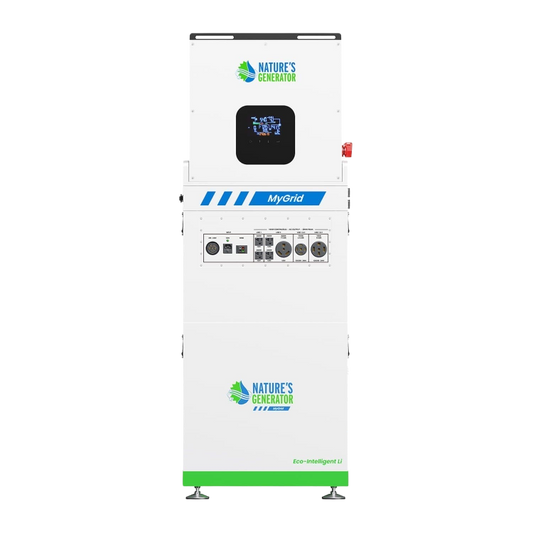
Nature’s Generator's MyGrid 10K is designed for this type of setup. It can connect to an existing grid-tied solar inverter through AC-coupling, allowing homeowners to add battery storage without automatically replacing their current solar inverter.
So, how does this potentially save $200 or more a month? It comes down to using more of your own solar power, shifting energy away from expensive times of day, and reducing how much electricity you buy from the grid.
What is AC-coupling and how does it work?
AC-coupling is a way to add batteries to an existing solar installation.
Your solar panels produce electricity during the day. Your current solar inverter converts that electricity into AC power for your home. With an AC-coupled battery system, excess solar can also be sent to the battery and stored for later use.
The basic flow looks like this:
Solar panels → solar inverter → home + battery storage → home
During daylight hours, your home runs on energy from the solar panels first. When production is higher than your household demand, the extra energy can be stored.
At night, when your solar panels are no longer producing electricity, the battery can provide power to your home.
That means you are not limited to using your solar energy only when the sun is out.
Nature’s Generator’s AC-Coupling solution is designed to add this storage capability while keeping the existing grid-tied solar inverter in place.
Why is that useful for an existing solar system?
Because many homes produce their most solar energy when they need the least electricity.
Imagine your solar panels are producing heavily at noon while everyone is at work or school. Then, at 7 p.m., everyone is home, the air conditioning is running, dinner is being cooked, and the television is on.
Without battery storage, you may export some of your daytime solar and buy electricity from the grid in the evening.
With a battery, you can store some of that midday energy and use it after sunset.
That is the basic idea behind energy shifting.
How does battery storage create monthly savings?
Battery storage does not create free electricity. It helps you use more of the electricity your solar system is already producing.
For example, imagine your home avoids buying 700 kWh from the grid in one month.
If your average electricity cost is $0.30 per kWh:
700 kWh × $0.30 = $210
That is $210 in avoided electricity costs.
Your real savings will depend on your electricity rates, solar production, energy use and battery capacity. Nature’s Generator says its MyGrid 10K can help some homeowners reduce electricity costs by up to 70%, depending on factors such as energy usage, electricity rates and system size.
So, the $200+ figure is possible, but it should be treated as a realistic scenario for the right home rather than a guaranteed result.
Which homes are most likely to save $200+?
Homes with higher electricity use generally have more opportunities to reduce grid purchases.
A good candidate might have:
-
An existing rooftop solar system
-
High daytime solar production
-
Heavy evening electricity use
-
Air conditioning or other larger electrical loads
-
A time-of-use electricity plan
-
Enough battery capacity to store meaningful amounts of energy
Consider a family with solar panels that generate excess electricity during the afternoon. The battery stores that energy. Later, when the family gets home and electricity demand rises, the stored power can help cover the evening load.
That can reduce the amount of electricity purchased from the utility at a time when rates may be higher.
Another example is a home with frequent evening usage from HVAC, cooking, refrigeration, lighting, computers and entertainment systems.
The more electricity your home uses after solar production falls, the more value there may be in storing daytime solar.
Is AC-coupling better than replacing an entire solar system?
For many homeowners with working solar equipment, AC-coupling can be a practical way to add storage without rebuilding the whole system.
With an AC-coupled setup, the existing solar inverter can remain in operation while battery storage is added separately.
That makes it particularly attractive for homeowners who already invested in solar and now want better energy storage and backup capability.
Here is the basic comparison:
Nature’s Generator specifically positions the MyGrid 10K as an AC-coupled option for existing grid-tied solar systems.
For many homeowners, the appeal is simple: add storage instead of starting over.
How much battery storage do you need?
The right battery size depends on how much electricity you want to store and what you want to power.
The MyGrid 10K has a battery capacity of 10,496 Wh and up to 10,000 W of continuous output. It also uses LiFePO4 battery technology and can support additional battery capacity.
A household mainly interested in essential backup loads may need less storage than a household trying to run larger appliances throughout the evening.
Start with your actual electricity usage.
Look at your utility bill and identify:
How much electricity do I use each month?
How much solar energy do I generate?
How much of that solar energy is used immediately?
How much is available to store?
How much electricity do I use after sunset?
The answers will give you a much better idea of the battery capacity you need than simply choosing the largest system available.
Can the same system lower your bill and provide backup power?
Yes. That is one of the biggest advantages of a hybrid setup.
On normal days, the system can help reduce grid purchases by storing solar energy for later.
During an outage, the stored energy can provide backup power, depending on the system configuration and which circuits are connected to the backup setup.
Nature’s Generator offers MyGrid 10K AC-coupling configurations with an automatic transfer switch option designed for different backup needs, including essential circuits and broader whole-home applications.
That means your battery does not have to sit idle waiting for a blackout.
It can work every day to manage energy costs.
Think about it this way:
Sunny day: Solar powers your home and charges the battery.
Evening: Stored energy helps reduce grid usage.
Peak-rate period: Stored energy can help avoid higher electricity prices.
Power outage: The battery becomes your backup source.
You get everyday value and emergency value from the same system.
What does customer feedback say about real-world savings?
Customer feedback can show how these systems perform in everyday homes, although results vary.
Nature’s Generator features customer John Darell from Los Angeles, who says his family's electricity bill dropped by nearly 70% after switching to the system.
That is a strong result, but it should not be viewed as a guaranteed outcome.
A home with low energy consumption or limited solar production has less opportunity to reduce its utility bill.
A home with strong solar generation, high electricity use and substantial evening demand has more room to benefit.
Customer feedback also highlights another practical advantage: battery storage can reduce dependence on the grid during outages while keeping important household devices running.
The bigger takeaway is that the battery is useful throughout the year—not only when the grid fails.
How should you use a hybrid system to get the most value?
The simplest approach is to match battery use to your household's daily energy pattern.
During the day, use solar energy directly whenever possible.
When your solar system produces more electricity than your home needs, store the surplus.
In the evening, use that stored energy instead of immediately buying electricity from the grid.
Where your electricity plan supports it, you can also use off-peak charging to store lower-cost electricity and use it during more expensive periods. Nature’s Generator highlights scheduled off-peak charging as part of its energy-saving strategy.
The goal is simple:
Use solar when the sun is out. Store the extra. Use it when grid electricity costs more.
That is how a battery can move beyond backup power and become part of your everyday energy strategy.
When might AC-coupling not save $200 a month?
AC-coupling is not automatically a $200-a-month solution for every household.
Savings may be lower if you have low electricity usage, limited excess solar, low electricity rates or most of your energy demand happens during sunny hours.
Battery storage also has an upfront cost, so you should compare expected savings with the full system and installation cost.
For example:
$200 per month = $2,400 per year
$100 per month = $1,200 per year
That gives you a simple starting point for thinking about payback.
The best approach is to use your own utility bills and solar production data rather than relying on a generic savings estimate.
Is the MyGrid 10K a good fit for an AC-coupled home?
The MyGrid 10K makes sense for homeowners who want more than basic emergency backup.
Its 10,496 Wh battery capacity and 10,000 W continuous output make it suitable for higher-capacity home energy applications, while its AC-coupling capability allows it to work with an existing grid-tied solar setup.
It can be a strong choice when you want to:
Store excess solar
Reduce grid purchases
Shift energy into the evening
Prepare for outages
Expand storage as your needs grow
If your main goal is simply keeping a few essential devices running during a short outage, a smaller solution may be enough.
If your goal is to combine solar savings, energy storage and broader home backup, a higher-capacity hybrid system may make more sense.
Can AC-coupling really reduce your bill by $200+?
It can for a household with the right combination of solar production, electricity usage, rates and battery capacity.
The math is simple:
700 kWh avoided × $0.30/kWh = $210
That is how a $200+ monthly reduction can happen.
The real question is how much electricity your own home can realistically avoid buying from the grid.
Look at your monthly usage, solar production, evening demand and electricity rates. Then size the battery around the amount of energy you can actually use.
The right system can do more than provide power during a blackout. It can help turn daytime solar generation into nighttime savings.
For homeowners who already have solar, Nature’s Generator offers a practical way to add storage through AC-coupling while keeping the existing grid-tied inverter in the system.
Use more of the energy you make. Buy less of the energy you need. And keep backup power ready when the grid goes down.


