


Hybrid clean energy is becoming a practical choice for homeowners who want lower electricity bills and dependable backup during power outages. By combining solar panels, battery storage, and other compatible charging sources, households can make better use of the energy they produce.
At Nature’s Generator, we believe a good home energy system should do more than generate electricity on sunny days. It should provide reliable backup power, help homeowners get more from a solar power generator, support the needs of a whole home power generator, and offer portable backup power when and where it is needed.
But why is 2027 an important time to consider hybrid clean energy? And is solar power alone enough to keep your home running during an outage? This guide explains the latest energy trends, compares different system setups, and helps you choose the right backup solution for your home.
Why is hybrid clean energy becoming more important in 2027?
Hybrid clean energy is gaining attention because electricity demand is growing, renewable energy is expanding, and homeowners want more control over how they use and store power.
The U.S. Energy Information Administration (EIA) forecasts that solar electricity generation will grow by 18% in 2027, while wind generation will increase by 5%. Its October 2026 outlook also points to continued growth in electricity use across the United States. Read the EIA's electricity outlook.
What does this mean for homeowners?
As more electricity comes from renewable sources, storing energy and using it at the right time become increasingly important. A home may produce plenty of solar power during the afternoon but still need electricity for cooling, cooking, lighting, and other appliances after sunset.
Hybrid systems help bridge this gap. They can combine solar panels with battery storage and, where suitable, additional charging sources such as wind or AC power.
The main reason to consider hybrid energy in 2027 is simple: generating electricity is only half the job. Having power available when you need it matters just as much.
Why isn't solar power alone enough for home backup?
Solar panels produce electricity when sunlight is available. Their output can drop during cloudy weather and stops after sunset. Without battery storage or another available power source, a solar-only setup cannot provide continuous independent power.
Here are four common situations where solar alone may fall short.
-
At night: Your panels cannot generate electricity after sunset, even though your refrigerator, Wi-Fi router, and other appliances may still be running.
-
During cloudy weather: Lower solar production means less energy is available to run appliances or recharge a battery.
-
During a long outage: Several days of poor weather can make it harder to generate enough electricity for your household.
-
During high-demand periods: Your family may need more electricity in the evening than your panels can produce at that moment.
There is another important detail to understand. Standard grid-tied solar systems generally shut down during a utility outage for safety reasons unless they have compatible equipment that allows them to operate independently.
That means having solar panels on your roof does not automatically mean your home will have power during a blackout.
Adding a compatible battery and backup equipment can help keep selected circuits running. The system must be designed to support the loads you want to power.
Solar remains a valuable source of clean electricity. The challenge is making that energy available when sunlight is limited.
What does a hybrid home energy system include?
A hybrid home energy system combines different ways to produce, store, or supply electricity. The goal is to make power available across changing weather conditions and household needs.
Solar panels generate electricity
Solar panels are usually the starting point. They capture sunlight and convert it into electricity that can power appliances, charge batteries, or reduce how much electricity you buy from the utility.
Homeowners can choose roof-mounted panels, ground-mounted panels, or portable panels, depending on available space and how they plan to use their system.
Batteries store power for later
Battery storage allows your household to use electricity that was generated earlier.
For example, solar panels may produce more electricity than you need at noon. A compatible battery can store some of that energy for use in the evening or during an outage.
When comparing batteries, check two important specifications:
-
Power output, measured in watts (W) or kilowatts (kW): How much electricity the system can deliver at one time.
-
Battery capacity, measured in watt-hours (Wh) or kilowatt-hours (kWh): How much energy the battery can store.
A system may have enough stored energy to run an appliance for several hours but still lack the power output needed to start a large air conditioner or another high-demand device.
Wind turbines can provide another charging source
Wind power can supplement solar energy in locations with suitable wind conditions. A compatible turbine may generate electricity when solar production is low, including at night.
However, wind power is not practical for every home. Wind speed, turbine placement, mounting requirements, local rules, and equipment compatibility all affect the results.
AC charging adds flexibility
Some systems can also recharge through a compatible AC power source. This can be useful when solar production is low or when a household needs to prepare its battery before a storm.
Not every system supports every charging method, so check the manufacturer's specifications before purchasing additional equipment.
A hybrid system can use just two or more energy sources, so you don’t need solar, wind, and batteries all together. Solar plus a battery can be enough for many households. Adding wind or other charging options makes sense when they solve a specific problem.
Is solar with a battery better than solar with wind power?
For many homeowners, solar panels with battery storage are the simplest place to start. Adding wind power may provide more flexibility, but the extra equipment is only worthwhile when local conditions support useful electricity generation.
|
System setup |
Best for |
Main limitation |
|
Solar panels only |
Daytime electricity generation |
Limited power availability after sunset |
|
Solar plus battery |
Evening use and essential backup |
Stored energy can run low during a long outage |
|
Solar, battery, and wind |
Homes with suitable sunlight and wind |
Higher cost and additional setup requirements |
|
Solar, battery, and AC charging |
Flexible charging and everyday backup preparation |
AC charging depends on an available power source |
Imagine a household that uses most of its power after the sun goes down. Solar panels may generate surplus electricity during the day, and a battery can store some of that energy for later use.
Now consider a rural property where strong winds are common and solar output changes significantly throughout the year. Adding a compatible wind turbine may provide another way to recharge the battery.
The important question is not which setup has the most features. It is which setup gives your household the best balance of cost, usable energy, and backup reliability.
Which Nature's Generator system should you consider?
The right system depends on which appliances you want to power, how long you need them to run, and whether you want portable backup or support for household circuits.
For portable backup and essential appliances
The Nature's Generator Lithium 3600 Solar and Wind Generator is worth considering for homeowners who want portable power with solar and wind charging options.
It provides 3,600W of continuous power and a 3,072Wh LiFePO₄ battery. The system supports compatible solar, wind, and AC charging, and its storage capacity can be expanded with additional compatible battery units.
This setup may suit households that need to power a refrigerator, lights, communication devices, and other appropriately rated appliances during an outage.
Before choosing it, estimate how much energy those appliances use and how often you expect to recharge the battery. Portability and expandability are useful, but actual runtime depends on your connected loads.
For larger backup loads
The Nature's Generator Powerhouse Solar and Wind Power Generator provides up to 7,200W of output and 4,800Wh of battery capacity, with 120V and 240V output options.
Its solar-and-wind charging setup gives homeowners another option when they want to support larger loads or explore off-grid power.
It may be suitable for a property with several essential appliances, tools, or compatible equipment that requires more output than a smaller portable system can provide. Additional battery capacity can also help extend runtime.
Remember that a high power rating does not guarantee that every appliance can run all day. Battery capacity, startup requirements, and available charging power still determine what the system can support.
For more extensive home backup
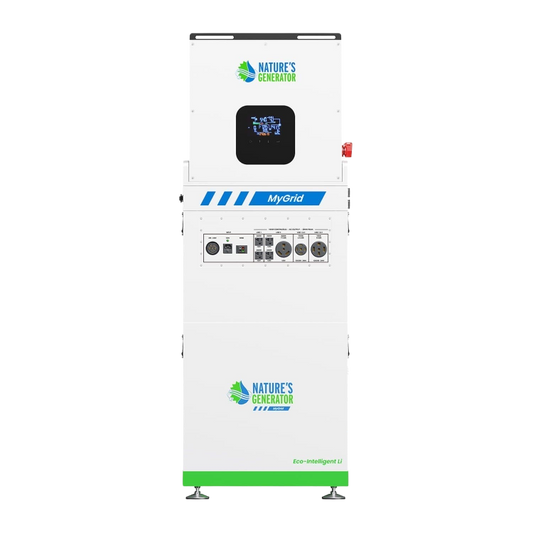
The Nature's Generator MyGrid 10K Gen 2 Solar Generator is designed for higher-demand home energy needs.
It offers 10,000W of continuous output and 10,496Wh of LiFePO₄ battery capacity. The system supports expandable storage and compatible solar charging, with additional configuration options for different home energy needs.
Homeowners considering whole-home backup should check which circuits the system can support, whether the inverter can handle the required loads, and how much stored energy is needed for their expected runtime.
A whole-home-capable system does not mean unlimited electricity. Large air conditioners, electric water heaters, cooking equipment, and other high-demand appliances can consume stored energy quickly.
Explore Nature's Generator's home backup power options to compare solutions for essential circuits and larger household needs.
How can hybrid clean energy help during a real power outage?
A hybrid system can help in several everyday situations, but the outcome depends on battery size, charging conditions, and how much electricity your household uses.
Example 1: The power goes out in the afternoon.
If the sun is shining, compatible solar panels may continue charging the battery while it supplies connected appliances. When the sun sets, the stored energy can help power those same loads.
Example 2: Cloudy weather continues for several days.
Solar production may fall, so the battery may not recharge as quickly as expected. A system with another compatible charging option can provide more flexibility when conditions allow. Reducing nonessential electricity use can also help extend runtime.
Example 3: Getting more use out of your solar power every day.
Rather than using solar power only when it’s being produced, you can save the extra energy in a battery and use it later in the evening. Depending on your utility rates and system settings, this may help reduce the amount of grid electricity you buy during more expensive periods.
For any of these scenarios, plan around your essential loads first. A refrigerator, internet router, and a few lights require a different amount of energy from a home that also needs air conditioning, laundry equipment, and electric cooking.
It is also important to use compatible transfer equipment and follow electrical safety requirements when connecting a generator system to household circuits.
What does customer feedback tell us about choosing backup power?
Questions from shoppers can reveal which product details matter most in daily use. Nature's Generator's product pages include customer questions about whether a Lithium 3600 can support continuous RV use, how to connect the wind turbine, and whether the Powerhouse can operate while charging.
These questions come down to three things: how long the system can power your devices, whether you can add more capacity or connect it to other equipment, and if it can recharge while running your appliances.
You can explore these questions on the Lithium 3600 product page and the Powerhouse product page.
For example, someone planning to use a power station in an RV needs to estimate daily consumption and make sure solar production and battery storage can keep up. A homeowner preparing for outages needs to know which appliances can run together and how the battery will be recharged.
These product-page questions are useful buying signals, not proof of guaranteed performance or customer satisfaction. Actual results depend on the setup, connected appliances, weather, and usage.
Before buying, look for feedback and product information that match your own needs. A system that works well for occasional phone charging may not be suitable for running essential household appliances through an extended outage.
What should you check before buying a hybrid backup system?
First, think about what you want your system to power. You can then compare products based on practical requirements rather than headline specifications.
-
List your essential appliances. Write down their wattage, expected hours of use, and startup requirements.
-
Estimate your energy needs. Calculate the total watt-hours or kilowatt-hours required during a typical outage.
-
Check the power output. Make sure the system can run the appliances you need to operate at the same time.
-
Compare charging options. Check the supported solar input, battery expansion options, and compatibility with wind or AC charging.
-
Plan for poor weather. Decide how you will manage your energy use if renewable generation stays low for several days.
-
Check installation requirements. For household circuits, confirm transfer-switch compatibility and follow applicable electrical codes.
-
Compare the full cost. Include panels, batteries, mounting equipment, installation, and accessories—not just the generator itself.
Taking these steps makes it easier to find a system that fits your home without paying for features you do not need or choosing a battery that cannot provide enough runtime.
Is 2027 the right time to invest in hybrid clean energy?
2027 is a useful time to review your home energy plans as electricity demand grows and renewable generation continues to expand. Every household has different needs, so one system won’t work for everyone.
Solar panels remain an effective way to generate clean electricity. Battery storage helps make that energy available at night and during outages, while wind and other compatible charging methods can provide additional flexibility where they make sense.
Nature's Generator offers options ranging from portable solar-and-wind power systems to higher-output solutions designed for home backup. Your ideal setup depends on the appliances you use, how long you need power, how you plan to recharge the system, and how much you want to spend.
Rather than choosing a system based on trends alone, start with the power your household actually needs. A well-sized system can help you make better use of clean energy every day and be better prepared when the grid goes down.


