


A reliable power supply is something most suburban homeowners take for granted—until the lights go out.
But today's grid has another challenge beyond storms and outages: getting the equipment needed to maintain and upgrade local power infrastructure. Suburban transformer delays are becoming part of a larger supply problem, especially as homes use more electricity for EV charging, heat pumps, air conditioning, and other high-demand appliances.
That is pushing more homeowners to look at energy systems they can control themselves.
In this guide, we’ll explain what transformer delays mean for homeowners, how grid supply bottlenecks can affect residential power, when a home microgrid makes sense, and how reliable backup power, a solar power generator, a whole home power generator, and portable backup power can help keep essential appliances running.
What are suburban transformer delays, and why should homeowners care?
Suburban transformer delays happen when utilities have trouble getting the transformers and related equipment needed to replace aging infrastructure, repair storm damage, or increase local grid capacity.
A transformer is a key part of the electricity system. It helps reduce the voltage coming from the utility network to a level that homes can safely use.
The problem is that transformers are not something utilities can always order and receive immediately. Manufacturing capacity, raw material shortages, specialized components, labor constraints, and strong demand can all contribute to longer lead times.
For homeowners, this matters because local electricity demand can grow much faster than neighborhood infrastructure can be upgraded.
Picture a typical suburban street.
Several homes add EV chargers. Another installs a heat pump. More families add larger air-conditioning systems. Someone starts working from home and runs a home office all day.
Each change seems small on its own. Across an entire neighborhood, however, the total electrical demand can increase significantly.
That creates a simple problem: the grid may need more capacity before the utility can deliver it.
A backup system does not replace the utility grid, but it can give homeowners another source of power while larger infrastructure projects catch up.
How are grid supply bottlenecks affecting residential electricity?
Grid supply bottlenecks can slow the replacement, expansion, and maintenance of electrical infrastructure.
The biggest issue for homeowners is not necessarily that their transformer is about to fail. It is that the electrical system around them has to keep up with changing demand.
Electricity use is becoming more concentrated and more demanding.
EV charging is a good example. A home that once had a relatively predictable evening electricity load may now add a high-power charging session after work.
Heat pumps and electric heating can create another major increase in demand, especially during extreme weather.
The result is a grid that has to handle more electricity while utilities are also dealing with aging equipment and infrastructure projects.
This is one reason homeowners are starting to think beyond simply asking:
How reliable is my utility?
They are also asking:
How much control do I have when the utility goes down?
That is where residential microgrids and home backup systems become more attractive.
What is a residential microgrid, and how does it work?
A residential microgrid is a local energy system that can combine power generation, battery storage, and household loads to provide electricity when the main grid is unavailable.
At its simplest, think of it as a smaller power network built around your home.
A residential microgrid can include:
-
Battery storage
-
Solar panels
-
Backup generators
-
Wind generation
-
Critical household circuits
-
Energy management equipment
When the utility is working normally, your home can continue using grid electricity.
When the grid goes down, the backup system can keep selected appliances—or a much larger portion of the home—running, depending on its capacity and electrical setup.
The big advantage is control.
Instead of waiting for the utility to restore service, you have stored energy and, in some systems, a way to make more.
Nature’s Generator builds systems around this idea, offering expandable battery storage and renewable charging options for homeowners who want more than a short-term emergency power source.
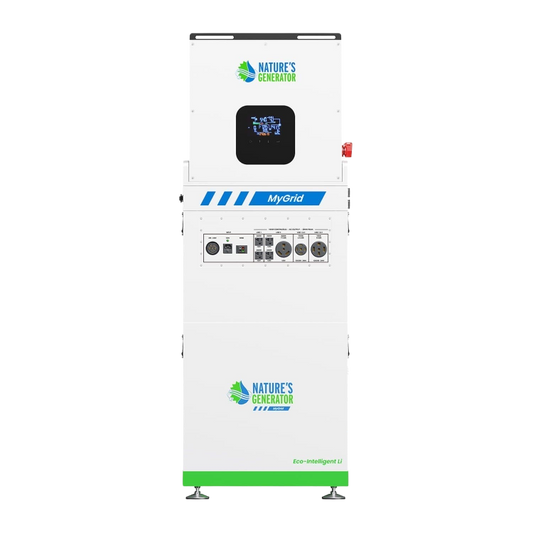
The Powerhouse Gen 2, for example, provides 120/240V split-phase output, making it suitable for larger household loads when properly installed and configured.
Is a home microgrid better than waiting for a utility upgrade?
Not necessarily. For most homeowners, the best approach is to use both.
Your utility is still the main source of electricity. A backup or microgrid system simply gives you another layer of protection.
Waiting for a utility upgrade may be perfectly reasonable if your current service is reliable and your home has modest electricity needs.
A backup system becomes more appealing when you deal with:
-
Frequent outages
-
Long restoration times
-
Critical appliances
-
High household electricity use
-
EV charging
-
Electric heating or cooling
-
Well pumps or other 240V equipment
-
Remote or less accessible properties
The important point is that you do not need to build a giant energy system just because the grid has supply problems.
Start with what you actually need.
For example, a homeowner may decide that refrigeration, Wi-Fi, lighting, phones, and a few outlets are essential. Another homeowner may need to keep a well pump, HVAC system, freezer, and other larger loads operating.
Those two homes need very different backup systems.
Which backup power system should a suburban homeowner choose?
The right setup depends on three things: how much power you need, how long you need it, and how you plan to recharge it.
Here is a simple way to think about it:
For smaller backup requirements, Nature’s Generator offers systems such as the Elite 3600, which can support essential household equipment while also allowing additional capacity to be added later.
For larger loads, the Powerhouse Gen 2 offers up to 7,200W of continuous output and 4,800Wh of base battery capacity.
The important distinction is between watts and watt-hours.
Watts tell you how much power your system can provide at one time.
Watt-hours tell you how much stored energy you have available.
So, for example, a system may have enough power to run a refrigerator and several lights at the same time, but the total runtime still depends on how much energy is stored in the battery.
Why does solar matter during a long power outage?
Solar becomes much more useful when an outage lasts longer than a few hours.
A battery can only store a finite amount of electricity. Once that stored energy is used, you need another way to recharge it.
Solar panels can provide that extra energy during daylight hours.
Imagine a two-day outage after a severe storm.
On the first night, your battery runs the refrigerator, internet equipment, lights, and other essentials.
The next day, solar panels recharge the battery while your home continues using electricity.
That night, you have another energy reserve instead of relying entirely on the original charge.
This is one of the main advantages of combining battery storage with renewable generation.
The Powerhouse Gen 2 supports solar charging and can also be expanded with additional battery capacity, giving homeowners more flexibility as their energy needs grow.
Solar will not magically solve every outage. Cloudy weather, shading, panel size, household demand, and battery capacity all affect how much energy you can produce.
But over a longer outage, having a way to make more electricity can be far more useful than simply starting with a larger battery.
What are customers actually asking before they buy a home backup system?
Customer questions reveal what really matters when people move from researching backup power to actually choosing a system.
People have asked about combining multiple Powerhouse units, increasing battery capacity, powering 240V equipment, charging times, everyday usage, and connecting a system to home circuits.
Those questions make sense because homeowners are rarely buying backup power just to look at a specification sheet.
They want to know:
Can it run my refrigerator?
Can it handle my pump?
Can I power my home office?
Will it work with my 240V equipment?
Can I add more battery storage later?
How will I recharge it after a long outage?
These are the right questions to ask.
For example, someone who only needs a refrigerator and internet connection may not need the same system as a homeowner who wants to support HVAC equipment and other larger loads.
Nature’s Generator states that the Powerhouse can be integrated with home circuits using appropriate equipment such as a transfer switch or power inlet box. Electrical installation should always be assessed and completed according to local requirements and by a qualified professional where required.
Why is an expandable backup system useful as electricity demand grows?
An expandable system can be a better long-term fit because your home's energy needs can change.
Today, you may only want emergency power for a freezer and a few outlets.
In a few years, you could add an EV, upgrade your heating system, install a larger air conditioner, or spend more time working from home.
Buying exactly what you need today can leave you short on capacity later.
Buying a much larger system than you need can mean spending more money upfront.
An expandable system sits somewhere in the middle.
You can start with a manageable setup and add capacity when your household needs it.
That matters even more as suburban electricity demand changes.
The Powerhouse Gen 2 can be expanded with additional Power Pods and can also be combined with other Powerhouse units. Nature’s Generator states that up to three Powerhouse Gen 2 units can be combined, allowing the overall system to scale significantly.
For a growing household, that flexibility can be more useful than chasing the biggest battery available on day one.
What should you check before buying a residential microgrid or home backup system?
Start with your appliances, not the marketing.
Make a list of everything you want to run during an outage.
Then divide those appliances into three groups:
Must run: refrigerator, freezer, internet, lighting, essential medical equipment, pumps, or heating and cooling.
Would be useful: television, kitchen appliances, computers, entertainment systems.
Can wait: non-essential equipment with high energy consumption.
Next, check each appliance's running wattage and starting or surge requirements.
Then look at voltage.
This matters because a system designed for standard 120V loads is not automatically suitable for equipment that requires 240V split-phase power.
Finally, think about outage duration.
A small battery may be fine for a short outage. A multi-day outage calls for a different strategy, especially if you want to continue running larger appliances.
A good buying decision comes down to five questions:
How much power do I need?
How much energy do I need to store?
What voltage do my appliances require?
How will I recharge the system?
Can I expand it later?
Answer those before comparing brands or prices.
Are grid bottlenecks making residential microgrids more important?
For some homeowners, yes.
Transformer shortages are only one part of the broader challenge facing electrical infrastructure. At the same time, homes are using more electricity and adopting technologies that put new demands on local distribution networks.
That does not mean the traditional grid is going away.
It means homeowners have another reason to build resilience at the household level.
A residential microgrid can help bridge the gap between what your home needs and what the larger grid can provide during an outage.
The strongest setups generally combine three things:
Storage for immediate backup power.
Generation such as solar for longer outages.
Expandability for changing household needs.
That combination is especially useful for homeowners who want to prepare for both short outages and longer disruptions.
Should you consider a residential microgrid?
Suburban transformer delays are a sign of a bigger issue: the electrical system is having to keep up with rising demand while utilities work through equipment, infrastructure, and supply constraints.
You cannot control when a utility upgrades your neighborhood.
You can control how prepared your home is when the grid goes down.
A properly sized home backup system can keep essential appliances running, while solar generation can help recharge your batteries during a longer outage. An expandable design can then give you room to increase capacity as your household's electricity use changes.
Nature’s Generator offers scalable options ranging from portable backup power to larger 120/240V systems for homeowners with more demanding loads.
The smartest approach is not simply buying the biggest system you can afford. It is choosing a system that matches your actual appliances, outage risks, recharge needs, and plans for the future.
As electricity demand grows and grid upgrades take time, that extra layer of control can make a meaningful difference when the power goes out.


