


Installing rooftop solar used to come with a pretty simple expectation: use the electricity you need, send the extra back to the grid, and get credit for it. That arrangement still exists in some places, but it has changed in others. As state utility commissions revise rooftop solar export rates, homeowners may get paid less for the electricity their panels produce than they pay to buy power later.
That can change the numbers behind a solar investment. The good news is that sending everything back to the grid isn't your only option. Nature’s Generator offers solutions for reliable backup power, including a solar power generator, a whole home power generator, and portable backup power for different household needs.
In this guide, we'll look at why export credits are falling, how that affects solar payback, and when battery storage and off-grid islanding make sense. We'll also cover what to check before choosing a system, because buying more equipment isn't always the answer.
Why Are State Utility Commissions Cutting Rooftop Solar Export Rates?
In many states, utilities are changing how much they pay homeowners for excess solar electricity. The idea is that electricity exported to the grid isn't always worth the same amount as electricity a homeowner buys from the utility.
Under traditional net metering, eligible customers could receive bill credits close to the retail electricity rate for the extra power their panels produced. Newer net billing programs often use a different calculation. The credit may reflect the estimated value of electricity to the grid at the time it's exported, which can be much lower than the retail price.
Why does that matter?
Solar panels tend to produce the most electricity around midday. When thousands of homes are doing the same thing, the grid can have plenty of solar power available at once. An additional kilowatt-hour at noon may be worth less than one supplied in the early evening, when people get home, turn on appliances, and solar production starts to fade.
Utilities also argue that retail electricity rates include more than the cost of generating power. They can cover transmission, distribution, and other grid-related expenses. When some solar customers buy less electricity from the utility, regulators must decide how those costs should be shared among customers.
Not everyone agrees on how those costs should be calculated. Solar advocates argue that rooftop systems can benefit the grid and reduce the need for certain types of power generation. Utilities, meanwhile, have raised concerns about recovering grid costs as more customers generate their own electricity.
The result varies by state. But for homeowners, the practical issue is the same: the value of your solar electricity may depend on when you use it and when you send it back to the grid.
Are Homeowners Being Penalized for Installing Rooftop Solar?
Usually, what's changing is the amount of compensation homeowners receive for exported electricity, not whether they're allowed to own solar panels.
The distinction matters. A homeowner who installed solar under an older compensation program may have planned their payback around retail-rate credits. Someone applying to connect a new system today may be subject to a different tariff with lower export payments.
California offers a clear example. The California Public Utilities Commission introduced its Net Billing Tariff for eligible new customers of the state's major investor-owned utilities beginning April 15, 2023. Under this arrangement, electricity used directly in the home helps offset purchases at applicable retail rates, while surplus electricity receives credits based on its value to the grid. Export values vary by time, and some high-demand evening periods can offer more attractive credits.
The commission publishes program information on its Net Energy Metering and Net Billing page.
Other states have taken different approaches. Illinois moved away from its previous retail-rate net-metering arrangement for new customers of major utilities such as ComEd and Ameren as its distributed-generation rules changed around the end of 2024 and start of 2025.
You can check individual state programs through the Database of State Incentives for Renewables & Efficiency (DSIRE).
Don't assume that a policy change automatically applies to your existing system. Your utility, interconnection date, customer eligibility, and current agreement all matter. Check the actual tariff before deciding that your solar investment has become less worthwhile.
How Much Can Lower Export Credits Cost You?
The difference can add up when your home exports electricity during the day and buys it back at night.
Here's a simplified example. Say your panels produce more electricity than your household needs, so you send 10 kilowatt-hours (kWh) to the grid. Your utility credits those exports at $0.05 per kWh. Later, you buy 10 kWh at $0.30 per kWh.
|
Electricity transaction |
Amount |
|
Electricity exported |
10 kWh |
|
Export credit rate |
$0.05/kWh |
|
Credit earned |
$0.50 |
|
Electricity purchased later |
10 kWh |
|
Retail purchase rate |
$0.30/kWh |
|
Cost of later purchases |
$3.00 |
|
Difference before other charges |
$2.50 |
You sent electricity worth 50 cents back to the grid, then paid $3 to buy the same amount later. That's the problem with relying heavily on exports when the buyback rate is much higher than the export credit.
Now imagine using some of that daytime electricity at home instead. Running the dishwasher, doing laundry, or charging compatible equipment while your panels are producing can reduce the amount you need to buy later.
Not every household has the flexibility to shift its energy use, of course. Some people are away from home all day. Others need most of their electricity in the evening. That's where storage may help.
Your payback also depends on installation costs, utility charges, incentives, and how much electricity your system actually produces. Lower export rates don't automatically make rooftop solar a bad investment, but they do make your household's energy habits more important.
Can a Solar Battery Help You Save More When Export Rates Fall?
Yes, provided the numbers and equipment make sense for your home.
A battery lets you keep some of your excess solar electricity instead of sending it all to the grid. You can charge it when your panels produce more power than you're using, then draw from it later when household demand rises.
Say your home regularly exports 8 kWh during the afternoon and uses more electricity after sunset. A suitably sized battery could store part of that surplus and supply it in the evening. You'd buy less power from the utility, which may be valuable when retail rates are high and export credits are low.
But a battery isn't free electricity. It costs money, loses some energy as it charges and discharges, and eventually needs replacement. Its savings depend on the difference between the electricity you avoid buying and the value of the exports you give up, along with system losses and other costs.
Battery size matters, too. A battery may have enough stored energy to run appliances for several hours but still lack the output needed to start a high-draw device. Usable capacity and power output need to be considered separately.
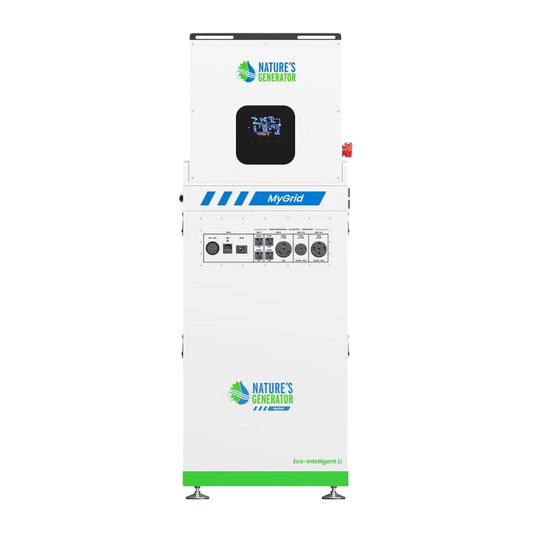
Nature’s Generator offers the MyGrid 10K Gen 2 Whole Home Generator, with a listed 10,000-watt output and a 10,496-Wh LiFePO4 battery. Its specifications also describe AC-coupling support for compatible solar configurations.
The AC Coupling page explains this approach to adding storage to an existing solar setup. AC coupling can make integration possible without necessarily replacing the existing solar inverter, but compatibility depends on the equipment and electrical design.
Customer feedback can provide a useful starting point when comparing systems. The MyGrid product page includes a customer testimonial reporting an electricity-bill reduction of nearly 70%. That's one customer's reported experience, not a typical result or a guaranteed saving. Your bill, local rates, solar production, battery settings, and usage patterns may produce a very different outcome.
Before buying, compare estimated savings against the complete installed cost. Storage tends to be more attractive when your home exports a meaningful amount of solar power and later buys electricity at a significantly higher price.
What Does Off-Grid Islanding Actually Do During a Power Outage?
Off-grid islanding lets a properly equipped solar-and-battery system power designated household loads separately from the utility grid.
Here's something that catches many homeowners off guard: having rooftop solar doesn't automatically mean you'll have electricity during a blackout.
Most standard grid-tied inverters shut down when the utility supply fails. That's a safety measure. Solar equipment must not continue feeding electricity into utility lines that may be under repair.
To keep power flowing at home, the system needs equipment designed for backup operation. Depending on the installation, that can include a battery, a compatible inverter capable of establishing a stable local supply, and suitable transfer or isolation equipment. The system must safely separate the home's backed-up circuits from the utility grid.
Once that separation is established, the system can supply supported loads from stored energy. If the installation is designed to do so, the solar panels may also continue producing electricity and recharge the battery while the grid is unavailable.
Imagine a storm knocks out power late in the afternoon. Your refrigerator is running, the family needs internet access, and you want a few lights on. A conventional grid-tied solar setup may go dark even though the sun is still shining. A properly configured solar-and-storage system with islanding capability may keep those essential circuits running.
That is the difference islanding makes. Your home can use its own available energy instead of waiting entirely on the utility to restore service.
The U.S. Department of Energy explains the relationship between solar power and outage resilience in its Solar and Resilience Basics guide.
One detail is worth keeping straight: islanding doesn't necessarily mean living permanently off-grid. It describes a system's ability to operate electrically separated from the utility when needed. A home that uses the grid normally but can disconnect during an outage has a different setup from a home designed to operate without a utility connection at all.
And islanding doesn't reverse lower export credits. It protects access to power during a grid failure. Battery storage may help with both energy management and outage resilience, but the two benefits need to be evaluated separately.
Which Nature’s Generator System Should You Consider?
The right choice depends on what you need to run, how long you need to run it, and whether you want to connect the system to existing rooftop solar.
MyGrid 10K Gen 2: For higher-output home backup and solar storage
The MyGrid 10K Gen 2 is worth evaluating if you want battery storage, substantial output, and a compatible AC-coupled solar arrangement.
Its listed specifications include 10,000 watts of output and 10,496 Wh of battery capacity. Those numbers describe different things. Watts tell you how much power the system can deliver at a given time; watt-hours tell you how much energy the battery can store.
If you want rooftop solar to keep working during an outage, check the entire setup—not just the battery. The inverter, transfer equipment, backed-up circuits, and control settings all need to support the operating mode you plan to use.
Powerhouse Gen 2: For essential loads and flexible backup planning
The Powerhouse Gen 2 Whole Home Generator lists up to 7,200 watts of output and 4,800 Wh of base battery capacity.
It may be a fit for households looking to support selected appliances and circuits during an outage. Whether it can meet your needs depends on which devices you plan to run, how much electricity they use, and how long you need them powered.
Start with the essentials: refrigerator, lights, internet equipment, phone chargers, and any other devices you rely on. Add their expected consumption, then check the system's available capacity and output. Don't assume that the term whole home means every appliance can run at once for an unlimited period.
Lithium 3600: For portable backup power
The Lithium 3600 Power Station lists a 3,600-watt continuous output and a 3,072-Wh LiFePO4 battery.
A portable power station may suit a smaller set of loads or a household that doesn't need a permanently integrated backup system. It's still important to confirm whether the intended appliances fit within its limits.
If your goal is to operate hardwired circuits or keep an existing rooftop solar array running during an outage, check compatibility and connection requirements first. A portable power station shouldn't be assumed to provide whole-home backup or grid-islanding functionality just because it can power individual devices.
How Do You Know Whether Adding Storage Is Worth the Money?
Before spending on a battery, look at four things.
First, check your export rate. Find out what your utility actually pays for surplus electricity, whether the credit changes by time of day, and which program applies to your system.
Second, check how much electricity you export. Your utility bill and solar monitoring data can help. If you rarely export excess power, a battery may have limited room to improve self-consumption. If you regularly send surplus electricity to the grid and buy it back at night, storage deserves a closer look.
Third, work out what you need during an outage. Do you just want the refrigerator, lights, and internet to keep working? Or do you need to support larger appliances and multiple circuits? Your answer affects the battery capacity, inverter output, installation, and cost.
Finally, compare the full price with the likely benefit. Include installation, electrical equipment, permits where needed, energy losses, and future maintenance. Then weigh estimated bill savings against the value of having backup power when the grid goes down.
There may be cheaper steps worth taking first. Running flexible appliances during sunny hours can reduce exports without requiring a battery. Adjusting consumption may also help you get more from a system you already own.
But if your household exports a lot of power, faces low export credits, and regularly needs electricity in the evening, battery storage could help address all three issues. Just make sure the system's operating capabilities match your goals.
How Can You Protect the Value of Your Rooftop Solar Investment?
Lower export credits can make rooftop solar less rewarding for homeowners who depend on selling surplus electricity. The response isn't necessarily to install more panels. It may be to use more solar electricity at home, store some for later, and understand what your utility actually pays for exports.
Off-grid islanding solves a separate problem. With compatible equipment, it allows your solar-and-battery system to keep supplying designated household loads when the grid fails. It won't restore old export rates or guarantee a faster payback, but it can help you get more practical use from your energy system during an outage.
Nature’s Generator offers options for different backup-power needs, from portable power stations to higher-output home systems. Before choosing one, compare your utility tariff, household demand, budget, and solar equipment compatibility. A system that fits the way your home actually uses electricity is a better investment than one chosen on capacity alone.


